The brief · about 1 minute
AI power: the value of arriving sooner
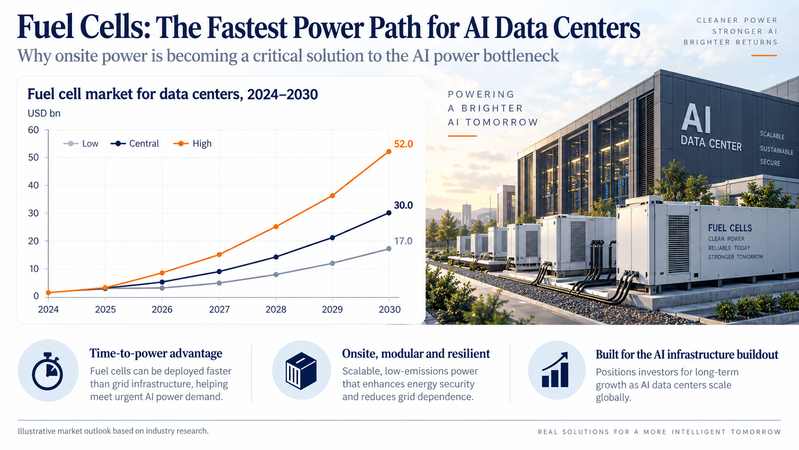
Grid delays can make the timing of electricity as important as its price. The article examines onsite fuel cells and whether Doosan can turn an initial opportunity into a repeatable business.
What to watch. Look for firm orders, delivery execution, operating performance and repeat customers. Compare technologies at the project level.
What could break it. Manufacturing, financing, service costs and competition can prevent a large addressable market from becoming profitable revenue.
Summary of the original dated research below. This is not a new market update; figures and views retain their original as-of dates.
Read the full analysis · about 15 minutes
Bloom Energy proved that time-to-power can be monetized. Doosan Fuel Cell’s first major U.S. AI data center order may be the moment the fuel-cell market becomes a multi-platform story.
Doosan Fuel Cell Co., Ltd. (KRX: 336260)
Author’s View: BUY — High Risk / High Optionality
Data as of September 2026
The AI Boom Has a New Bottleneck: Power
For much of the past three years, investors looking for bottlenecks in artificial intelligence focused on GPUs, HBM memory, advanced packaging and networking.
The next bottleneck may be much more basic.
Electricity.
AI data centers are being planned faster than utilities can connect them. JLL estimates that the average wait for a grid connection in major data center markets now exceeds four years.
Four years is an eternity in AI.
A hyperscaler that has already spent billions of dollars on GPUs cannot afford to leave those assets idle while waiting for transmission lines, substations or new generation capacity.
That changes the economics of power.
The cheapest megawatt is no longer necessarily the most valuable megawatt.
The megawatt that arrives first may be worth more.
And that is the fundamental reason fuel cells have moved from the clean-energy fringe into the center of the AI infrastructure debate.
Bloom Energy Did More Than Sell Fuel Cells. It Sold Time.
No company has benefited more visibly from this shift than Bloom Energy.
Bloom’s solid oxide fuel cells, or SOFCs, generate electricity onsite rather than requiring a data center to wait for the full expansion of the utility grid.
The attraction is easy to understand.
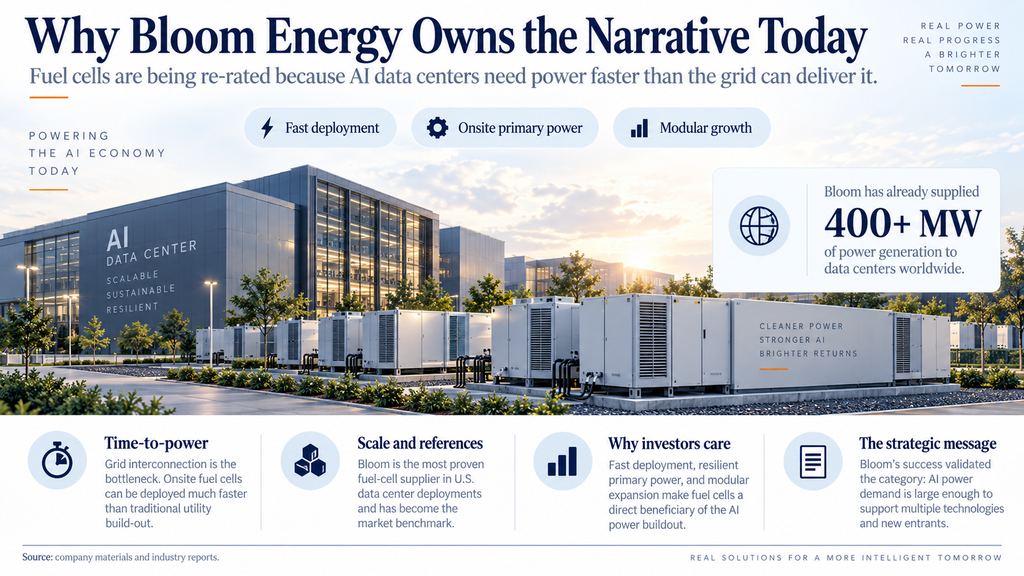
Bloom says its systems can be deployed in as little as 90 days in certain configurations. Its Energy Servers provide continuous primary power, can be installed incrementally and can operate behind the meter.
Compare that with multi-year grid interconnection queues.
This is the economic engine behind Bloom’s re-rating.
Bloom is not simply selling electricity.
It is selling time-to-power.
For a normal industrial facility, receiving electricity a year earlier is useful.
For an AI data center filled with rapidly depreciating GPUs and enormous revenue potential, receiving electricity a year earlier can be worth an extraordinary amount of money.
That is why the market has become willing to assign such a large strategic premium to onsite generation.
Bloom says it has already supplied more than 400MW of power to data centers worldwide, and its installed footprint spans dozens of U.S. data center facilities. The company has also been expanding its manufacturing base, targeting approximately 2GW of annual production capacity by the end of 2026.
The numbers increasingly suggest that this is not a temporary bridge technology.
It is becoming infrastructure.
The Market May Be Much Larger Than Bloom Alone
The most important insight for investors may actually be this:
Bloom’s success is not evidence that Bloom will own the entire market.
It is evidence that the market exists.
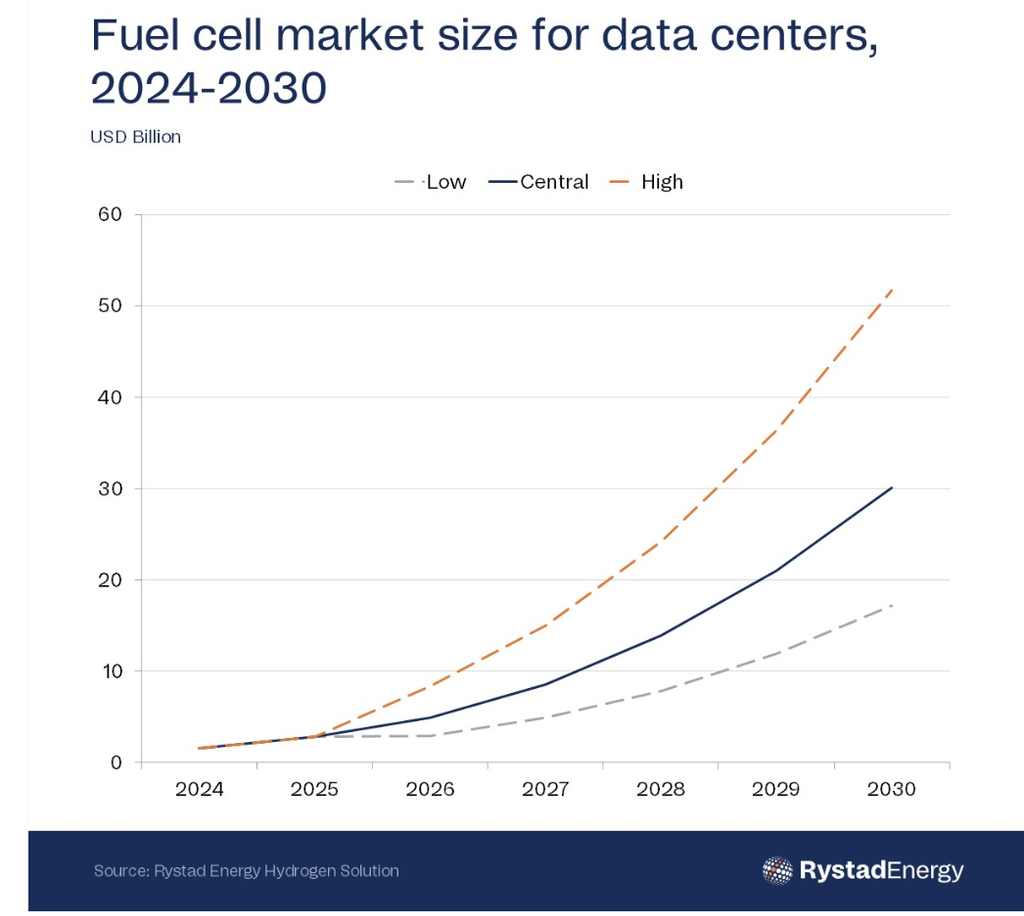
Rystad Energy’s central scenario estimates that the fuel-cell market for data centers could reach approximately $30 billion by 2030, versus only a small fraction of that today. Its high case exceeds $50 billion.
That is a dramatic expansion in addressable demand.
And evidence of a broader market is already appearing.
FuelCell Energy signed an agreement in June for up to 380MW of onsite fuel-cell capacity for data centers, beginning with an initial 30MW phase. The company is now working toward expanding annual manufacturing capacity to 500MW.
That matters.
It means Bloom may have enjoyed something close to a narrative monopoly, but the underlying market is clearly not destined to remain a one-company market.
Different technologies are beginning to find different customers and different use cases.
Which brings us to the company that, in our view, could become one of the most interesting next beneficiaries.
Doosan Fuel Cell.
A New Challenger Has Entered the U.S. AI Power Market
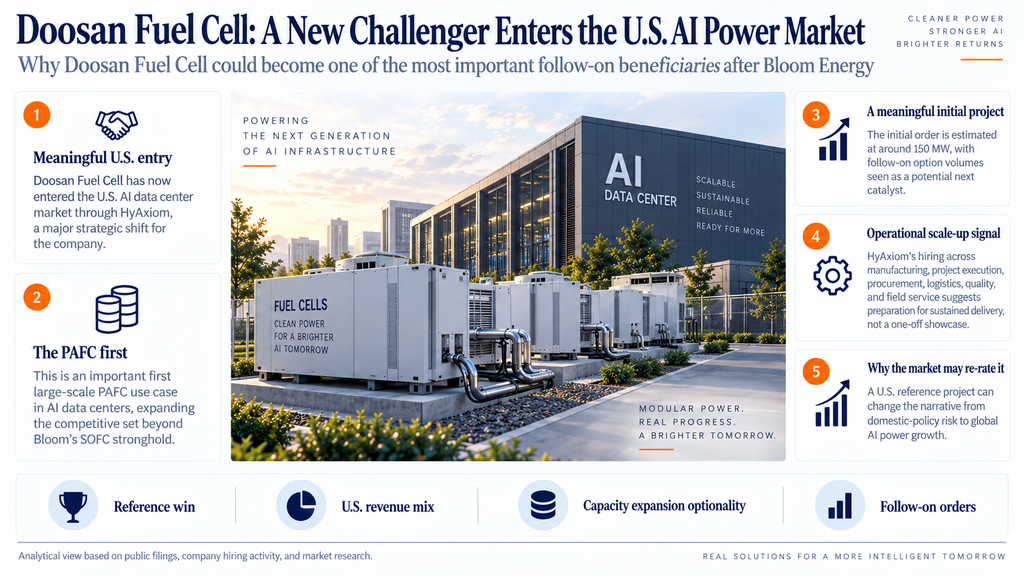
On September 2, Doosan Fuel Cell announced a KRW 501.4 billion contract to supply phosphoric acid fuel-cell systems to HyAxiom for U.S. AI data centers.
Deliveries are scheduled from the second half of 2026 through the first half of 2028.
At first glance, this can be treated as just another large order.
We think that misses the point.
The strategic significance is far greater than the contract value itself.
Until now, the investment case for Doosan Fuel Cell was dominated by Korea.
That was becoming a serious problem.
The Korean stationary fuel-cell market had been heavily influenced by government support and domestic hydrogen policy, leaving Doosan exposed to policy uncertainty at exactly the moment when its earnings remained weak.
The company needed another market.
Then AI arrived.
And with it came the largest power shortage the data center industry has faced in decades.
The U.S. order therefore does more than add backlog.
It potentially changes the identity of the company.
From:
Korean hydrogen-policy beneficiary
to:
Global supplier of onsite power for AI infrastructure.
That is the re-rating opportunity.
This Is Also an Important Technology Milestone
Bloom’s dominance in data-center fuel cells has been built primarily around SOFC technology.
Doosan is entering with something different:
PAFC — phosphoric acid fuel cells.
That distinction matters.
PAFC is not superior to SOFC in every metric.
In fact, it clearly is not.
SOFC generally has higher pure electrical efficiency, and Bloom has dramatically more accumulated data-center experience, customer references and manufacturing scale.
We do not believe investors should pretend otherwise.
But the mistake is assuming that every future AI data center will optimize for exactly the same variables.
They will not.
AI infrastructure is beginning to separate into different layers, and each layer may value power differently.
AI Infrastructure Is Becoming Both Bigger — and More Distributed
The first phase of the AI infrastructure boom was dominated by enormous centralized clusters built for training frontier models.
Those campuses are not disappearing.
They will become even larger.
But inference is beginning to change the topology of AI infrastructure.
Deloitte expects inference to account for roughly two-thirds of AI compute in 2026. JLL expects inference to eventually become the primary driver of AI workloads and notes that latency requirements will encourage more geographically distributed regional infrastructure. NVIDIA is already promoting its concept of AI Grids, connecting giant AI factories with metro hubs and distributed edge locations.
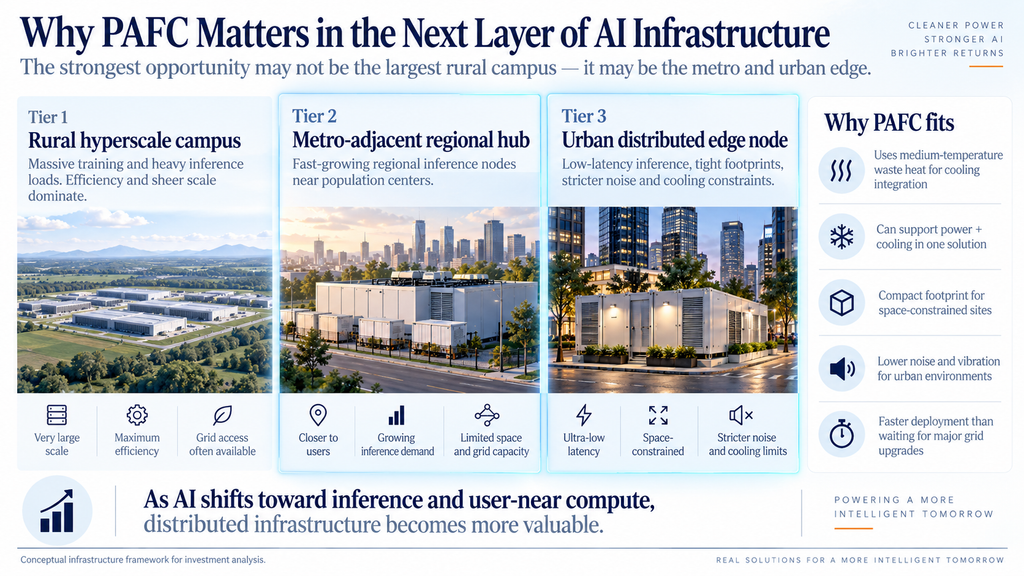
The future of AI infrastructure may therefore look less like a single layer and more like a hierarchy:
Tier 1 — Rural Hyperscale AI Factories
Hundreds of megawatts to gigawatts.
Large training clusters and heavy inference workloads.
Land is abundant. Maximum electrical efficiency and absolute generation scale dominate.
Natural-gas turbines and SOFC are likely to remain extremely competitive here.
Tier 2 — Metro-Adjacent Regional AI Hubs
Tens of megawatts to roughly 100MW.
Located closer to population centers and major network infrastructure.
Latency, permitting, available land and grid congestion matter more.
Tier 3 — Urban / Distributed Edge AI
Smaller nodes located close to end users, enterprises, telecom infrastructure and dense metropolitan regions.
Here, footprint, noise, water consumption, resilience, cooling integration and deployment speed become increasingly important.
This is where PAFC becomes much more interesting.
Why PAFC Could Have a Real Data Center Use Case
Doosan does not need PAFC to become the universally superior fuel-cell technology.
It only needs PAFC to become a superior solution for certain locations and architectures.
There are several reasons why that could happen.
1. Power and Cooling Can Be Integrated
PAFC produces usable medium-temperature waste heat.
HyAxiom markets the use of thermal output for heating or cooling. The cited figure of up to approximately 90% combined efficiency includes useful recovered heat; it is not electrical conversion efficiency. A data center needs a practical, continuous use for that heat to realize the combined benefit.
This matters for data centers.
Cooling represents a meaningful portion of facility power consumption.
If waste heat can drive an absorption-chiller system, the customer is no longer evaluating only:
electricity efficiency
but potentially:
electricity + cooling + infrastructure footprint + time-to-power.
That changes the equation.
Pure electrical efficiency remains important.
But it may no longer be the only metric that matters.
2. PAFC Is Quiet, Modular and Designed for Distributed Generation
HyAxiom’s M400 platform has very few moving parts, produces low noise and can operate continuously onsite.
These characteristics matter more as generation moves closer to populated areas.
A remote 1GW campus can tolerate infrastructure that a 20MW metro facility cannot.
The closer the data center gets to people, the more valuable compact and low-impact power generation can become.
3. Load Following and Microgrid Compatibility Matter
PAFC operates at much lower temperatures than conventional high-temperature SOFC systems.
Doosan and HyAxiom emphasize its load-following capabilities and use in microgrids.
For a large 24/7 baseload facility, this difference may not be decisive.
But in smaller regional facilities that combine grid power, batteries, onsite generation and variable workloads, greater operational flexibility can become valuable.
Again, the argument is not:
PAFC beats SOFC.
The argument is:
the AI power market may be large and heterogeneous enough for both technologies to win.
That is a much more credible—and much more investable—thesis.
NIMBY May Become an Unexpected Tailwind
There is another structural issue that could matter over time:
community resistance.
The bigger data centers become, the more visible their externalities become.
Electricity demand.
Transmission infrastructure.
Water consumption.
Diesel backup generators.
Noise.
Land usage.
Electricity prices for nearby residents.
Bloom’s own 2026 data center survey identified growing community scrutiny as an increasingly meaningful obstacle to development.
This creates an interesting possibility.
The AI infrastructure boom may simultaneously produce:
larger centralized campuses
and
more distributed regional capacity.
Political resistance is rarely linear.
A 500MW project can create substantially more controversy than five geographically dispersed 100MW projects.
That does not mean hyperscale campuses disappear.
But at the margin, permitting friction may increase the value of smaller, distributed, onsite-powered facilities.
And the closer those facilities move toward cities and users, the more relevant PAFC’s compact footprint, low noise and thermal integration may become.
This is where the long-term Doosan thesis becomes more interesting than merely “Bloom Energy is sold out, so customers need another supplier.”
Shortages may open the door.
Infrastructure architecture could keep the door open.
The HyAxiom Hiring Data Suggests This May Not Be a One-Off Project
Before the U.S. order was formally announced, we had been watching something else.
Hiring.
During August, HyAxiom—the Doosan group’s U.S. fuel-cell arm—began recruiting across multiple parts of the operating organization.
Manufacturing.
Project execution.
Procurement.
Logistics.
Quality.
Electrical design.
Control systems.
Field service.
One posting is particularly revealing.
HyAxiom’s August 20 Project Engineer, Manufacturing role explicitly states that the employee will support manufacturing projects focused on:
“increased production capacity, cost reduction, and new process implementation.”
Even more importantly, the job description introduces HyAxiom as a supplier working to meet the growing demands of the data center market.
That language matters.
Hiring does not prove future orders.
But once the first major order has already been announced, the interpretation changes.
Before the contract, the hiring activity was circumstantial evidence.
After the contract, it looks more like preparation for execution and scale.
The pattern spans nearly the full industrial chain:
engineering → procurement → manufacturing → quality → logistics → project execution → field service
Companies generally do not build that infrastructure merely to issue a press release.
The hiring activity therefore strengthens our view that Doosan and HyAxiom see the U.S. AI power opportunity as a multi-year business rather than a single project.
The Most Important Number May Not Be the First Order
Korean sell-side analysts have estimated that the recently announced U.S. contract could represent roughly 150MW of capacity.
Doosan itself has not publicly disclosed the project’s MW size, so investors should treat that figure as an estimate rather than company guidance.
But whether the final number is exactly 150MW is less important than what happens next.
Doosan currently describes its annual fuel-cell production capacity at around 275MW and is considering further expansion as demand increases.
Think about the implication.
If one U.S. data-center customer can consume a material portion of existing annual capacity, then successful follow-on orders do not merely increase revenue.
They create the economic justification for another manufacturing expansion cycle.
That is precisely what has happened elsewhere in the sector.
Bloom is expanding toward 2GW.
FuelCell Energy is moving toward 500MW.
When the addressable market grows fast enough, manufacturing capacity stops being a fixed constraint.
It becomes an investment decision.
This is why we do not view Doosan’s existing capacity as the ceiling of the opportunity.
It may be the starting point.
Bloom vs. Doosan: Do Not Make the Wrong Comparison
It would be intellectually lazy to take Bloom Energy’s valuation multiple and simply apply it to Doosan Fuel Cell.
Bloom deserves a premium.
It has greater scale.
More customers.
More data-center references.
Better pure electrical efficiency through SOFC.
A more mature U.S. commercial organization.
And significantly better recognition among global investors.
Doosan should trade at a discount.
The question is:
How large should that discount remain if Doosan proves it can repeatedly win U.S. AI power projects?
That is where the asymmetry lies.
Bloom’s manufacturing capacity is several times larger than Doosan’s.
Its valuation is also dramatically larger.
Doosan therefore does not need to replace Bloom.
It does not even need to become the market leader.
Imagine instead that the global data-center fuel-cell market reaches Rystad’s central case of roughly $30 billion by 2030.
Doosan only needs a modest share of that market for the earnings opportunity to become extremely meaningful relative to the company’s current business base.
Applying an illustrative 5% share to the assumed $30 billion market produces $1.5 billion. This arithmetic describes an industry scenario, not Doosan’s forecast revenue, orders or profit. Addressable geography, product eligibility, competition and execution would determine what a supplier could actually capture.
A 10% share would represent roughly $3 billion.
Those figures should not be treated as forecasts.
They illustrate the operating leverage embedded in the opportunity.
Doosan Has Another Option That the Market Should Not Ignore
There is one additional element to the story.
Doosan is not exclusively a PAFC company anymore.
It has also built approximately 50MW of SOFC manufacturing capacity and has begun commercial production of its lower-temperature SOFC platform.
This creates an unusual strategic position.
PAFC can target applications where heat utilization, load flexibility and distributed deployment matter.
SOFC gives Doosan exposure to the higher-electrical-efficiency segment where Bloom has demonstrated the largest opportunity.
Execution is still early, particularly on SOFC manufacturing yields and commercial references.
But over time, Doosan has the potential to operate as a dual-platform fuel-cell supplier.
That optionality is difficult to value today.
It becomes much easier to value if the U.S. business proves repeatable.
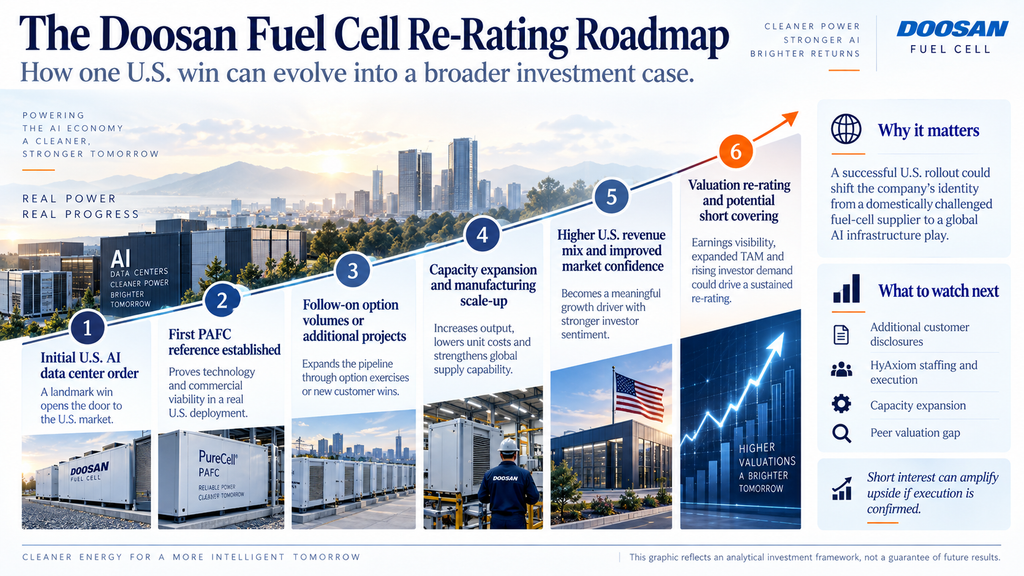
The Re-Rating Roadmap
The investment thesis does not require every step to happen immediately.
The path is relatively straightforward.
Step 1 — First major U.S. AI data center order
Done.
Step 2 — Establish a commercial PAFC reference in U.S. AI infrastructure
Now underway.
Step 3 — Secure follow-on orders or exercise additional project options
This is the next major catalyst.
Step 4 — Expand manufacturing capacity
A large repeat-order pipeline would make expansion economically rational.
Step 5 — Increase the U.S. share of revenue
This would reduce the company’s historical dependence on Korean hydrogen policy.
Step 6 — Demonstrate improving manufacturing economics and SOFC execution
This changes the discussion from thematic growth to earnings growth.
Step 7 — Valuation re-rating
At that point, investors are no longer valuing Doosan as a troubled domestic fuel-cell manufacturer.
They are valuing an AI power infrastructure supplier.
What Could Go Wrong?
This is not a low-risk investment.
There are several reasons Bloom still deserves a substantial valuation premium.
First, PAFC has lower pure electrical efficiency than SOFC.
Second, Doosan has far less U.S. data-center operating history.
Third, the company still needs to demonstrate that recent orders can translate into attractive margins.
Fourth, meaningful capacity expansion may require additional capital.
Fifth, the U.S. project pipeline still needs to prove that the first large order is repeatable rather than exceptional.
And finally, technological competition will increase.
Bloom will not stand still.
FuelCell Energy is scaling.
Gas turbines, reciprocating engines, batteries, nuclear projects and other distributed-generation technologies will all compete for portions of the same market.
That is why this is a high-risk BUY, not a low-volatility compounder.
But risk is also why the opportunity exists.
Conclusion: Bloom Proved the Market. Doosan Now Has to Prove It Belongs There.
The most important thing Bloom Energy accomplished was not simply selling fuel cells.
Bloom demonstrated that AI companies will pay for speed.
It proved that when electricity becomes the bottleneck, onsite power can move from an energy product to a strategic piece of computing infrastructure.
That insight changed the valuation of the entire sector.
The next question is no longer whether onsite fuel cells can power AI.
We already know they can.
The question is:
Who else can scale?
Doosan Fuel Cell has just crossed the most important threshold.
It has entered the U.S. AI data center market with a major commercial PAFC order.
Its U.S. affiliate is hiring across manufacturing and execution functions.
Its PAFC technology offers a differentiated power-and-thermal proposition.
Its existing manufacturing capacity gives it a platform from which to expand.
Its emerging SOFC business adds another layer of optionality.
And the evolution of AI toward inference, regional hubs and distributed compute could expand the number of locations where compact onsite generation becomes strategically valuable.
Bloom Energy is still the benchmark.
It should be.
But the most interesting equity opportunity is not always the company that proved the theme first.
Sometimes it is the company that enters after the market has already been validated—but before investors believe it can scale.
That, in our view, is where Doosan Fuel Cell sits today.
Investment View: BUY
Bloom proved the model.
AI is expanding the market.
Doosan now has its first real seat at the table.
The first U.S. order was not the end of the story.
It may have been the beginning.
Selected Sources
Doosan Fuel Cell — Doosan Fuel Cell Makes Its Debut in U.S. AI Data Center Power Market, September 2, 2026.
Bloom Energy — 2026 Data Center Power Report and 2026 Mid-Year Data Center Power Report.
JLL — 2026 Global Data Center Market Outlook.
Deloitte — 2026 Technology, Media & Telecommunications Predictions.
NVIDIA — AI Grids for Distributed AI Infrastructure, 2026.
FuelCell Energy — Fit Energy data-center agreement and 2026 manufacturing capacity updates.
HyAxiom — PureCell M400 product information and August 2026 recruiting materials.
Rystad Energy Hydrogen Solution — Fuel Cell Market Size for Data Centers, 2024–2030.
Disclaimer
This article is provided for informational and educational purposes only and reflects the author’s personal views as of the date of publication. It does not constitute investment advice, investment research, a solicitation, or a recommendation to buy or sell any security or financial instrument.
The information contained herein has been obtained from sources believed to be reliable, including company disclosures, corporate materials, industry research and publicly available information, but its accuracy or completeness is not guaranteed. Certain statements in this article—including market-size estimates, potential project capacity, future orders, market share, manufacturing expansion and valuation outcomes—are estimates, interpretations or forward-looking scenarios rather than confirmed future results.
Investments in individual equities involve substantial risk, including the possible loss of principal. Fuel-cell companies in particular may be exposed to technology risk, customer concentration, policy changes, financing requirements, manufacturing execution risk and significant share-price volatility.
The author may hold, initiate, increase, reduce or exit positions in securities discussed in this article without notice. Readers should conduct their own research and consult an appropriately licensed financial professional before making investment decisions. Past performance is not indicative of future results.