The brief · about 1 minute
Where the AI hardware bottleneck moves
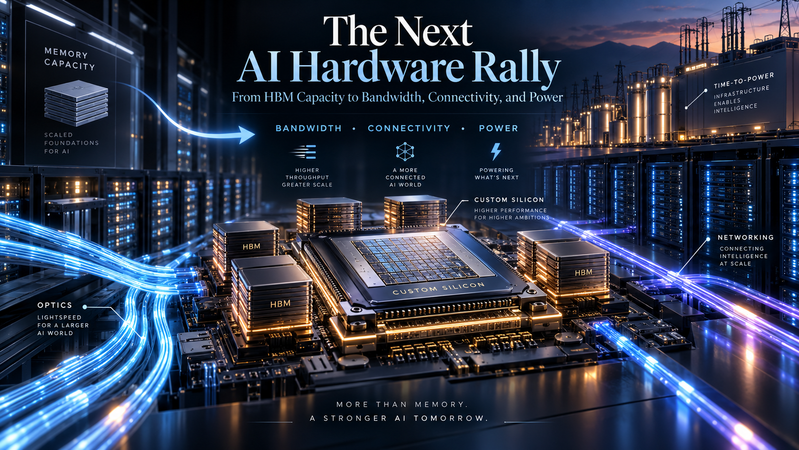
As agents attempt more useful work, the hardware constraint may extend beyond memory capacity into connectivity, custom silicon and power. The article uses Marvell to examine that potential shift.
What to watch. Follow design wins, revenue conversion and the economics of custom silicon and networking.
What could break it. Stronger AI demand does not guarantee an attractive stock return when expectations and valuations are already high.
Summary of the original dated research below. This is not a new market update; figures and views retain their original as-of dates.
Read the full analysis · about 15 minutes
AI demand may be reaccelerating just as the hardware bottleneck shifts from memory capacity toward bandwidth, connectivity, custom silicon and power.
Marvell Technology, Inc. (NASDAQ: MRVL)
Author’s View: CONSTRUCTIVE — High Growth / High Expectations
Data as of September 2026
The most interesting thing about the latest AI rally may not be that artificial intelligence is back in favor.
It may be that the leadership is changing.
On Friday, a much stronger-than-expected U.S. jobs report pushed Treasury yields higher and dragged the broader equity market lower. Yet semiconductors materially outperformed. Memory, equipment and connectivity names rallied even as the major indices slipped.
It is dangerous to explain a market move with a single headline. But the timing is notable.
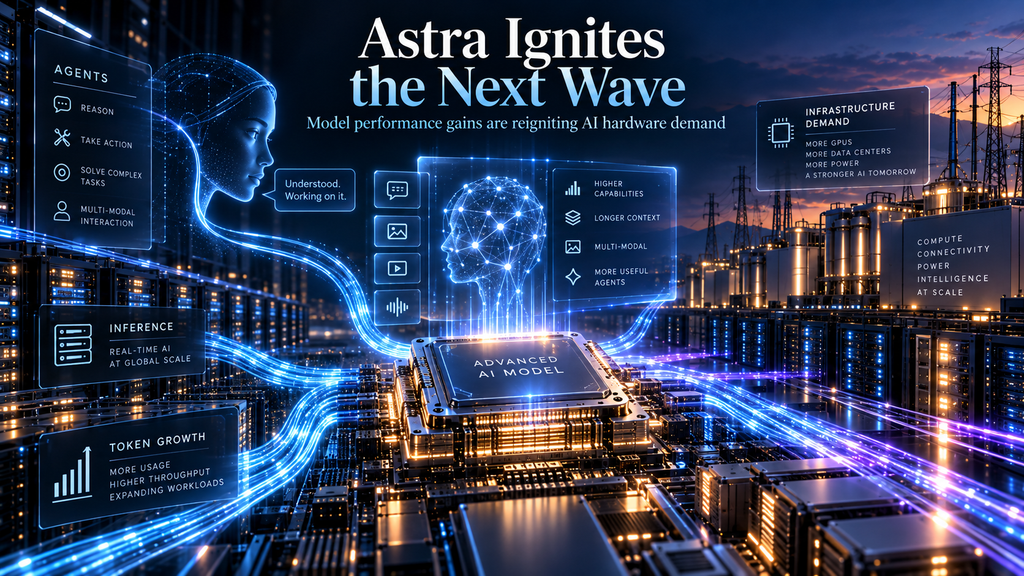
OpenAI had just introduced Astra, a model that appears to represent a meaningful step higher in agentic capability, computer use and long-horizon task execution.
If Astra is only another benchmark winner, the market reaction will fade.
If it is the beginning of a new demand curve for AI agents, the implications for hardware could be much larger.
And the next hardware rally may not look like the last one.
Astra Matters Because Capability Can Create New Demand
Falling inference costs are bullish for AI adoption, but lower token prices alone do not necessarily create new categories of work.
They can simply make existing workloads cheaper.
A real jump in capability is different.
A model that can reliably operate software, navigate websites, work through spreadsheets, maintain context across long tasks and execute multi-step workflows can expand the set of economically useful tasks that AI can perform.
That is the distinction I am watching with Astra.
OpenAI describes Astra as its most capable model for complex, end-to-end work, with major improvements in coding, research and computer use.
The model was also trained using an extraordinary amount of compute, reinforcing an important point:
Frontier intelligence is still extremely compute intensive.
But the most interesting part may be what happens after training.
One benchmark is particularly notable.
The original note cites different ARC-AGI-3 results under a standard harness and a provider adapter. These are not like-for-like measurements: state retention, tools and evaluation setup can materially affect results. A directly linked benchmark report is needed before using the quoted scores as investment evidence.
That difference deserves attention.
The correct interpretation is not that Astra has suddenly achieved biological-style online learning.
The model is not rewriting its weights after every task.
The more important point is architectural:
Persistent state, memory management and context reuse can dramatically change the effectiveness and economics of an AI agent.
That matters because the hardware needs of an agentic system are different from those of a simple chatbot.
A chatbot answers a question.
An agent may reason, call tools, inspect files, execute software, revisit prior state, maintain long contexts and continue working for minutes or hours.
That means:
More tokens.
More memory traffic.
More networking.
More sustained inference.
And potentially much more compute consumption per user.
If agents move from a tool used by a small number of power users to something ordinary workers use every day, the total amount of machine intelligence consumed could expand much faster than the cost per token declines.
That is the demand-side bull case Astra may have reopened.
The Hardware Bottleneck Is Also Changing
The supply-side story is evolving at the same time.
For the last several years, one of the cleanest ways to express the AI buildout was HBM.
More accelerators required more HBM.
Each generation used more memory.
Higher bandwidth supported higher ASPs.
That thesis is not broken.
But the incremental information has changed.
The lower-HBM Rubin Ultra configuration discussed here is a reported design scenario, not a confirmed final specification. The investment implication depends on the shipping design, stack count, interface speed and workload performance.
The important distinction is between:
Capacity
and
Bandwidth.
HBM stack height primarily affects capacity.
Aggregate bandwidth depends more heavily on the number of stacks, interface width and transfer speed.
If the number of stacks and interface configuration remain similar, moving from 12-Hi to 8-Hi can reduce the number of DRAM dies per stack by roughly one-third while still maintaining extremely high aggregate bandwidth through faster interfaces.
In other words, the optimization target is becoming less about maximizing the number of gigabytes attached to every accelerator.
It is increasingly about maximizing:
useful bandwidth per dollar, per watt and per unit of scarce DRAM.
This does not mean HBM demand is about to fall.
Quite the opposite may still happen.
More accelerators can easily offset lower memory content per accelerator.
HBM4 and HBM4E can still carry higher bandwidth and higher value per stack.
Agentic workloads can also expand total memory requirements through longer contexts and larger KV caches.
But the old bull case contained two reinforcing assumptions:
More AI accelerators × more HBM content per accelerator
The first remains powerful.
The second is now less certain.
That matters for relative leadership.
I am not bearish on memory.
I am simply less convinced that raw memory capacity must remain the highest-beta way to express the next leg of AI infrastructure spending.
From Capacity to Bandwidth, Connectivity and System Utilization
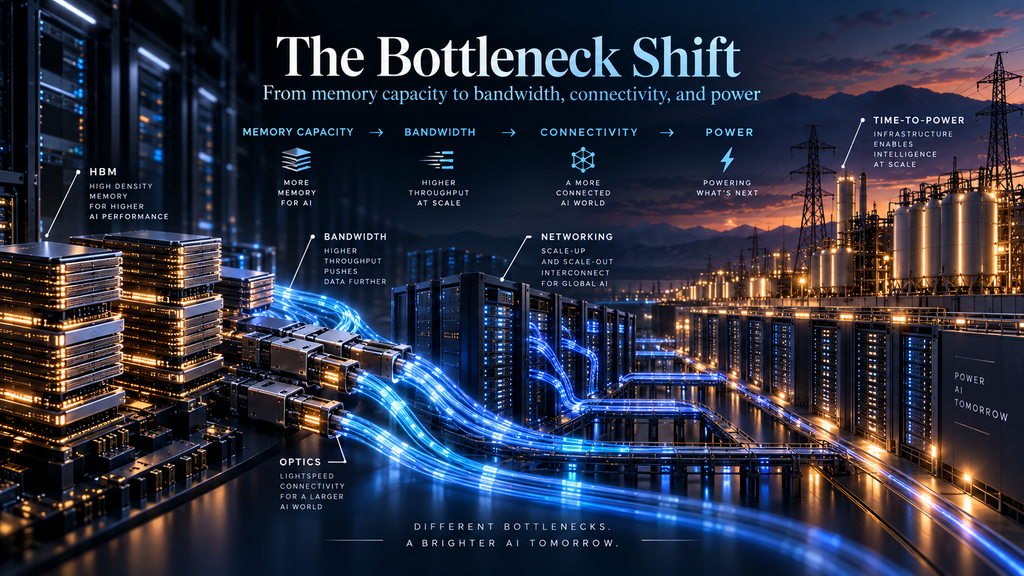
If accelerator count keeps rising while memory content per accelerator becomes more economically optimized, value does not disappear.
It migrates.
Inside the accelerator, memory bandwidth remains critical.
Across accelerators, data movement becomes critical.
Across racks and clusters, networking becomes critical.
Across heterogeneous compute architectures, custom silicon becomes more important.
And across the entire data center, power becomes the final physical constraint.
The key question is no longer simply:
How much compute can be manufactured?
It is increasingly:
How efficiently can that compute be fed, connected and powered?
This is the framework I think matters for the next stage of AI infrastructure.
Memory capacity → bandwidth → connectivity → custom silicon → power.
Marvell is one of the most interesting companies sitting near the middle of that transition.
Custom Silicon Is Becoming a Larger Part of the AI Stack
NVIDIA remains the dominant AI accelerator platform.
Nothing in this thesis requires that to change.
But hyperscalers increasingly want purpose-built silicon for specific workloads, particularly inference, where performance per dollar and performance per watt can matter more than general-purpose flexibility.
The AI compute market is therefore becoming increasingly heterogeneous.
It is no longer simply:
NVIDIA GPU or nothing.
It increasingly looks like:
NVIDIA GPU
plus
Google TPU
plus
AWS Trainium
plus
other custom accelerators
depending on workload, customer and economics.
OpenAI itself is a useful illustration.
It continues to secure large amounts of NVIDIA capacity while also committing to consume large amounts of AWS Trainium capacity.
Using a cloud provider does not automatically mean using its proprietary accelerator.
A customer on AWS can still use NVIDIA GPUs.
A customer on Google Cloud can choose among several accelerator options.
But the direction is clear:
Frontier AI demand is no longer tied to a single silicon architecture.
As AI usage grows, the addressable market for custom accelerators, memory interfaces, networking and the infrastructure attached to those accelerators can grow with it.
That is the important point for Marvell.
OpenAI using Trainium is not automatically Marvell revenue.
But it is evidence that the custom-silicon category itself is becoming strategically important.
Marvell still needs design wins to monetize that category.
And it is getting them.
Why the Google Agreement Changed the Marvell Story
In August, Marvell disclosed an expanded partnership with Google spanning a broad set of custom silicon programs attached to the TPU ecosystem.
The agreement includes:
AI inference accelerators
Storage controllers
Network interface controllers
Memory interface controllers
Near-memory compute
This is much more important than a single-chip design win.
It places Marvell around the accelerator as well as inside parts of the custom-compute roadmap.
Google also received a warrant to purchase up to approximately 59 million Marvell shares.
Most of the warrant vests based on purchases of Marvell custom products through fiscal 2033.
At the maximum performance threshold, the arrangement corresponds to as much as roughly $120 billion of cumulative custom-product purchases.
That number should not be treated as guidance.
It is a performance ceiling embedded in a commercial agreement.
It is not management forecasting $120 billion of revenue.
But it tells us something important about the potential scale of the relationship.
It also does not mean Marvell has displaced Broadcom from Google’s TPU ecosystem.
That would be too aggressive an interpretation.
The more reasonable conclusion is that:
Google is broadening its supplier base
and
Marvell has become a materially more important participant.
For investors, that is enough to change the long-term earnings distribution.
Marvell Is Not Just a Custom-Silicon Company
This is where the thesis becomes more interesting.
If the next AI cycle were only about custom ASICs, Marvell would simply be one of several companies competing for hyperscaler design wins.
But Marvell also has meaningful exposure to the surrounding bottlenecks.
1. Custom Silicon
Marvell helps hyperscalers design purpose-built accelerators and infrastructure silicon optimized for specific workloads.
As inference scales, the economic incentive to use workload-specific silicon rises.
2. Optical Connectivity
Larger AI clusters require more bandwidth between accelerators, racks and data-center fabrics.
The more accelerators deployed, the more data has to move between them.
Marvell participates across high-speed optical DSPs, silicon photonics and next-generation optical connectivity.
3. Networking
An expensive accelerator is economically useless when it is waiting for data.
As clusters grow, the cost of poor utilization increases.
Switching, NICs, retimers and high-speed interfaces become part of the performance equation rather than secondary components.
4. Memory Infrastructure
This becomes particularly interesting after the Rubin Ultra discussion.
If the industry stops solving every memory problem by simply attaching more expensive HBM directly to each accelerator, memory architecture becomes more sophisticated.
CXL memory expansion.
Memory pooling.
Near-memory compute.
Storage offload.
Shared memory.
Data movement.
These increasingly matter.
Agentic AI makes this even more important.
Longer-running agents generate longer contexts and larger KV caches.
The problem therefore becomes not only:
How much memory exists?
but also:
Where should that memory sit, how quickly can it be accessed, and how efficiently can it be moved?
That is another area where Marvell has exposure.

The Earnings Selloff May Have Created a Better Setup
The stock story matters because the fundamental story was already becoming crowded before earnings.
Marvell shares rallied after the Google partnership was announced.
Investors quickly began pricing a much larger custom-silicon opportunity into fiscal 2029 and beyond.
Then Marvell reported a strong quarter.
Second-quarter fiscal 2027 revenue reached approximately $2.74 billion, up roughly 37% year over year.
Data-center revenue increased approximately 46% year over year.
Management raised its fiscal 2027 revenue outlook.
It also raised its fiscal 2028 outlook.
Data-center growth expectations increased.
Custom silicon is expected to more than double.
A new XPU program is expected to contribute meaningful revenue next year.
The following quarter was guided to approximately $3.15 billion of revenue.
This was not a weak earnings report.
Yet the stock sold off after the announcement.
Why?
Because the market was asking a different question.
Investors already believed fiscal 2027 and fiscal 2028 would be strong.
What they wanted was a clearer answer to:
How large does Google and custom silicon become in fiscal 2029 and beyond?
Management confirmed the opportunity.
But it did not provide the level of long-term numerical detail the market wanted.
The message was essentially:
Yes, the opportunity is large.
Yes, the Google impact becomes more meaningful later.
Yes, there is substantial upside beyond existing long-term targets.
But:
More detail will come at Investor Day.
That created an unusual setup.
Near-term fundamentals improved.
The strategic opportunity expanded.
But investors did not receive enough detail on the timing and magnitude of the long-term upside.
The stock therefore experienced an expectations reset rather than a fundamental collapse.
That distinction matters.
Marvell’s upcoming Investor Day has therefore become one of the most important events in the story.
What I want to hear is straightforward.
How quickly do the new custom programs ramp?
How large can fiscal 2029 custom revenue become?
How much of the Google opportunity sits in accelerators versus attach products such as NICs, storage and memory interfaces?
How much optical content is attached to each generation of AI compute?
And how should investors think about gross margin as lower-margin custom silicon becomes a larger part of the mix?
If management can answer those questions with credible numbers, the recent pullback may eventually look less like a warning and more like an expectations reset before the next phase of the story.

Why Marvell May Fit the Next Hardware Rally Better Than the Last One
The previous AI rally rewarded scarcity.
GPU scarcity.
HBM scarcity.
Advanced packaging scarcity.
The next phase may increasingly reward efficiency and system architecture.
How many useful tokens can a data center produce per dollar?
How much memory bandwidth can an accelerator access without overpaying for capacity it does not need?
How efficiently can thousands of accelerators communicate?
How much custom silicon can hyperscalers deploy to reduce inference costs?
How much compute can be kept busy instead of stalled?
Marvell has exposure to several of those questions at once.
That is why I find the company more interesting today than when it was simply described as a custom-silicon alternative to Broadcom.
It is becoming a broader toll collector on AI system complexity.
Custom silicon monetizes the shift away from one-size-fits-all compute.
Optics monetizes larger clusters.
Networking monetizes higher accelerator counts and the need to keep those accelerators utilized.
Memory interfaces monetize the movement toward disaggregated memory and more sophisticated memory hierarchies.
The exact winner in AI compute can change.
The requirement to move data efficiently does not disappear.
That is the reason Marvell may have a particularly interesting position in the next phase of AI infrastructure spending.
Power Is Where the Chain Ends
There is one bottleneck even Marvell cannot solve.
Electricity.
Every improvement in semiconductor economics ultimately allows more compute to be deployed.
If Astra and the next generation of AI agents create genuinely new workloads, lower inference costs do not necessarily reduce total infrastructure demand.
They can increase usage enough to raise aggregate compute consumption.
This is the classic rebound effect applied to intelligence.
Cheaper intelligence can create more demand for intelligence.
More inference means more accelerators.
More accelerators mean more networking.
More networking means larger data centers.
And larger data centers require more electricity.
Unlike memory density or networking bandwidth, power availability cannot be improved indefinitely through semiconductor scaling.
A data center still needs:
physical megawatts
at a
physical location.
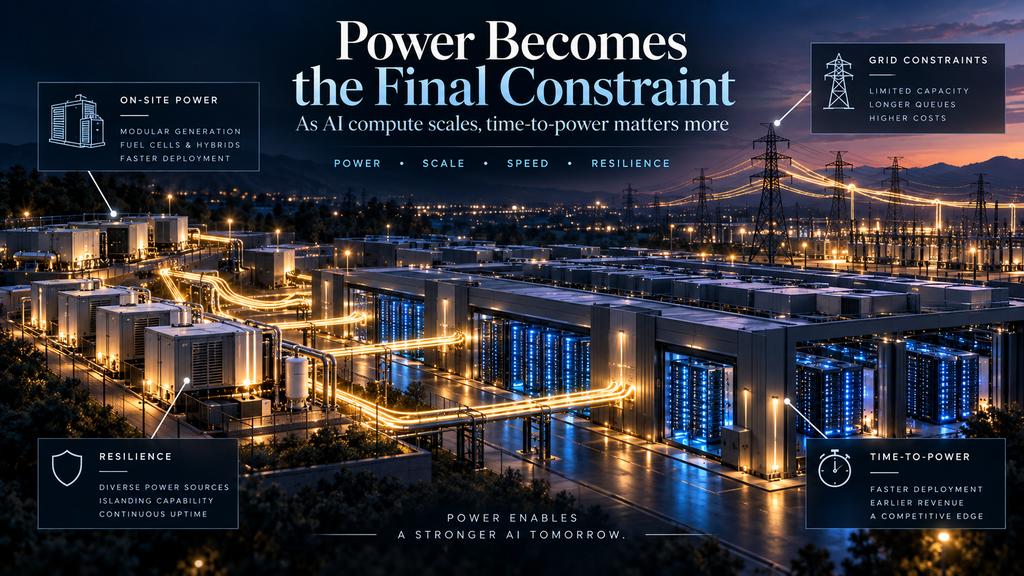
Grid interconnection can take years.
That is why I continue to view:
Time-to-Power
as the final physical constraint in the AI infrastructure stack.
Bloom Energy remains one of the most interesting public-market expressions of this problem.
Its onsite fuel-cell systems are designed around faster deployment and avoiding long grid interconnection delays.
This does not make Bloom a semiconductor trade.
It makes Bloom the last link in the same causal chain.
Better models
→ more useful AI
→ more inference
→ more accelerators
→ more networking
→ more electricity
The semiconductor bottleneck can migrate.
The power requirement accumulates.
What Could Make This Thesis Wrong?
There are several reasons to remain cautious.
First, Astra may prove to be more impressive in benchmarks and demonstrations than in real enterprise workloads.
The entire thesis depends on capability gains translating into economically useful demand.
Second, lower HBM capacity per accelerator does not mean memory is structurally weak.
Agentic workloads may create such large memory and KV-cache requirements that total memory demand remains one of the strongest parts of the AI stack.
Third, custom-silicon growth does not automatically translate into Marvell growth.
Broadcom remains a formidable competitor.
NVIDIA continues to expand its own ecosystem.
Hyperscalers can diversify suppliers.
Fourth, the maximum Google warrant economics should never be modeled as guaranteed revenue.
Fifth, custom silicon can pressure gross margin even as it expands revenue and operating-profit dollars.
Finally, many AI infrastructure equities already trade on aggressive long-term assumptions.
A strong structural thesis can still produce a poor investment if expectations are too high.
That is why the upcoming Investor Day matters.
Conclusion: The Next AI Hardware Rally May Have Different Leaders
Astra has brought the capability side of the AI debate back to the center of the market.
If the model represents a real step toward broadly useful agents, the important implication is not simply that OpenAI has a better product.
It is that the:
demand curve for intelligence may be moving outward again.
At the same time, the hardware stack is becoming more heterogeneous.
NVIDIA GPUs remain central.
But custom ASICs are scaling.
HBM remains essential.
But the optimization target may be shifting from capacity alone toward bandwidth economics and memory hierarchy.
Larger clusters increase the value of optical connectivity and networking.
And more deployed compute increases the value of scarce power.
That is why I think the next AI infrastructure rally could look different from the last one.
I am not looking for the death of memory.
I am looking for where the marginal bottleneck moves next.
Today, my framework is:
Memory capacity → bandwidth → connectivity → custom silicon → power
Marvell sits unusually close to the middle of that transition.
Bloom Energy sits near the end of it.
If Astra really does mark the beginning of mass-market agentic AI, the next winners may be the companies that make intelligence:
cheaper to compute,
faster to move,
and
possible to power.
That is the part of the AI hardware cycle I am watching now.
Selected Sources
OpenAI — Astra product and release materials.
ARC Prize — ARC-AGI-3 results and harness methodology.
TrendForce — Rubin Ultra HBM configuration and next-generation AI accelerator memory analysis.
Marvell Technology — Q2 FY2027 earnings release and conference-call materials.
Marvell Technology — August 2026 Google partnership 8-K.
Marvell Technology — AI memory infrastructure and CXL product materials.
OpenAI / Amazon — Strategic partnership and Trainium capacity commitments.
Bloom Energy — 2026 Data Center Power Report and data-center power materials.
Disclaimer
This article is provided for informational and educational purposes only and reflects the author’s personal views as of the date of publication. It does not constitute investment advice, investment research, a solicitation, or a recommendation to buy or sell any security or financial instrument.
The information contained herein has been obtained from sources believed to be reliable, including company disclosures, corporate materials, industry research and publicly available information, but its accuracy or completeness is not guaranteed. Certain statements in this article—including estimates regarding AI demand, custom-silicon adoption, future HBM configurations, product ramps, market opportunities, customer spending, power demand and potential valuation outcomes—are estimates, interpretations or forward-looking scenarios rather than confirmed future results.
Investments in individual equities involve substantial risk, including the possible loss of principal. Semiconductor, AI infrastructure and power-related companies may be exposed to technology risk, customer concentration, competitive pressure, capital intensity, supply constraints, manufacturing execution risk, regulatory changes and significant share-price volatility.
The author may hold, initiate, increase, reduce or exit positions in securities discussed in this article without notice. Readers should conduct their own research and consult an appropriately licensed financial professional before making investment decisions. Past performance is not indicative of future results.
Read this dated thesis alongside current company disclosures; expectations and valuation can change before the operating thesis does.