The brief · about 1 minute
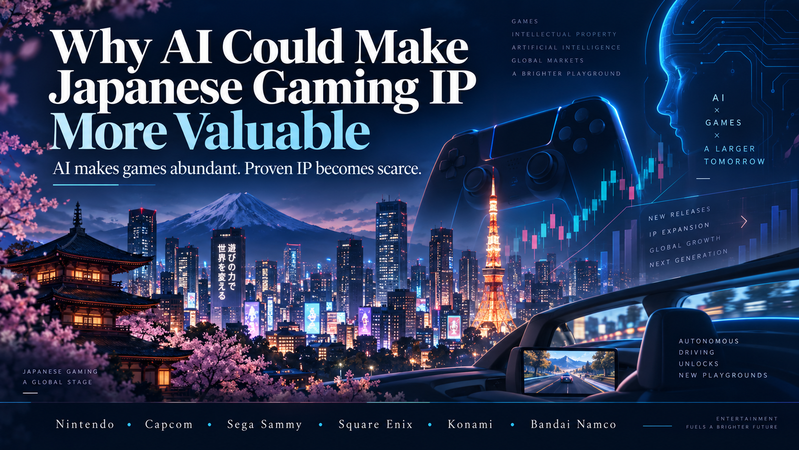
AI makes games abundant. Attention stays scarce.
Cheaper game production could increase competition for players’ time. The article argues that recognizable Japanese franchises may become more valuable if they help publishers stand out.
What to watch. Look for evidence of development productivity, durable catalog sales and successful releases—not AI adoption alone.
What could break it. Savings may be competed away, releases may disappoint and strong IP can still be overpriced.
Summary of the original dated research below. This is not a new market update; figures and views retain their original as-of dates.
Read the full analysis · about 15 minutes
AI can increase the supply of games. Established franchises may help publishers compete for scarce attention.
Japanese gaming equities have quietly become one of the stronger areas of the Japanese market.
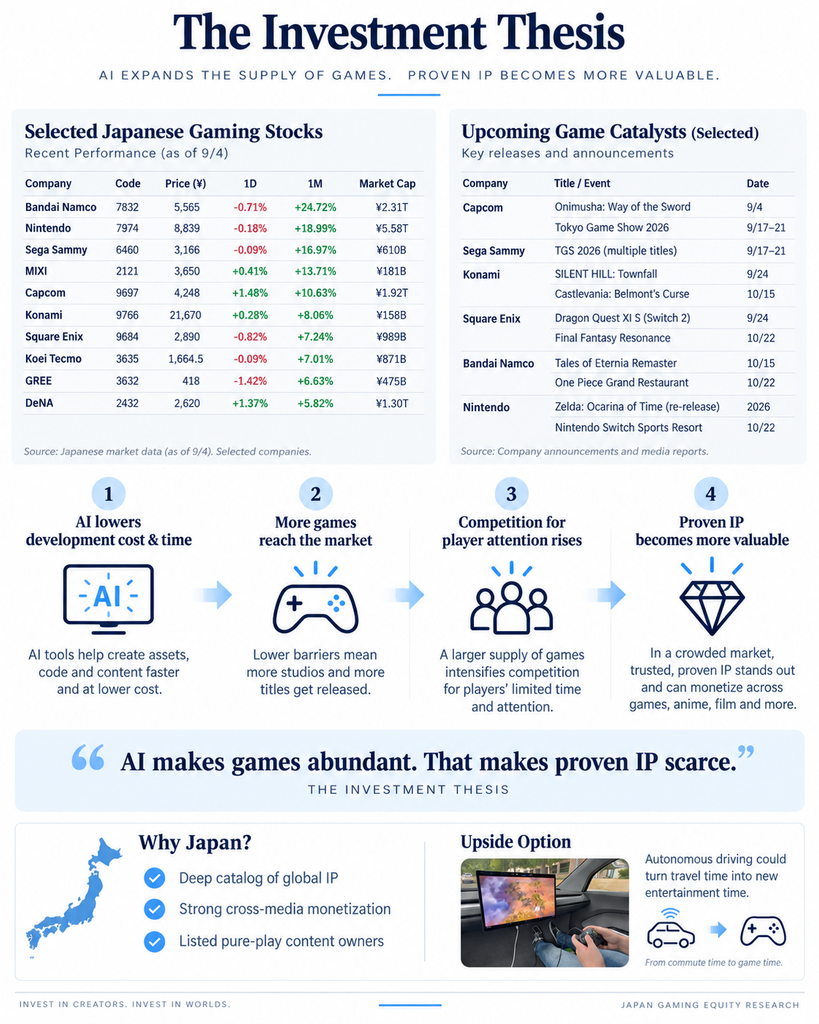
As of September 4, Bandai Namco had risen 24.7% over one month, Nintendo 19.0%, Sega Sammy 17.0%, MIXI 13.7%, Capcom 10.6%, Konami 8.1%, and Square Enix 7.2%.
It would be easy to dismiss the move as another rotation away from crowded AI hardware trades.
We think there may be something more interesting happening.
The next phase of the AI investment cycle is unlikely to remain confined to GPUs, memory, servers and power infrastructure. As AI tools move deeper into software and production workflows, industries capable of turning AI into higher productivity should begin to matter more.
Gaming is one of them.
But our thesis is not simply that AI will make game developers more profitable.
It is more nuanced:
AI makes games more abundant. Abundance makes proven IP more scarce.
If AI lowers the cost and time required to build games, the industry should ultimately produce more content. But consumers still have only 24 hours in a day.
That means competition for attention could become even more intense.
And in a world where games become easier to create, the scarce asset may no longer be the ability to make a game.
It may be the ability to make players care.
That is where Japanese gaming companies become particularly interesting.
Investment Thesis
Our Japanese gaming thesis rests on four ideas.
First, AI can improve development productivity by reducing repetitive work across coding, testing, documentation, research and content production.
Second, those productivity gains should eventually increase the supply of games and other digital content.
Third, player attention does not increase at the same rate as content supply. More games therefore mean more competition for a finite amount of consumer time.
Fourth, the companies best positioned in that environment are likely to be owners of globally recognized IP that can repeatedly attract players across new releases, remakes, downloadable content, animation, film, merchandise and licensing.
Japan has an unusually deep listed universe of exactly these companies:
Nintendo, Capcom, Sega Sammy, Square Enix, Konami and Bandai Namco.
For investors, the important question is therefore not:
“Who can use AI to make the most games?”
It is:
“Who owns the IP capable of capturing attention when everyone can make more games?”
1. AI Is Already Entering Game Development
The idea that AI could improve game-development productivity is no longer purely theoretical.
Unity’s 2026 Game Development Report found that the developers it surveyed were primarily using back-end AI tools for coding assistance, at 62%, and writing or narrative work, at 44%. The most commonly cited benefit was greater efficiency.
Capcom provides an even more useful real-world example.
The company has said that it is already seeing some effectiveness from generative AI in improving operational efficiency. Importantly, Capcom’s approach is not to replace the creative core of game development. Its stated policy is to use generative AI for routine operations so developers can spend more time on work that creates genuine value for players.
That distinction matters.
The realistic near-term AI scenario is probably not:
100 developers → 30 developers
It is closer to:
100 developers + AI → faster iteration, less repetitive work, more prototypes and more content from the same development organization.
Capcom already operates with another structural productivity advantage: its proprietary RE ENGINE provides a unified development environment, allows technology to be shared across titles and enables more flexible allocation of personnel. The company has also disclosed that its technical teams are testing AI technologies as part of the engine’s evolution.
For a large publisher with multiple proven franchises, even modest improvements in development efficiency can matter.
Saving six months on a weak game is not especially valuable.
Saving six months across Resident Evil, Monster Hunter, Street Fighter or Onimusha can be.
2. But AI Productivity Is Not Bullish for Every Game Company
This is where our view differs from the simple “AI lowers costs, therefore gaming stocks win” narrative.
If AI tools become widely available, every developer receives access to at least some of the same productivity improvements.
The industry-level effect could therefore look like this:
Development cost ↓
Development time ↓
Barriers to content creation ↓
Number of games ↑
And eventually:
Competition for player attention ↑
This is not necessarily good for the average developer.
The supply of entertainment can expand almost infinitely.
Consumer attention cannot.
A gamer can choose between thousands of titles, but the number of hours available to play them remains limited. The same person is simultaneously being competed for by YouTube, TikTok, Netflix, sports, music, social media and every other form of digital entertainment.
AI therefore creates an interesting paradox.
It may make producing content less scarce while making attention more scarce.
And when attention becomes the bottleneck, established IP becomes more valuable.
3. AI Could Turn Proven Gaming IP Into a Scarce Asset
Consider what happens when the market is flooded with more games.
A new developer still has to convince a consumer to discover its title, understand it, trust it, download it, learn it and spend dozens of hours playing it.
An established franchise begins with an enormous advantage.
A new Mario, Zelda, Resident Evil, Monster Hunter, Persona, Final Fantasy, Dragon Quest, Metal Gear, Silent Hill, Gundam or Dragon Ball title does not need to build consumer awareness from zero.
The IP already owns a place in the consumer’s mind.
That reduces one of the most important costs in an increasingly crowded entertainment market:
the cost of acquiring attention.
This is why the economics of established IP can improve even if the economics of game production become more competitive.
Successful IP can also be monetized repeatedly:
Original release → sequel → remake → remaster → DLC → live service → mobile → animation → film → merchandise → licensing
The marginal value of development productivity is therefore potentially much greater for the owner of a valuable franchise than for a studio without one.
Capcom explicitly talks about expanding IP through multiple usage and marketing measures and using catalog sales as part of its business model.
Square Enix is moving in a similar strategic direction. Its medium-term plan emphasizes a shift from quantity to quality, more disciplined development spending, major releases centered on core IP, broader multi-platform distribution and deeper monetization of catalog titles and IP across merchandise, events and cross-media projects.
Bandai Namco goes even further. Its corporate strategy is explicitly built around an “IP Axis Strategy” designed to create broad and repeated connections between its franchises, fans and multiple business segments.
This is exactly the type of business model we think becomes more valuable if AI accelerates content creation.
4. Why Japan?
The United States has valuable gaming assets.
Take-Two owns Grand Theft Auto and Red Dead Redemption. Electronic Arts owns major sports franchises. Microsoft owns Activision Blizzard and Bethesda.
But many of the world’s strongest publicly investable pure-play or near-pure-play gaming IP portfolios are concentrated in Japan.
That matters because Japan’s strongest publishers do not merely own individual successful games.
They own libraries of worlds.
Nintendo
Mario. Zelda. Pokémon. Animal Crossing. Fire Emblem.
Nintendo combines elite IP with its own hardware ecosystem and direct access to the consumer.
Its strength is not simply that its franchises are popular. It is that those franchises can survive across generations of hardware while preserving pricing power, fan loyalty and cultural relevance.
Capcom
Resident Evil. Monster Hunter. Street Fighter. Devil May Cry. Onimusha.
Capcom is particularly interesting because it combines strong global IP with evidence of high development productivity, a proprietary game engine, successful catalog monetization and a willingness to revive dormant franchises.
Sega Sammy
Sonic. Persona. Like a Dragon. Total War. Crazy Taxi.
Sega owns a broad collection of global IP and currently has one of the cleaner near-term event pipelines among Japanese publishers.
Square Enix
Final Fantasy, Dragon Quest and Kingdom Hearts provide franchise exposure under different rights arrangements. Kingdom Hearts includes Disney intellectual property; do not value every franchise as wholly owned by the game publisher.
Few publishers possess a back catalog with similar global recognition. The strategic question is whether Square Enix can improve execution and extract more value from those assets as it restructures around fewer, higher-quality projects and broader platform distribution.
Konami
Metal Gear. Silent Hill. Castlevania. Yu-Gi-Oh!. eFootball.
Konami’s opportunity is increasingly about IP revival. Several franchises that spent years under-monetized are returning to active development.
Bandai Namco
Gundam, Dragon Ball and One Piece illustrate Bandai Namco’s franchise exposure, but exposure is not the same as outright ownership. Licensed properties carry contractual limits and royalty obligations; investors should distinguish owned rights, licensed rights and revenue-sharing arrangements.
Bandai Namco is arguably the clearest example of an IP ecosystem that extends far beyond individual game releases into toys, animation, licensing and other forms of entertainment.
This combination is difficult to replicate.
AI can help create more content.
It cannot instantly create four decades of Mario fandom or thirty years of Final Fantasy brand equity.
5. The Near-Term Setup Is Also Becoming Interesting
The structural thesis would matter less if there were no catalysts.
There are.
Tokyo Game Show 2026 takes place from September 17 through September 21, creating a concentrated window for new demos, trailers, gameplay impressions and announcements.
Sega and Atlus have one of the more compelling lineups.
Their official TGS site lists Stranger Than Heaven, Persona 4 Revival, Crazy Taxi: World Tour, Sonic Racing: CrossWorlds and several other titles.
Stranger Than Heaven is scheduled for January 15, 2027, while Persona 4 Revival is scheduled for February 18, 2027.
Capcom also entered September with a tangible catalyst.
Onimusha: Way of the Sword launched on September 4, marking the first new Onimusha title in more than two decades. Capcom specifically describes the revival of dormant franchises as part of its effort to maximize the value of its content portfolio.
Konami has a similarly visible pipeline.
Silent Hill: Townfall is scheduled for September 24 and Castlevania: Belmont’s Curse for October 15.
Square Enix has Dragon Quest XI S coming to Nintendo Switch 2 on September 24 and Final Fantasy Resonance on October 22, while its TGS booth will also feature the next Final Fantasy VII project.
Nintendo’s own release schedule includes Fire Emblem: Fortune’s Weave on September 17, Nintendo Switch Sports Resort on October 22, and a new Switch 2 version of The Legend of Zelda: Ocarina of Time later in 2026.
Bandai Namco also has opportunities to monetize older and licensed IP, including Tales of Eternia Remastered in October and a new One Piece management game later in the month.
The point is not that every title will become a hit.
The point is that investors are about to receive a large amount of new information on exactly the companies whose IP portfolios sit at the center of our structural thesis.
6. Our Japanese Gaming Watchlist
Capcom — Best Structural Fit
If we had to choose one company that most clearly demonstrates the thesis, it would be Capcom.
The company combines:
- globally proven IP,
- a high-quality proprietary engine,
- evidence of AI use for operational productivity,
- strong catalog economics,
- disciplined franchise management,
- and the ability to reactivate older intellectual property.
Onimusha is particularly interesting in this context.
Capcom is not trying to create every future hit from scratch. It can return to an existing franchise with built-in awareness and apply a modern development platform, modern distribution and modern production tools.
That is exactly how old IP can become more valuable when development becomes more efficient.
Our angle: AI productivity + premium global IP + catalog flywheel.
Sega Sammy — Best Near-Term Catalyst Setup
Sega Sammy may offer the most interesting combination of IP scarcity and event momentum.
Sonic is one of the most globally recognized Japanese gaming franchises, while Persona and Like a Dragon have built increasingly international audiences.
More importantly, the company has a dense slate of upcoming information.
Tokyo Game Show will provide hands-on exposure to Persona 4 Revival, Stranger Than Heaven and Crazy Taxi: World Tour, among other titles.
The investment case is therefore not dependent on a single release.
Investors can move through a sequence of:
announcement → demo → release → reviews → unit sales → earnings contribution
That makes Sega one of the cleaner catalyst names in the group.
Our angle: late-cycle momentum + global IP + visible event pipeline.
Square Enix — The Re-Rating Candidate
Square Enix is different.
The company does not need to prove that it owns strong IP.
It needs to prove that it can monetize that IP more efficiently.
Its strategic reset explicitly targets development productivity, better project selection, a shift from quantity to quality, multi-platform distribution and more consistent releases of major titles centered on core franchises.
That creates operating leverage to any improvement in execution.
If the company can use better internal discipline — and eventually AI-enabled productivity — to shorten development cycles while expanding the addressable market for Final Fantasy, Dragon Quest and Kingdom Hearts, the re-rating potential could be meaningful.
Our angle: deep catalog + execution reset + monetization upside.
Konami — The IP Revival Story
Konami is one of the most interesting examples of dormant IP becoming active again.
Metal Gear, Silent Hill and Castlevania are franchises with decades of accumulated brand equity.
The strategic advantage is clear:
Konami does not need to invent cultural relevance from scratch.
It needs to reactivate it.
The upcoming Silent Hill and Castlevania releases make this particularly timely.
Yu-Gi-Oh! also demonstrates how valuable gaming-related IP can extend into cards, merchandise and other media.
Our angle: under-monetized IP revival + cross-media expansion + near-term catalysts.
Bandai Namco — The Cross-Media IP Machine
Bandai Namco may have the strongest example of the thesis outside Nintendo.
The company has long operated around the idea that an IP should not be monetized through a single product.
It can move across:
games → anime → toys → collectibles → events → licensing
That is why Bandai Namco describes its strategy around IP itself rather than around one specific entertainment format.
If AI makes content creation cheaper, companies capable of deploying an existing franchise across the greatest number of formats should have an advantage.
The main near-term concern is simply price.
The stock had already gained roughly 25% over the month through September 4.
Our angle: elite cross-media IP economics, but more short-term expectations may already be reflected.
Nintendo — Highest-Quality IP, Less Obvious Re-Rating
Nintendo arguably owns the best gaming IP portfolio in the world.
That makes it an obvious long-term beneficiary of an environment in which recognizable franchises become increasingly valuable.
The question is less about quality and more about incremental expectations.
Nintendo already receives a premium for its ecosystem, IP and platform ownership, and the shares had risen roughly 19% over the prior month by September 4.
This does not weaken the structural thesis.
It simply means the market may already understand a larger portion of it.
Our angle: highest-quality IP asset, but less obvious near-term re-rating than some peers.
Keep the thesis focused. The case rests on development economics, durable franchise demand and valuation. Speculative new entertainment channels are not required for it to work.
7. What Could Break the Thesis?
There are several risks.
AI may not reduce AAA development costs as much as expected
Large games require complex integration across art, engineering, narrative, gameplay, testing and project management.
AI may improve individual workflows without materially shortening the full development cycle.
More content could hurt even strong IP
Famous franchises are not immune to poor execution.
A sequence of weak releases can damage brand equity quickly.
IP is valuable only if management protects it.
Development inflation could offset productivity gains
Higher graphical standards, larger teams, more platforms and increasing player expectations continue to push AAA budgets higher.
AI savings could simply offset part of existing cost inflation rather than create a major margin windfall.
The sector has already started to re-rate
The recent one-month performance of several Japanese gaming stocks has been strong.
The better the thesis becomes understood, the more important entry price becomes.
Catalysts create event risk
Tokyo Game Show, trailers and major releases can create expectations as easily as they create upside.
Poor reviews, delays or weaker-than-expected sales can reverse momentum quickly.
Rights and royalties affect the economics
A popular franchise does not guarantee attractive publisher returns. License renewals, royalty rates, development costs and revenue-sharing terms can reduce the cash flow attributable to shareholders.
The thesis does not require autonomous driving to work.
8. How We Would Frame the Opportunity
We would divide the universe into three groups.
Best structural expression:
Capcom
The clearest combination of global IP, development productivity, catalog economics and direct evidence of AI experimentation.
Most interesting catalyst / re-rating names:
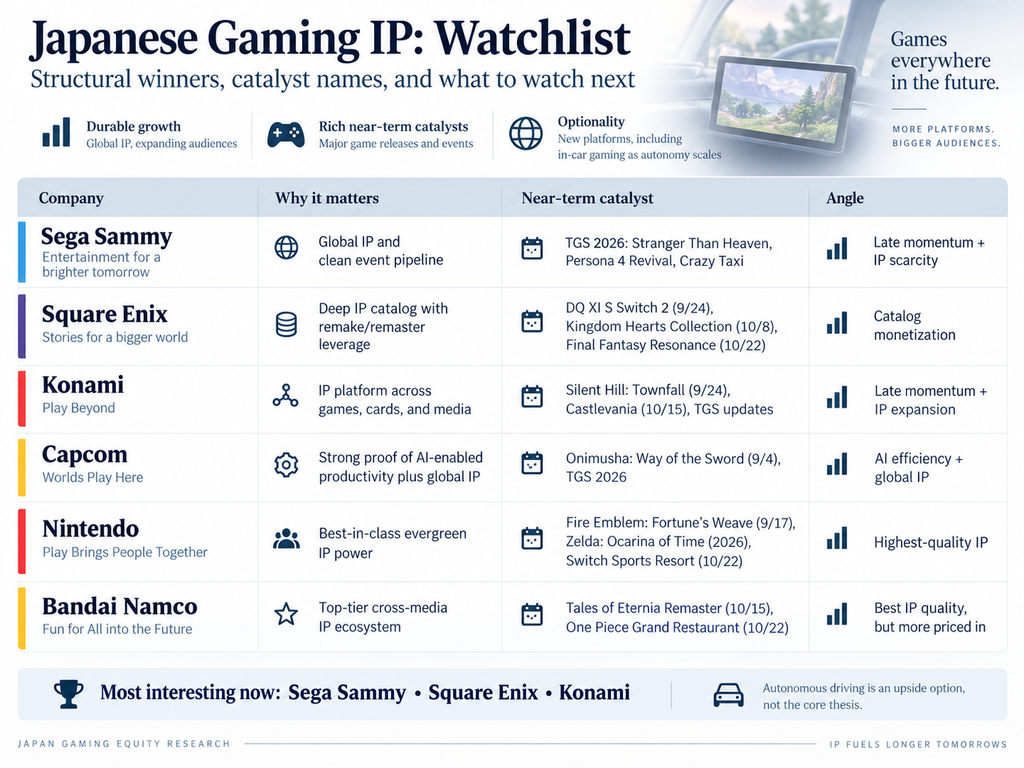
Sega Sammy, Square Enix, Konami
These companies combine strong IP with more visible upcoming events or a greater opportunity for investor expectations to change.
Highest-quality IP assets, but potentially more priced in:
Nintendo, Bandai Namco
Both have exceptional franchise portfolios. The debate is more about valuation and expectations than strategic quality.
This ranking can change quickly as releases, valuations and earnings evolve.
But the framework should remain useful.
Conclusion
The easiest way to think about AI and gaming is to assume cheaper production is automatically bullish for game developers.
We think that misses the more important second-order effect.
If AI makes it easier to build games, then games themselves become less scarce.
More titles will compete for the same players.
More media will compete for the same hours.
And the bottleneck increasingly becomes attention.
In that environment, the most valuable asset may not be development capacity.
It may be a franchise that consumers already know, trust and want to spend time with.
That is why we believe Japan deserves particular attention.
Few public markets offer investors comparable exposure to such a concentrated collection of globally recognized gaming IP.
Capcom has Resident Evil and Monster Hunter.
Sega has Sonic and Persona.
Square Enix has Final Fantasy and Dragon Quest.
Konami has Metal Gear and Silent Hill.
Bandai Namco operates one of the deepest cross-media IP ecosystems in entertainment.
Nintendo owns perhaps the strongest collection of gaming franchises of all.
The AI era may therefore produce a counterintuitive outcome:
The easier games become to make, the harder attention becomes to win.
And if that happens,
AI will make games abundant. Proven IP will become scarce.
That may be one of the more interesting long-term investment cases developing in Japanese equities.
Disclosure & Disclaimer
This article is for informational and research purposes only and does not constitute investment advice, a recommendation, or an offer to buy or sell any security.
The views expressed reflect the author’s interpretation of publicly available information at the time of publication and may change without notice.
Investing involves risk, including the potential loss of principal. Readers should conduct their own research and consider their individual circumstances before making investment decisions.