Investment Thesis
Global food inflation is beginning to re-accelerate, but the equity market implications are unlikely to be uniform across the food value chain.
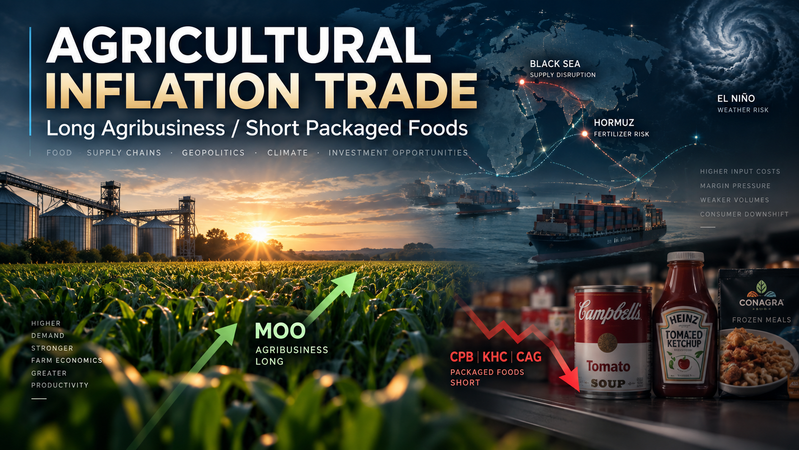
Our preferred expression is a relative-value trade: long the VanEck Agribusiness ETF (MOO), while shorting a basket of U.S. packaged-food companies including Campbell’s (CPB), Kraft Heinz (KHC), and, at lower conviction, Conagra Brands (CAG).
The thesis rests on three increasingly visible supply-side pressures: severe disruption to Black Sea grain logistics, lingering fertilizer-market stress following the Strait of Hormuz shock, and a strengthening El Niño that could extend weather-related agricultural risks well into 2027.
At the same time, U.S. packaged-food companies are already demonstrating the problem we believe could become more pronounced: pricing is increasingly being used to offset cost inflation, but higher prices are often accompanied by weaker volumes.
This creates an attractive asymmetry.
Agribusiness companies can capture higher nominal agricultural spending, stronger fertilizer economics, greater demand for productivity-enhancing inputs and, in some cases, higher commodity-processing margins.
Packaged-food manufacturers, by contrast, sit downstream. They must absorb or pass through higher raw-material, freight and packaging costs while dealing with a consumer that has become increasingly price-sensitive.
The trade is therefore less about simply betting that “food prices go up.”
It is about owning the part of the agricultural value chain with greater exposure to the inflationary upside while shorting the part where inflation increasingly becomes a margin and volume problem.
Key Takeaways
Position: Long MOO / Short CPB, KHC and CAG
Time horizon: 6–12 months
Core thesis: Agricultural supply risks are rising faster than the market’s ability to normalize them.
Primary catalysts: Black Sea disruption, fertilizer constraints, El Niño and rising global food prices.
Primary risk: Rapid geopolitical normalization, favorable harvests or faster-than-expected agricultural supply response.
Short-basket preference: CPB > KHC > CAG in conviction.
1. Food Inflation Is Re-Entering the Investment Debate
The starting point is straightforward: global food prices are no longer behaving like a post-2022 normalization story.
The FAO Food Price Index reached 133.3 in August 2026, up from a revised 130.8 in July and the highest level since November 2022. Importantly, the increase was broad-based: cereals, vegetable oils, sugar, meat and dairy all rose during the month.
This does not mean agricultural commodities are about to revisit the extreme levels seen immediately after Russia’s invasion of Ukraine. The FAO index remains roughly 17% below its March 2022 peak.
What matters for equities, however, is the direction and persistence of the marginal cost shock.
FAO also cut its 2026 global cereal-production forecast to 2.980 billion tonnes, 2% below 2025 and the largest annual decline since 2018. Meanwhile, geopolitical disruptions are making the geographic location of inventories increasingly important: grain sitting inside an exporting country is less useful to global buyers if ports and shipping lanes cannot move it efficiently.
That distinction between physical supply and deliverable supply is central to our thesis.
2. The Black Sea Has Become a Supply-Chain Problem Again
Russia and Ukraine remain systemically important to global agriculture.
During the 2025/26 marketing year, Russia accounted for approximately 21.1% of global wheat exports and Ukraine another 6.2%, putting their combined share at roughly 27.3%.
The problem is no longer theoretical.
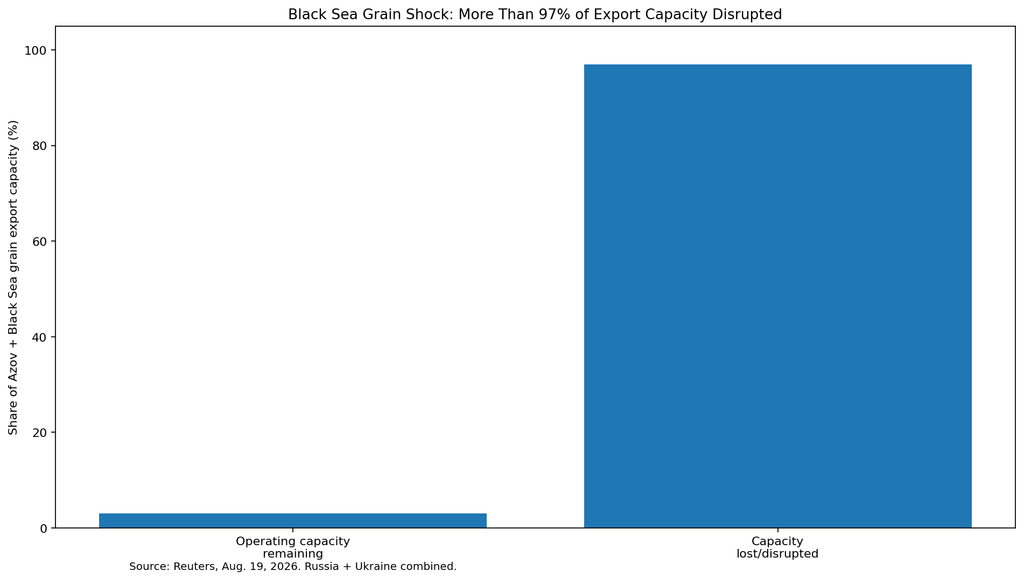
Escalating attacks on ports, terminals and commercial vessels have disrupted more than 97% of Russia and Ukraine’s grain export capacity in the Azov and Black Sea basin compared with last season’s capacity. The region had been exporting an average of roughly 7.2 million tonnes of grain per month.
Alternative routes exist, but they are inferior.
Russia is redirecting more grain toward Baltic routes, while Ukraine is relying more heavily on the Danube, rail and road. Yet Russia’s alternative routes cannot fully replace its southern export system, and Ukraine’s Danube corridor is already experiencing vessel queues and infrastructure constraints.
The result is exactly what one would expect from a logistics shock: buyers are paying more to source the same commodity elsewhere.
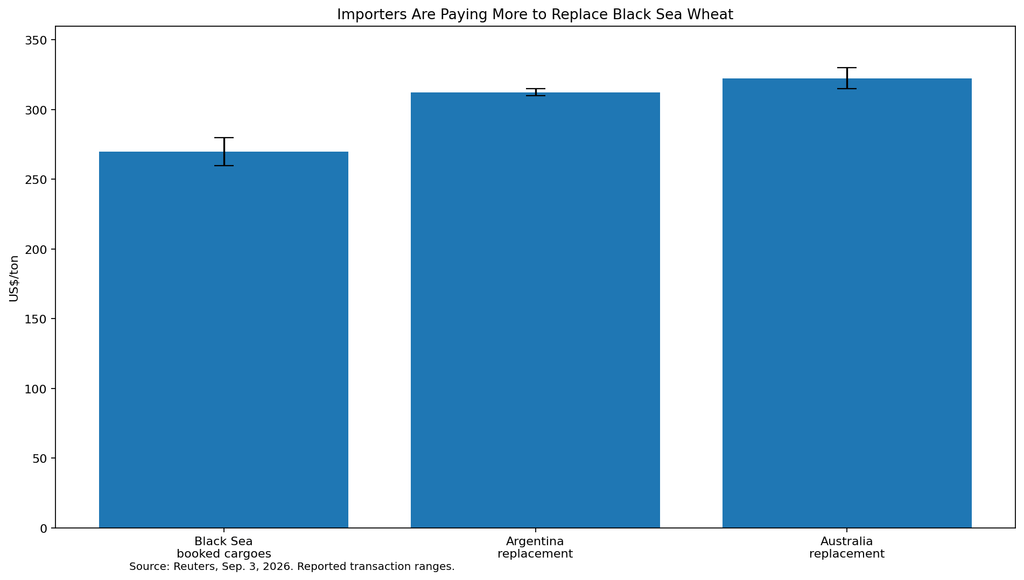
Asian importers recently bought at least 500,000 tonnes of Australian and Argentine wheat to replace delayed Black Sea cargoes.
Australian Premium White wheat was transacting around $315–330 per tonne, while Argentine wheat was around $310–315, compared with roughly $260–280 for previously booked Black Sea cargoes.
Benchmark Chicago wheat futures have risen approximately 35% since late June.
This is important.
The bullish agricultural thesis does not require global wheat production to collapse.
A sufficiently large disruption to the world’s lowest-cost export corridors can raise the marginal delivered price of food even when grain still exists elsewhere.
3. Hormuz Adds a Second Shock: Fertilizer
The Black Sea affects the output side of agriculture.
The Strait of Hormuz affects one of its most important inputs.
Before the 2026 conflict, roughly one-third of globally traded urea and nearly half of seaborne sulphur passed through the Strait of Hormuz. When traffic was severely disrupted, fertilizer availability tightened sharply and prices spiked.
Urea matters because nitrogen fertilizer is not an optional input for modern high-yield agriculture.
Farmers facing substantially higher fertilizer costs have several choices, none particularly attractive: accept lower margins, reduce fertilizer application, switch crop mix where possible, or attempt to pass the economics through via higher crop prices.
The immediate crisis has eased somewhat as shipments resumed, but normalization has been incomplete. Reuters reported that traffic remained well below pre-war levels even after the interim agreement, with hundreds of ships stranded and fertilizer production facilities in parts of the Gulf requiring repairs.
This creates a second-order effect that markets can underestimate.
Energy shock → fertilizer shock → farm input inflation → crop-price pressure → food-manufacturing cost inflation.
The transmission takes time.
That is precisely why the agricultural inflation thesis may persist even if geopolitical headlines improve before the underlying physical supply chain fully normalizes.
4. El Niño Extends the Time Horizon Into 2027
The third pillar is weather.
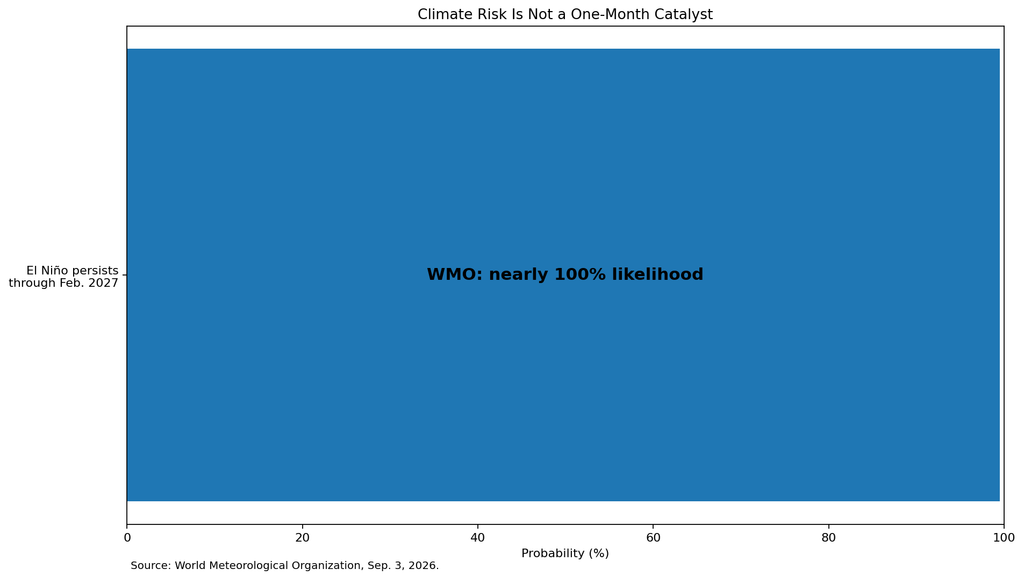
On September 3, the World Meteorological Organization said El Niño is firmly established and expected to strengthen into a very strong event, with an exceptionally high likelihood — described as nearly 100% — that it persists through February 2027.
El Niño is not uniformly bullish for every agricultural commodity. Its effects differ substantially by geography and crop.
That nuance matters.
Our thesis is not that El Niño mechanically causes every crop price to rise. Rather, a very strong El Niño increases the distribution of weather outcomes precisely when agricultural logistics and fertilizer markets are already under stress.
Extreme rainfall in one region, drought in another, and abnormal temperatures elsewhere can alter yields for palm oil, sugar, grains and other agricultural products.
In isolation, markets can often absorb a weather shock.
Combined with constrained export logistics and elevated input costs, however, the same weather shock can have a disproportionately large price effect.
5. Why We Prefer MOO on the Long Side
We do not want to express this thesis simply by buying wheat futures.
Our preferred long exposure is the VanEck Agribusiness ETF (MOO) because the thesis extends beyond any single commodity.
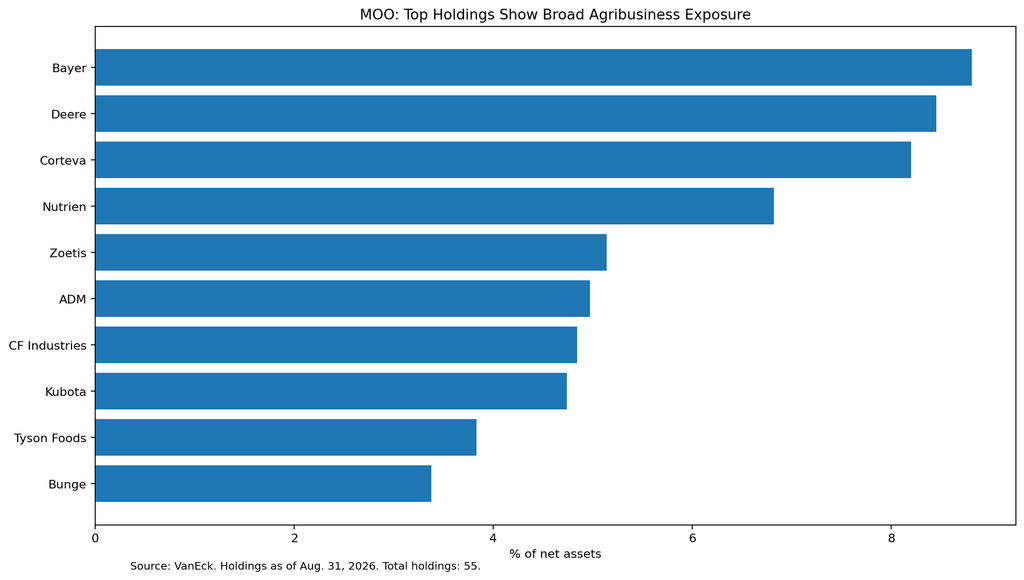
As of August 31, 2026, MOO held 55 companies across the global agricultural value chain. Its largest positions included Bayer at 8.81%, Deere at 8.45%, Corteva at 8.20%, Nutrien at 6.82%, Zoetis at 5.14%, Archer-Daniels-Midland at 4.97% and CF Industries at 4.84%.
That composition gives investors exposure to several potential beneficiaries of an agricultural capex and pricing cycle:
| Company | MOO Weight* | Exposure |
|---|---|---|
| Bayer | 8.81% | Crop science / agricultural inputs |
| Deere | 8.45% | Agricultural machinery |
| Corteva | 8.20% | Seeds / crop protection |
| Nutrien | 6.82% | Fertilizer |
| Zoetis | 5.14% | Animal health |
| ADM | 4.97% | Agricultural processing |
| CF Industries | 4.84% | Nitrogen fertilizer |
| Kubota | 4.74% | Agricultural machinery |
| Tyson Foods | 3.83% | Protein |
| Bunge | 3.38% | Agricultural merchandising / processing |
*VanEck holdings as of August 31, 2026.
MOO is therefore not a pure commodity-price ETF, and that distinction should be explicit.
Its attraction is that it owns the infrastructure surrounding agriculture: fertilizer, seeds, machinery, animal health, grain processing and other businesses whose economics can improve when farmers and the global food system have stronger incentives to increase productivity and secure supply.
In other words, we prefer to own the picks and shovels of agricultural scarcity rather than make the entire thesis dependent on the spot price of one crop.
6. Why Short Packaged Foods?
The other side of the trade is where the thesis becomes more interesting.
Higher agricultural prices do not automatically mean higher profits for food companies.
For packaged-food manufacturers, agricultural commodities are inputs.
When those inputs rise, management must either absorb the cost or increase retail prices.
The first option hurts margins.
The second can hurt volumes.
And recent earnings suggest this tension is already visible.
Campbell’s: The Cleanest Short in the Basket
Campbell’s fiscal Q4 2026 results provide perhaps the clearest example.
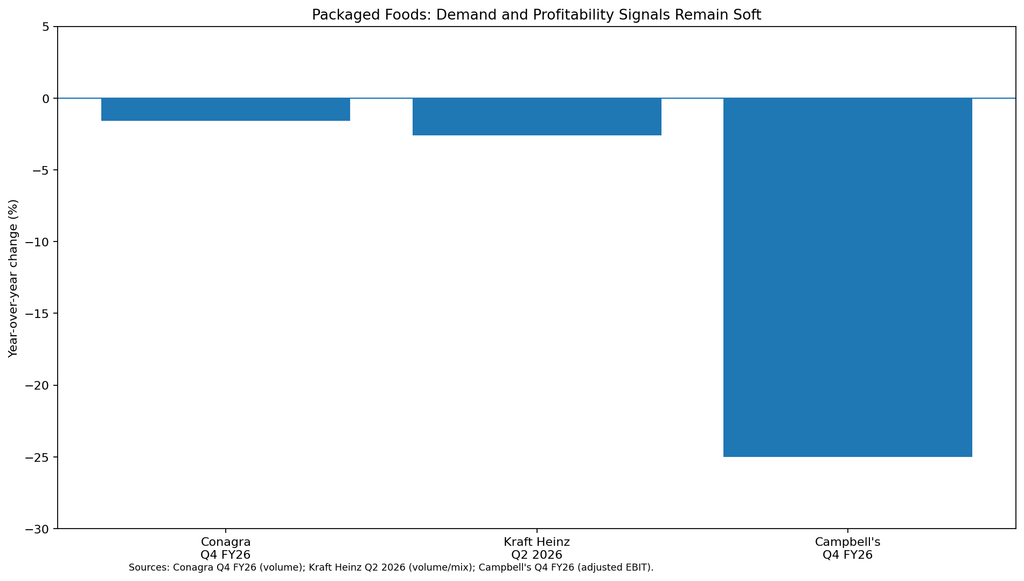
Organic sales declined 1%, adjusted gross margin fell 190 basis points to 28.6%, adjusted EBIT declined 25%, and adjusted EPS fell 37%.
Management explicitly cited cost inflation and supply-chain costs, including tariffs, as major drivers of gross-margin pressure.
More strikingly, Campbell’s reduced its quarterly dividend from $0.39 to $0.25, a 36% cut, as part of its effort to accelerate debt reduction.
This is exactly the type of operating environment we want to be short against an agribusiness long.
The issue is not simply weak revenue.
It is the combination of soft top-line growth + inflationary costs + margin compression + balance-sheet pressure.
Kraft Heinz: Pricing Up, Volume Down
Kraft Heinz exhibits a slightly different version of the same problem.
In Q2 2026, organic net sales declined 1.3%.
Price contributed +1.3 percentage points, but volume/mix declined 2.6 percentage points. In North America, organic sales fell 2.7%, with price up 1.1 points but volume/mix down 3.8 points.
Adjusted operating income fell 18.4% year over year to approximately $1.0 billion. The company cited inflation in manufacturing and logistics, unfavorable volume/mix and increased advertising among the headwinds.
This is the elasticity problem in a single earnings report:
Raise prices → protect revenue per unit → lose volume → fixed-cost absorption deteriorates → earnings remain under pressure.
Kraft Heinz has strong brands and its emerging-market business is performing better, so the thesis is not that the company is structurally broken.
The relative trade simply argues that another agricultural input-cost cycle creates a less favorable earnings setup for KHC than for the upstream agricultural businesses we own through MOO.
Conagra: A Short, But With Lower Conviction
Conagra requires more nuance.
In fiscal Q4 2026, total organic sales were flat, with price/mix +1.6% offset by volume -1.6%.
Within Grocery & Snacks, price/mix increased 4.0% while volume declined 3.5%.
That fits our thesis.
However, Refrigerated & Frozen showed volume growth of 0.3%, and Conagra gained volume share in several frozen-food categories.
Therefore, we would not treat CAG as equally attractive a short as CPB.
Its inclusion is primarily a basket expression of downstream food inflation and consumer elasticity, while the company’s improving frozen-food trends represent an important counterargument.
That makes CPB our highest-conviction short, followed by KHC, with CAG smaller or lower conviction.
7. The Relative-Value Logic
The beauty of the trade is that we do not need to predict the absolute direction of the equity market.
We are expressing a view about where inflation accrues within the value chain.
When agricultural scarcity increases:
Agricultural inputs / productivity / fertilizer / machinery
→ potentially gain strategic and pricing value.
Meanwhile:
Packaged-food manufacturers
→ face higher input costs and must negotiate the trade-off between price and volume.
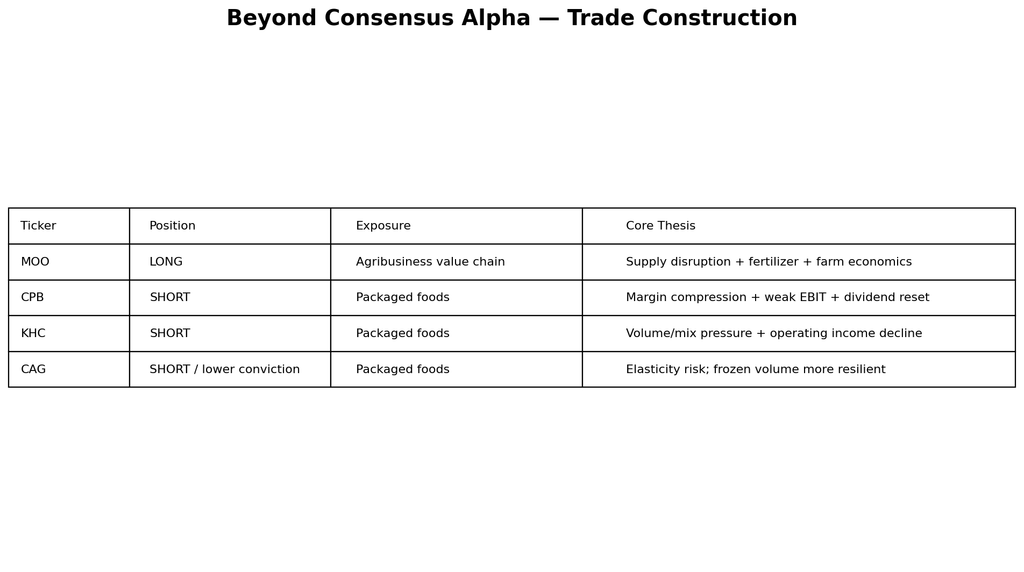
This creates the following structure:
| Ticker | Position | Role |
|---|---|---|
| MOO | LONG | Diversified agribusiness exposure |
| CPB | SHORT | Highest-conviction packaged-food hedge |
| KHC | SHORT | Pricing/volume elasticity + margin pressure |
| CAG | SHORT, lower conviction | Basket hedge; partially offset by better frozen trends |
The point is not that every MOO constituent will outperform every packaged-food stock.
The thesis is that the aggregate earnings distribution should increasingly favor upstream agricultural assets over downstream branded food manufacturers if agricultural inflation remains elevated.
8. What Could Break the Trade?
Every good thesis needs an explicit kill condition.
There are four primary risks.
First, rapid normalization of Black Sea logistics. A durable ceasefire combined with reopening of major Russian and Ukrainian export terminals could remove a substantial geopolitical premium from wheat and other grains.
Second, faster normalization of fertilizer markets. Full restoration of Hormuz shipping and Gulf fertilizer production could push nitrogen and phosphate costs lower faster than expected.
Third, favorable global weather. El Niño raises weather risk but does not guarantee poor harvests. Strong yields in major exporting regions could offset localized losses.
Fourth, packaged-food companies may regain pricing power. Cost savings, portfolio restructuring and stronger consumer demand could allow CPB, KHC or CAG to protect margins despite agricultural inflation.
There is also a fifth, subtler risk: MOO is not a direct agricultural commodity instrument.
Its constituents are equities with their own valuation, currency, execution and company-specific risks. A sharp global equity selloff could overwhelm otherwise favorable agricultural fundamentals.
We would therefore treat this as a 6–12 month relative-value thesis rather than an unconditional commodity supercycle call.
Conclusion: Own the Producers, Hedge the Processors
Three previously separate risks are beginning to converge.
Black Sea disruption is raising the cost of moving grain.
The Hormuz shock has demonstrated the vulnerability of the global fertilizer system.
And a potentially very strong El Niño extends agricultural weather uncertainty into 2027.
At the same time, packaged-food earnings are already revealing the downstream consequences of inflation: weaker volumes, margin pressure and, in Campbell’s case, a substantial dividend reset.
Our preferred expression is therefore:
Long MOO / Short CPB + KHC + CAG, with lower short conviction in CAG.
The thesis is not simply that food prices will rise.
It is that if agricultural scarcity persists, the market may increasingly reward the businesses that enable agricultural production while penalizing the companies forced to absorb those costs downstream.
In a higher-for-longer agricultural inflation regime, where you sit in the value chain matters.
Disclosure & Disclaimer
This article represents independent research and market commentary based on publicly available information. It is provided for informational and educational purposes only and does not constitute investment advice, an offer to buy or sell securities, or a recommendation tailored to any investor.
The author may hold long or short positions in securities discussed in this article. Positions may change without notice. All investments involve risk, including loss of principal. Readers should conduct their own research and consult appropriate professional advisers before making investment decisions.