
Why the next macro question is how quickly capital becomes power, factories and useful output.
Beyond Consensus Alpha | Flagship Series | Part I of III
Research cutoff: September 8, 2026.
Framework note: “Y Strategy” is this research’s analytical framework, not the name of an official U.S. government program. It connects policies that have different mandates and decision makers; it does not assume a coordinated master plan. Fact identifies documented institutions or announcements. Interpretation identifies our causal analysis. Speculation identifies conditional future possibilities.
The next decisive American investment may begin with an unglamorous question: can a transformer arrive before a data center’s financing runs out?
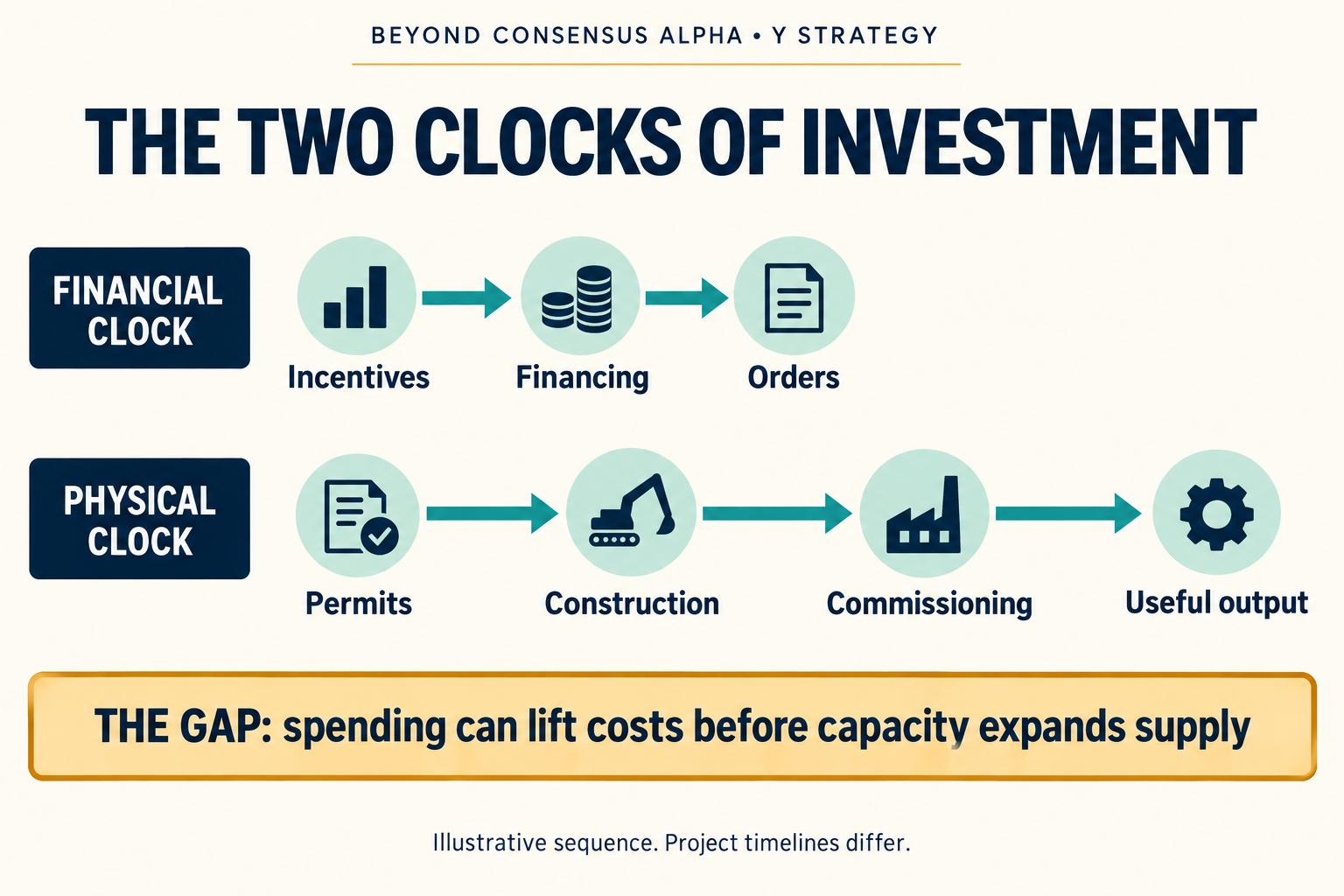
Capital can be committed in a board meeting. Electricity has to reach a particular site. Between those events lie equipment orders, construction crews, permits, transmission connections and customers willing to pay. An economy can have abundant financial ambition and still struggle to turn it into usable capacity.
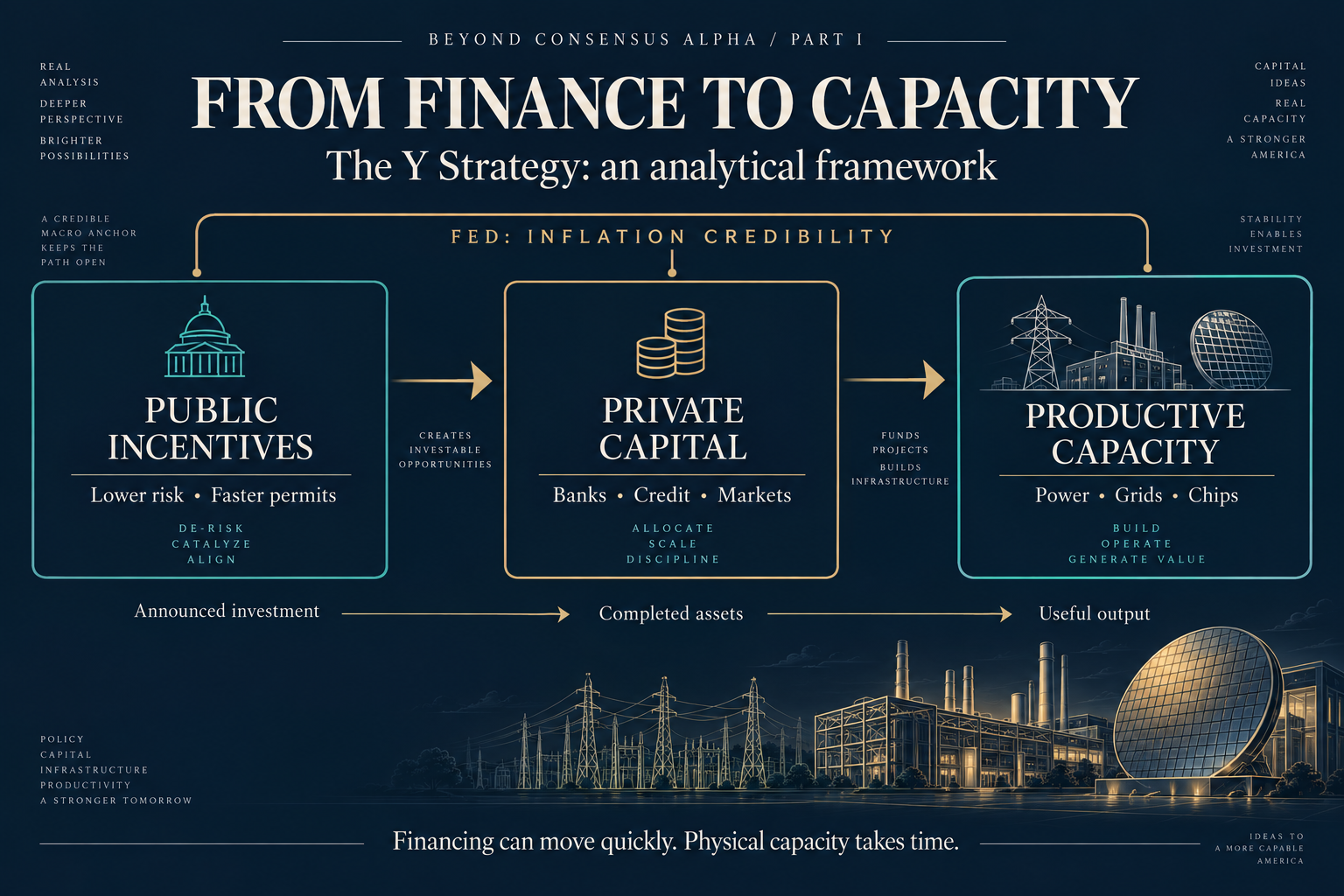
That gap is the starting point for America’s Y Strategy. The proposition is that the United States can encourage strategic production by changing the economics of private investment, while the Federal Reserve preserves monetary credibility. Banks and capital markets finance the buildout; businesses undertake construction and bear commercial risk. Success means additional financing produces more useful output before it produces an intolerable inflation or financial-stability problem.
This is a framework for evaluating policy and investment, not a claim that Washington has already solved the coordination problem. Its value is that it replaces a vague question about “more liquidity” with a harder one: what does the financing actually build, when will it work, and who captures the return?
The investment case in three points
- Follow conversion, not announcements. A funded project is a step toward productive capacity, not proof of it.
- Policy can change private returns. Procurement, guarantees and faster approvals can make a viable project financeable, but can also protect an uneconomic one.
- The timing gap is the central macro risk. Construction spending and input demand arrive before the completed asset’s contribution to supply.
In this article: What Y means · How incentives work · How credit reaches projects · The AI power test · How to measure success.
1. What “Y” means—and what the equation cannot prove
In the familiar identity MV = PY, M is a defined money stock, V its income velocity, P an aggregate price level and Y real output. The right side is nominal output. With consistent definitions, the identity describes an accounting relationship. It does not establish that a particular monetary change causes inflation or investment.
In growth rates, the useful approximation is inflation ≈ money growth + velocity growth − real-output growth. This is an accounting decomposition, not a forecasting model. A financing commitment is not automatically new money; nominal credit growth is not interchangeable with growth in MV. Asset-price inflation is also not the same object as the output price deflator.
Interpretation. The original research’s productive-absorption idea—raising ΔY relative to Δ(MV)—is best used as a question about transmission. How much of a spending impulse is met by additional production? The raw ratio should not be presented as an official statistic or a stable policy target. Its value depends on units, definitions, time horizons and the business cycle; it can become uninformative when the denominator is small or negative.
There is a second distinction. Y in the identity is actual output, while a power plant or factory expands potential capacity. The bridge between them is utilization. A completed facility with no economic customers may add measured capital but contribute little durable productivity. For this series, “building Y” is shorthand for expanding capacity that can produce economically useful goods and services.
The framework therefore follows four separate steps: investment spending today, a completed asset later, actual production after commissioning, and wider productivity gains if the economy uses that production well. Conflating these steps is how a construction boom becomes mistaken for an assured growth miracle.
2. A distributed approach to strategic development
The United States and China both mix public intervention with private enterprise. Neither fits a pure textbook model. China’s state-owned banks and enterprises give authorities more direct channels for influencing credit allocation. The American system generally relies more on private financing decisions, market prices, legal contracts and a divided set of federal, state and local powers.
The title’s “without state capitalism” describes this institutional emphasis. It does not imply that America lacks public lending, public utilities, state ownership or industrial policy, or that China lacks competitive private firms.
Interpretation. The American alternative is to distribute development functions. Congress establishes tax and spending authority. Executive agencies administer programs within their mandates. Regulators set financial boundaries. Utilities and local authorities determine critical project conditions. Private investors decide whether expected returns justify putting capital at risk.
This can preserve useful price discovery and allow different solutions to compete. It also creates coordination failures: a federal incentive cannot by itself deliver a state permit, a transmission connection or a skilled workforce. The strength of the system is flexibility. Its weakness is that no single actor controls the entire path from policy to production.
3. The government as a designer of investment economics
Consider a factory whose customers appear credible but whose construction schedule is uncertain. Its financing problem may be less about the total availability of money than about when revenue starts and who absorbs the downside.
A purchase commitment can reduce uncertainty over future sales. A guarantee can reduce a lender’s expected loss. Faster permitting can shorten the period during which interest accumulates without revenue. Tax provisions can improve after-tax cash flow. Each changes a different part of the investment decision.
Interpretation. We call this “return engineering.” Treasury is part of that architecture, but the shorthand “Treasury as return engineer” must not erase the roles of Congress, Commerce, Energy, procurement agencies, state regulators and local authorities. Nor does it mean Treasury directs independent Fed decisions.
| Policy mechanism | What changes for investors | What still needs testing |
|---|---|---|
| Tax credit or faster depreciation | After-tax project cash flow | Eligibility, timing and whether benefits were already priced in |
| Loan guarantee | Lender exposure to specified losses | Coverage limits, exclusions and public contingent liabilities |
| Procurement or purchase commitment | Revenue visibility | Contract enforceability, cancellation and performance conditions |
| Faster approvals | Time before revenue and construction risk | Other permits, appeals and physical connections |
| Input tariff relief | Equipment and material costs | Scope, durability and domestic-content conditions |
Fact. The April 20, 2026 presidential determination on grid infrastructure identifies equipment and upstream supply chains as defense-essential and authorizes implementation using tools including purchases, commitments and financial support. This is evidence of a policy channel; it is not evidence that every eligible project has received money or reached completion. See the White House determination.
The relevant public-finance question is additionality: would the project have proceeded anyway? A large private investment announced beside a small public commitment does not prove a large causal multiplier. Compare incremental capacity with the expected public cost, including the risk of guarantees being called and the value of alternative uses for public resources.
A hypothetical illustration makes the timing channel tangible. At an 8% annual discount rate, receiving the same cash flow two years earlier increases its present value by about 16.6%, before allowing for changes in construction costs or risks. This is arithmetic, not a forecast of any project’s return. The lesson is that reducing time-to-revenue can matter as much as a headline subsidy.
4. Monetary credibility remains a binding constraint
Fact. In his August 28 Jackson Hole remarks, Fed Chair Kevin Warsh emphasized the 2% inflation objective and short-term interest rates as the main policy instrument, while arguing for restraint in unconventional easing outside genuine crises. His remarks also treated AI’s productivity effects and the distribution of its returns as open questions. See “In Our Time”.
Interpretation. That stance is compatible with a division of labor in which fiscal and regulatory policy improve project economics while monetary policy restrains aggregate inflation. Compatibility is not coordination. The Fed can tighten even when doing so makes favored investments harder to finance.
Calling the Fed an “expectations governor” describes an emphasis, not a new legal mandate. The Fed still manages rates, its balance sheet, payments and liquidity. Banks have always created deposits when lending; the financial system is not suddenly acquiring a function formerly monopolized by the central bank.
Credibility can reduce compensation for inflation uncertainty, but speeches alone do not guarantee lower bond yields. Investors may require higher real yields if investment opportunities improve, or a higher term premium if fiscal risks worsen. A productive-capacity expansion can therefore coexist with expensive long-term financing.
5. More lending capacity is only the first step
Fact. Regulators finalized a reduction in the optional community bank leverage ratio from 9% to 8%, effective July 1, 2026. The change applies to qualifying community banks within that framework, not every bank or every capital constraint. See the joint regulatory release.
Interpretation. A less binding capital requirement can expand lending capacity at the margin. Whether lending actually increases depends on deposits, funding costs, borrower demand, underwriting standards and other constraints. It does not create a mechanical credit multiplier, and additional credit need not fund new production.
A bank loan can create a deposit. A private-credit fund more commonly channels capital raised from investors, sometimes with borrowing of its own. Bond markets transfer funds from buyers to issuers. These mechanisms can all finance capacity, but they should not be collapsed into a single claim about money creation.
A second mortgage on an existing asset, a refinancing and a loan for a new transformer factory have different direct implications for capacity. That does not make every nonindustrial loan socially useless: household finance, services, working capital and housing can support output. It means the analyst must examine use of proceeds instead of treating a growing balance sheet as the desired outcome.
6. AI power demand is the clearest practical test
A data center can generate an immediate demand shock for electricity while taking years to support broader productivity. The local question is whether its developer merely competes for existing power or helps finance additional supply and delivery infrastructure.
Fact. The March 4, 2026 Ratepayer Protection Pledge calls for participating companies to bring additional power supply, pay for delivery upgrades and negotiate separate rate structures with utilities and relevant states. It includes commitments to pay for designated power and infrastructure even if unused. The pledge describes voluntary commitments; implementation depends on actual agreements and regulatory arrangements. See the published pledge.
Interpretation. A durable arrangement can connect new demand to new supply while assigning more project costs to the beneficiary. But a press release does not settle cost allocation. Investors need the utility tariff, the interconnection agreement, the power contract and the rules governing stranded assets if the customer leaves.
The wider productivity test goes beyond megawatts. Does the new facility deliver reliable, competitively priced compute? Do businesses use that compute to improve output per hour or lower costs? A fully energized site can still earn poor returns if demand disappoints or technology makes its hardware obsolete.
Our related essay on AI’s power constraints and the Bloom Energy–Doosan investment debate explores the equipment and supplier side. Here, the question is how the financing and public-policy structure support—or delay—the physical buildout.
7. A measurement system that resists headline inflation
The source research proposes a Productive Credit Ratio: incremental credit financing productive fixed investment divided by total incremental private credit. This is a research construct, not an official published series. It should be built bottom-up from disclosed uses of proceeds and reconciled against aggregate data.
For practical monitoring, track new originations and actual disbursements separately from changes in outstanding credit. Refinancing can increase gross issuance without financing new assets; repayments can make a net denominator misleading. Avoid counting the same project loan again when it is securitized. Equity-funded projects also matter, so the credit ratio cannot describe the entire investment cycle.
Pair financing evidence with physical milestones. Announced megawatts should progress through funded, permitted, under-construction, energized and commercially utilized stages. Compare the same cohort over time; dividing today’s completions by today’s announcements mixes projects from different vintages. Report cancellations rather than removing them from the denominator.
Finally, distinguish installed capacity from useful output and output from productivity. Energy production, fab yields and utilization help establish the first transition. Output per hour, unit labor costs and broader business adoption help establish the second. No single quarterly release proves the thesis.
8. Where the framework can fail
The most immediate risk is that spending moves faster than supply. Equipment, copper, steel and skilled labor can become more expensive during construction. Monetary tightening may then raise debt-service costs before a project earns revenue. There is no universal two-to-four-year clock: software adoption, substations, fabs and transmission lines have very different development paths.
Policy can also work against itself. Tariffs that encourage domestic production may raise the cost of the equipment needed to build it. Guarantees can attract capital to weak projects. Subsidized demand can push scarce workers away from equally valuable construction elsewhere. A dollar spent on strategic capacity is not necessarily a dollar of net additional national capacity.
The strongest counterargument is simpler: perhaps these policies remain fragmented responses to separate problems, while private investment proceeds mainly for commercial reasons. If financing expands but completion rates, useful output and productivity do not improve, the Y Strategy offers an appealing narrative without an economic payoff.
The proposition to carry forward
America does not need to own every strategic enterprise to influence what gets built. It can change the risks, revenues and timing facing private capital. The discipline is to trace those changes through to completed assets and useful production, while recognizing that taxpayers, consumers and investors may still bear substantial costs.
The Fed supplies monetary credibility; public institutions shape incentives; private finance evaluates and funds projects; industry must deliver the output. The arrows between those functions are conditional. That is where the research belongs.
The next question is how the system finances the waiting period. Part II examines stablecoins, Treasury funding and the Bridge Regime. For the portfolio implications and monitoring framework, read Part III: Winners, Risks and Signals to Watch.
Evidence and methodology
This article reconstructs sections 0–9, 13–16, 20–24 and the framework conclusions of DENSE MASTER 13: The American Y Strategy, dated September 8, 2026. Original analysis is identified as interpretation. Official documents are linked beside the factual claims they support. Announcements and legal authorities are not treated as realized investment or proof of a unified policy. Numerical probabilities from the source are not reproduced as calibrated forecasts.
Disclaimer
This article is for information and education and presents thematic analysis as of September 8, 2026. It is not personalized investment advice or an offer or solicitation to transact in any security. Interpretations and scenarios may be wrong; policies, data and market conditions can change. Investments can lose principal. Readers should independently assess suitability, valuation and risk. References to companies or sectors illustrate the framework and do not establish a recommendation or an author position.