
How short-term dollar demand can help finance a long buildout—and where the risk goes while America waits.
Beyond Consensus Alpha | Flagship Series | Part II of III
Research cutoff: September 8, 2026.
Framework note: “Y Strategy” and “Bridge Regime” are this research’s analytical terms, not official U.S. government programs. Fact means documented policy, institutional design or a historical precedent. Interpretation means our analysis of a possible connection. Speculation means a conditional future scenario, not an announced policy.
A Treasury bill can mature several times before a transmission project starts delivering electricity. A floating-rate coupon can reset repeatedly before a semiconductor factory produces a saleable chip. Financial markets operate on a different clock from the assets they help finance.
The Y Strategy asks whether America can improve that mismatch. Public incentives make strategic projects more attractive; private finance funds construction; real productive capacity eventually expands. But someone must carry funding, interest-rate and execution risk during the wait.
This article calls that interval the Bridge Regime. Its central proposition is conditional: stronger demand for short-term dollar assets, more resilient Treasury intermediation and carefully bounded liquidity facilities might help the financial system accommodate a prolonged investment cycle. None can guarantee that the underlying projects succeed.
Stablecoins can add a buyer at the short end. They cannot turn short-term liabilities into costless long-term funding. That distinction separates an investable macro thesis from a story about debt disappearing through financial engineering.
1. Three balance sheets, three different jobs
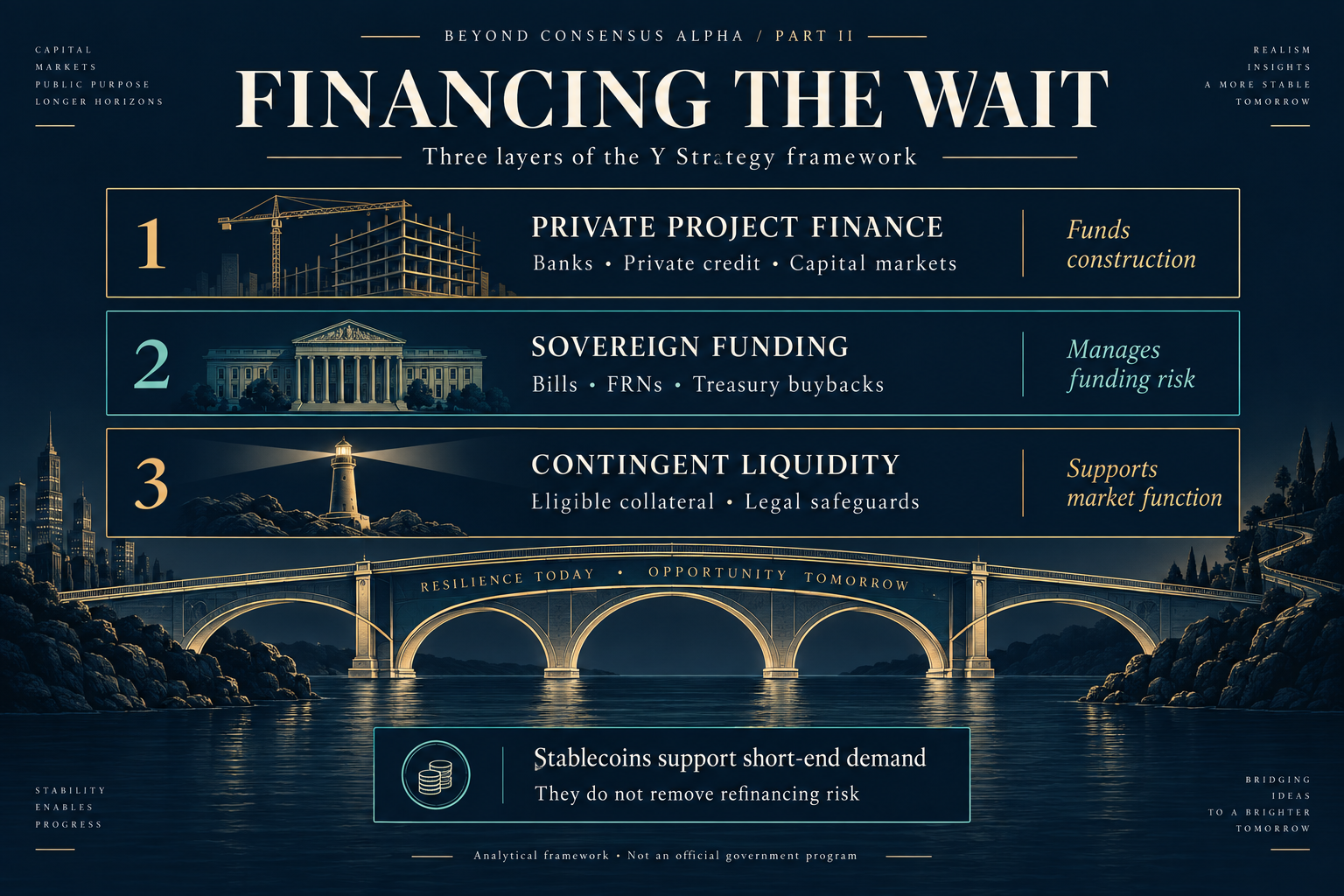
The architecture has three layers. The first funds private projects. The second manages sovereign borrowing. The third supports market functioning when eligible institutions face liquidity stress. They interact through funding markets and collateral, but they are not interchangeable pots of money.
| Layer | Economic function | Risk that remains |
|---|---|---|
| Private project finance | Banks, funds and bondholders finance construction and operating assets | Completion, demand, credit and refinancing risk |
| Sovereign funding | Treasury issues debt and manages maturity and market liquidity | Debt service, rollover and fiscal risk |
| Contingent public liquidity | Eligible facilities exchange funding for acceptable collateral under applicable rules | Credit losses are not automatically transferred to the public |
A stablecoin reserve manager buying a bill does not directly finance a particular data center. Treasury borrowing finances government obligations; any public support for industrial projects requires its own authority and implementation. Private project lending is a separate decision. The proposed connection is through the cost and resilience of the wider financial system.
In this article: Stablecoins and net demand · Treasury buybacks · Bills and FRNs · The Bridge Regime · Collateral and clearing · Public liquidity safeguards.
2. Stablecoin reserves: a new channel, not free capital
Fact. The GENIUS Act establishes a reserve framework for permitted payment stablecoins, including at least one-for-one backing in specified liquid assets. Eligible categories include cash and deposits, qualifying short-dated Treasury securities and certain repo and government money-market-fund exposures. Treasury securities in the specified category have a remaining maturity of 93 days or less. See Public Law 119–27.
Fact. Treasury’s August 17, 2026 proposed rulemaking describes January 18, 2027 as the expected effective date of the Act. An enacted statute, a proposed implementation rule and an operational licensing regime are different stages. See the Treasury rulemaking announcement.
Interpretation. Growth in fully backed dollar tokens can channel demand toward bills and other reserve assets. But token issuance is not the same as an equal increase in net Treasury demand. The source of the holder’s money matters.
If an investor sells a money-market fund that already holds bills to acquire a stablecoin whose issuer buys bills, much of the transaction rearranges the ownership chain. If a new overseas user moves from a non-dollar asset into a dollar token, the potential addition to dollar demand is different. A transfer from bank deposits can change a bank’s funding mix even if the issuer later places some reserves back into the banking system.
A useful ledger therefore distinguishes gross issuer reserve purchases from displaced demand elsewhere. It also distinguishes Treasury holdings from deposits, repo and fund shares. Counting a stablecoin issuer’s government-fund investment and the fund’s underlying bills as separate new demand would double-count the exposure.
The monetary implications are similarly nuanced. A fully backed token creates a transferable claim, but it is not a bank making an unsecured industrial loan. The reserve asset already has a liability counterpart elsewhere. A September 4 Federal Reserve staff note on new forms of money discusses how evolving use could affect monetary-aggregate measurement; it is not an announcement that all stablecoins have been added to M1 or M2.
Reserve quality also does not eliminate redemption risk. Holders care about custody, legal claims, access to cash, operational reliability and the timing of redemptions. Short assets reduce duration exposure, but rapid outflows can still test settlement and liquidity arrangements.
3. The dollar-network argument is broader than bill yields
Interpretation. Stablecoins may extend dollar use into online commerce, cross-border transfers and eventually machine-mediated payments. That can strengthen a private distribution channel for dollar liabilities. It does not replace the legal institutions, deep markets and confidence in public finances that support the dollar.
The relevant question is usage, not a mechanical lifespan for reserve currencies. A dollar token’s trading volume can reflect crypto-market activity rather than additional trade invoicing or productive commerce. Reserve-currency demand, payment activity and demand for long-duration Treasuries should be measured separately.
Speculation. AI agents could become substantial users of programmable dollar payments. That is a plausible extension of the network thesis, but its scale, settlement architecture and revenue economics remain uncertain. It belongs in an optionality case, not in the funding assumptions required for the base thesis to work.
4. Treasury buybacks and the limits of the “quasi-Twist” analogy
Fact. On August 19, Treasury announced larger liquidity-support buyback operations for nominal securities in the 10–20-year and 20–30-year sectors. The announced operation size rises from a $2 billion maximum to at least $4 billion, starting September 9 and covering the remainder of the refunding quarter through November 4. At this article’s cutoff, the change is announced but has not yet begun. See Treasury’s announcement.
These are operation-size terms, not a guarantee that Treasury purchases the full amount offered. The stated purpose is market liquidity. Investors should check actual accepted purchases, eligible securities and the accompanying issuance program.
Interpretation. Buying older, less liquid bonds can improve market functioning. If purchases of longer-duration bonds are financed with shorter liabilities, the private sector may hold less duration than under an alternative issuance mix. But if replacement borrowing carries similar duration, the net effect is smaller or absent.
That is why the source’s “quasi-Twist” is an analogy rather than a description of monetary policy. Treasury buybacks are debt management. Fed asset purchases involve the central bank’s balance sheet and monetary-policy objectives. A buyback does not extinguish the underlying fiscal financing need.
The right calculation is duration-weighted and net of replacement issuance. Compare the interest-rate sensitivity removed through purchases with that added by all new securities and with shifts in investor demand. Do not subtract gross buyback dollars from gross coupon issuance and call the result a complete measure of duration pressure. The same dollar amount of a short note and a long bond carries very different rate sensitivity.
5. Bills and FRNs move risk across time
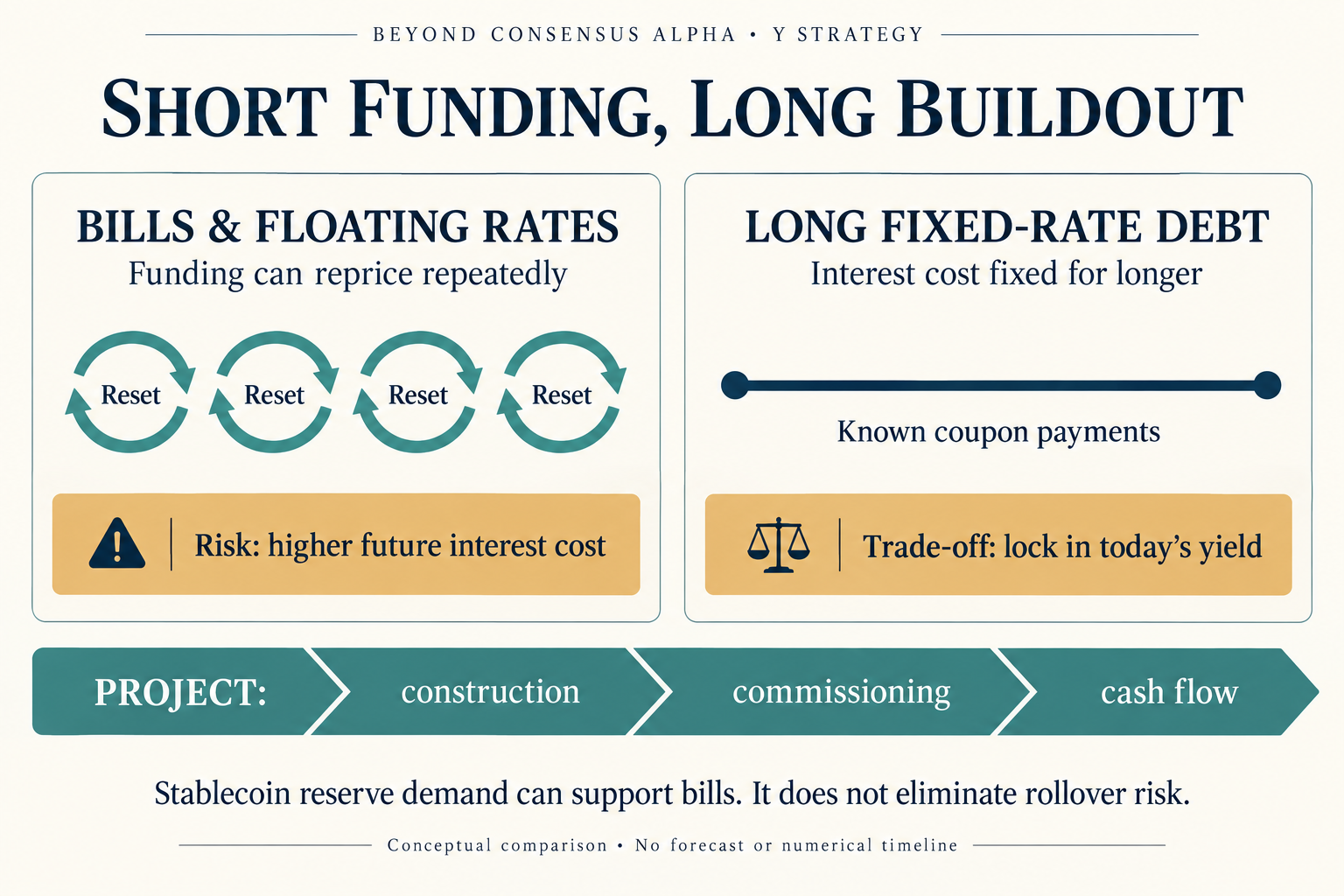
Short borrowing can be attractive when demand for liquid instruments is strong. But a lower current yield is not an assurance of lower total borrowing cost over a project’s life. Treasury must refinance bills as they mature; floating-rate debt passes changing short rates into interest expense even before principal matures.
Fact. Existing Treasury floating-rate notes mature in two years and reset their index to the latest 13-week bill auction rate, with a spread fixed at issuance. They are not SOFR-linked. See TreasuryDirect’s FRN description.
Fact. The February 3, 2026 Treasury Borrowing Advisory Committee minutes discuss dealer views on a possible SOFR-linked Treasury FRN. Supporters cited demand diversification; concerns included cannibalizing existing products and exposure to spikes in the secured overnight financing rate. Discussion is not issuance approval. See the TBAC minutes.
| Instrument | What it can offer the issuer | What it cannot remove |
|---|---|---|
| Long fixed-rate bond | Known nominal interest payments for a long period | The cost of locking in today’s yield |
| Treasury bill | Access to short-term demand | Frequent refinancing at uncertain future rates |
| Existing two-year FRN | Floating-rate investor demand with a two-year principal maturity | Rapid interest-cost repricing |
| Hypothetical SOFR FRN | A different investor and benchmark niche | SOFR basis, funding-stress and design risks |
A transparent sensitivity example is more useful than a precise rate forecast. If $1 trillion of financing is exposed to an average rate 2 percentage points higher than assumed, annual interest expense rises by roughly $20 billion once the full amount has repriced. At $5 trillion, the corresponding figure is $100 billion. This ignores timing and other offsets and is not a projection of actual issuance.
The source characterizes greater short-rate exposure as being “short volatility.” That is a useful metaphor for vulnerability to adverse repricing, but bills and FRNs are not literally options sold by Treasury. The concrete risks are refinancing frequency, floating-rate sensitivity and the possibility of high rates persisting longer than expected.
6. What would make the Bridge Regime succeed?
Speculation. The constructive scenario has three stages. First, short-end demand and effective intermediation accommodate funding while projects are built. Second, useful capacity comes online without destabilizing inflation expectations or private credit. Third, stronger productive performance and credible fiscal policy make it possible to refinance on durable terms and reduce excessive rate sensitivity.
These are conditional stages, not official milestones or a forecast that a particular year will deliver an exit. Nor is issuing longer debt automatically evidence of success: Treasury may lengthen maturities in adverse conditions to reduce rollover risk. The quality of the exit depends on cost, resilience and the underlying fiscal outlook.
Productivity gains do not guarantee a fall in long-term yields. Stronger returns on capital may raise equilibrium real rates. Inflation compensation or fiscal risk premiums could fall at the same time. The net result depends on which component dominates, so a successful Y Strategy need not be a simple long-bond trade.
The failure case is a bridge with no economic destination: financing keeps rolling, guarantees accumulate, and completed assets do not generate sufficient output or taxable income. Fiscal debt dynamics still depend on the interest-growth relationship and the primary balance. Better maturity management cannot substitute for that arithmetic.
7. Better market plumbing helps, but does not create output
Repo is secured short-term financing: one party provides cash against securities, with an agreement reversing the trade. Clearing, settlement and intraday liquidity arrangements determine how effectively cash and collateral move through the system.
Fact. The August 2026 TBAC report discusses intraday funding mismatches and potential improvements in liquidity distribution. It also notes that intraday repo is not yet widely adopted. These are market-structure discussions, not proof that a new financing system is already operating at scale. See the TBAC report.
Fact. The SEC’s August 2026 implementation update identifies December 31, 2026 and June 30, 2027 as the extended compliance dates for eligible Treasury cash and repo clearing, respectively. Scope and exemptions matter. See the SEC update.
Interpretation. Netting can reduce some gross exposures, and improved settlement can reduce cash trapped by timing mismatches. But clearing also concentrates risk at central counterparties and creates margin and default-management obligations. Faster turnover can transmit stress more quickly if participants rely on fragile funding.
“Collateral velocity” is a useful description of collateral reuse and settlement efficiency. It is not the V in MV = PY, which is income velocity for a specified money aggregate. There is a possible causal connection through intermediation and spending, not an accounting equivalence. Better collateral mobility does not mechanically create an equal amount of new bank credit, let alone physical production.
Likewise, tokenization changes the record and transfer mechanism, not the credit quality of the underlying claim. Legal finality, interoperability and reliable cash settlement must be demonstrated. The investment case is operational efficiency under stress as well as in normal times.
8. Financing construction is different from refinancing an operating asset
A new industrial project initially has uncertain costs and little cash flow. Once it is completed and contracted revenue is visible, a wider set of lenders may be willing to finance it. The financing stack can change as risks are resolved.
Interpretation. Development equity and specialist credit can support early work; construction loans can fund the build; term debt or infrastructure investors can finance operations. Securitization may pool qualifying loans or contractual receivables and distribute risks among investors. That is a possible project-finance sequence, not a claim that every data-center or power contract can become a standardized asset-backed security.
Commercial paper is generally short-term funding for creditworthy issuers or appropriately supported structures. It is not naturally suited to an uncompleted, unhedged multiyear project without dependable liquidity and refinancing support. A power-purchase agreement improves revenue visibility only to the extent that its customer, terms and enforceability are sound.
Securitization redistributes risk; it does not erase it. Completion guarantees, technology obsolescence, customer concentration and correlated electricity-price shocks can survive the packaging. Investors should identify the party bearing the first loss and test whether the structure still works if refinancing markets close.
9. Public liquidity is not an automatic project guarantee
Fact. Standing repo operations supply liquidity to eligible counterparties against qualifying securities to support policy implementation and market functioning. They are an existing operating tool, not a direct industrial-loan program. See the New York Fed’s facility explanation.
Fact. Historical facilities such as CPFF, PDCF and TALF addressed particular market stresses. Section 13(3) emergency programs must satisfy legal conditions, including broad-based eligibility and prior Treasury Secretary approval; they cannot simply be designed to rescue one insolvent company. See the Federal Reserve Act’s emergency-lending provisions.
Fact. In 2008, the TSLF Options Program offered options to borrow Treasury securities against eligible collateral over specified financing periods. This provides a historical example of contingent liquidity access. It is not an outstanding promise of a future Y-project rescue. See the New York Fed’s TSLF history.
Speculation. A future, legally authorized facility might use contingent terms to address broad market dysfunction. But a TALF-like facility for new categories of productive credit, or a modern TOP-style design, would require explicit decisions about eligibility, collateral, pricing, safeguards and any fiscal loss protection. Existing precedent alone does not confer access.
The clean analytical distinction is between a viable asset experiencing a temporary funding squeeze and a project whose expected cash flows no longer cover its obligations. In practice the boundary can be uncertain. Public liquidity can reduce fire-sale losses, while risk to taxpayers depends on collateral quality, haircuts and facility design. It is too strong to say the public always bears only liquidity risk and never credit risk.
10. Speculative extension: could Treasury hedge short-rate exposure?
Speculation—not current policy. If short-rate exposure became a dominant fiscal vulnerability, one could imagine pay-fixed, receive-floating swaps, rate caps or payer swaptions supplementing debt issuance. The source raises this as a research hypothesis. This series identifies no announced U.S. Treasury program implementing that strategy.
A pay-fixed swap could offset some floating-rate exposure, but introduces counterparty, collateral, margin and basis risks. A cap requires a premium. A swaption purchases a future choice at a cost. Scale, legal authority, budget treatment and governance would all matter, and ordinary fixed-rate issuance is an essential comparator.
No derivative manufactures fiscal capacity or guarantees cheaper funding. The Treasury Secretary’s professional background is not evidence that a particular instrument will be adopted. The base thesis should stand without this extension.
The financing test
The financial architecture is useful only if it helps viable investment survive the wait for productive cash flows at an acceptable total cost. More bill buyers, smoother settlement and credible liquidity arrangements can help. None produces a transformer, guarantees AI adoption or settles the government’s long-run budget.
To assess the Bridge Regime, follow net reserve demand, issuance and actual buybacks, principal maturity and rate-reset exposure, project completion, and the terms on which borrowers refinance. The central question is whether the system is reducing the time to useful output faster than it is accumulating fragile liabilities.
Read Part I for the productive-capacity framework and Part III for potential beneficiaries, failure signals and a practical investor dashboard.
Evidence and methodology
This article reconstructs the source report’s stablecoin, Treasury, dollar-network and three-layer financing analysis, including sections 10–12, 18–19 and 25–41. Dated official statements are linked beside factual claims. TBAC discussions are treated as advisory work, and historical facilities as precedents rather than active commitments. The Bridge Regime and sovereign-derivative extension remain conditional hypotheses. The interest-cost example is a sensitivity calculation, not a forecast.
Disclaimer
This article is for information and education and presents thematic analysis as of September 8, 2026. It is not personalized investment, legal or tax advice or an offer to transact. Bonds, derivatives, private credit and digital assets involve market, liquidity, credit and operational risks; losses can be substantial. Scenarios are illustrative and may not occur. Readers should verify current rules and assess suitability independently. No government support or investment outcome is promised.