
A global investor’s framework for separating capacity builders, financial enablers and overpriced promises.
Beyond Consensus Alpha | Flagship Series | Part III of III
Research cutoff: September 8, 2026.
Framework note: “Y Strategy” is this research’s analytical framework, not an official U.S. government program. It describes a possible interaction between public incentives, private finance and productive investment. Fact labels documented evidence. Interpretation labels our investment analysis. Speculation labels conditional scenarios. Sector discussions below are interpretations, not guaranteed beneficiaries or buy recommendations.
An investor can be right about America’s industrial expansion and still lose money in the companies building it. The equipment may be essential, the order book enormous and the policy support visible. None establishes that the current share price leaves an attractive return for the next owner.
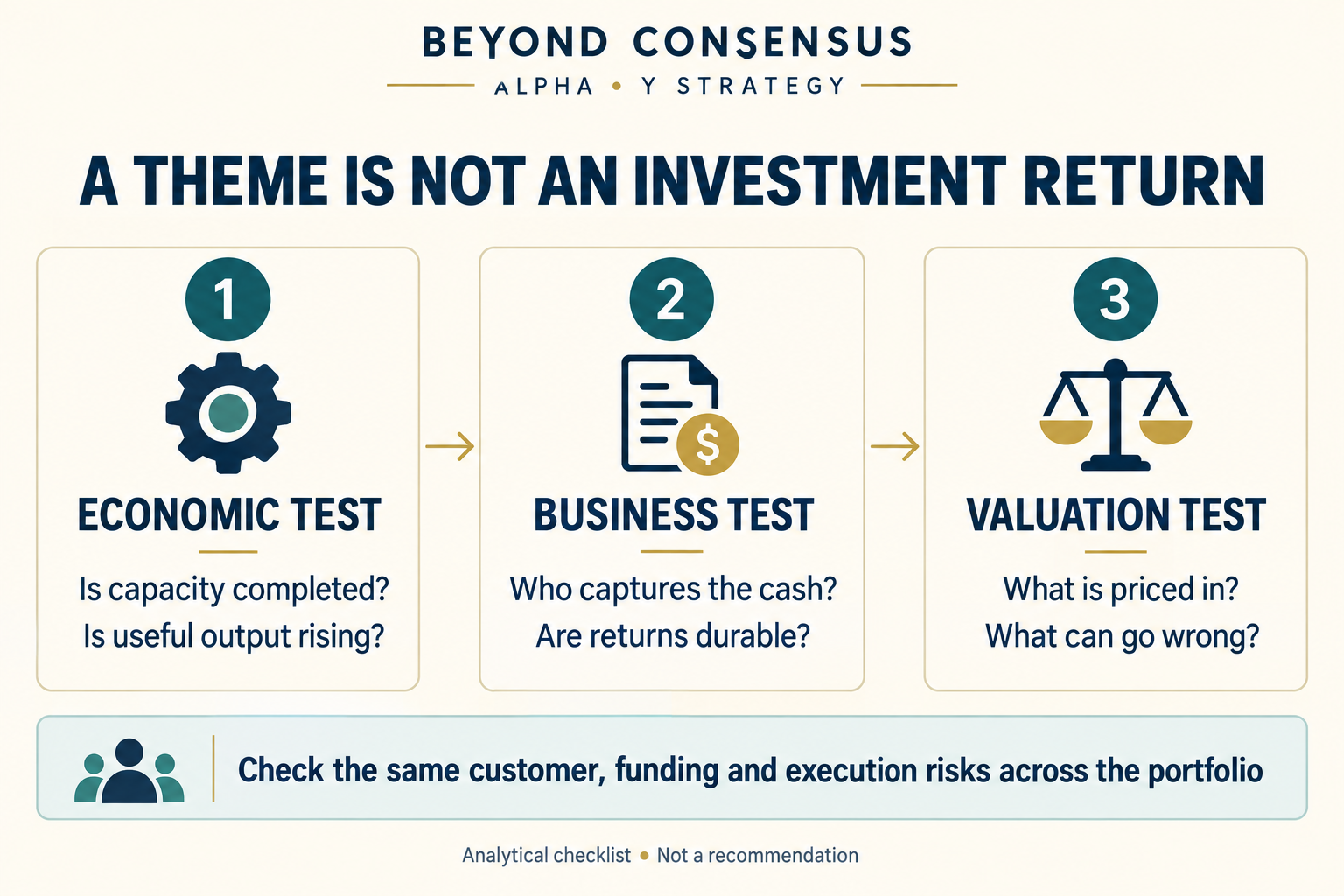
The Y Strategy therefore needs two tests. The economic test asks whether financing becomes useful production. The investment test asks who earns cash from that process, how durable the earnings are, and how much success the market has already priced in.
The framework starts with a conditional proposition: public incentives can improve private project economics; banks and markets can finance the buildout; monetary credibility and resilient funding can help the system survive the wait. Its payoff depends on completed grids, power facilities, factories and productive AI adoption. Its failure modes include inflation, delays, poor underwriting and ever more fragile refinancing.
For a global portfolio, the opportunity is broader than American technology shares. Equipment suppliers, contractors, lenders, infrastructure owners and overseas manufacturers can participate. Their exposures differ sharply, however, and the same policy can help one business while increasing another’s costs.
The portfolio framework
- Separate the buildout from the payoff. Suppliers can earn during construction; operators depend on utilization and customer economics.
- Separate scarcity from durable advantage. Today’s bottleneck can become tomorrow’s excess capacity.
- Separate business growth from investor return. Valuation, dilution, working capital and financing costs determine what shareholders receive.
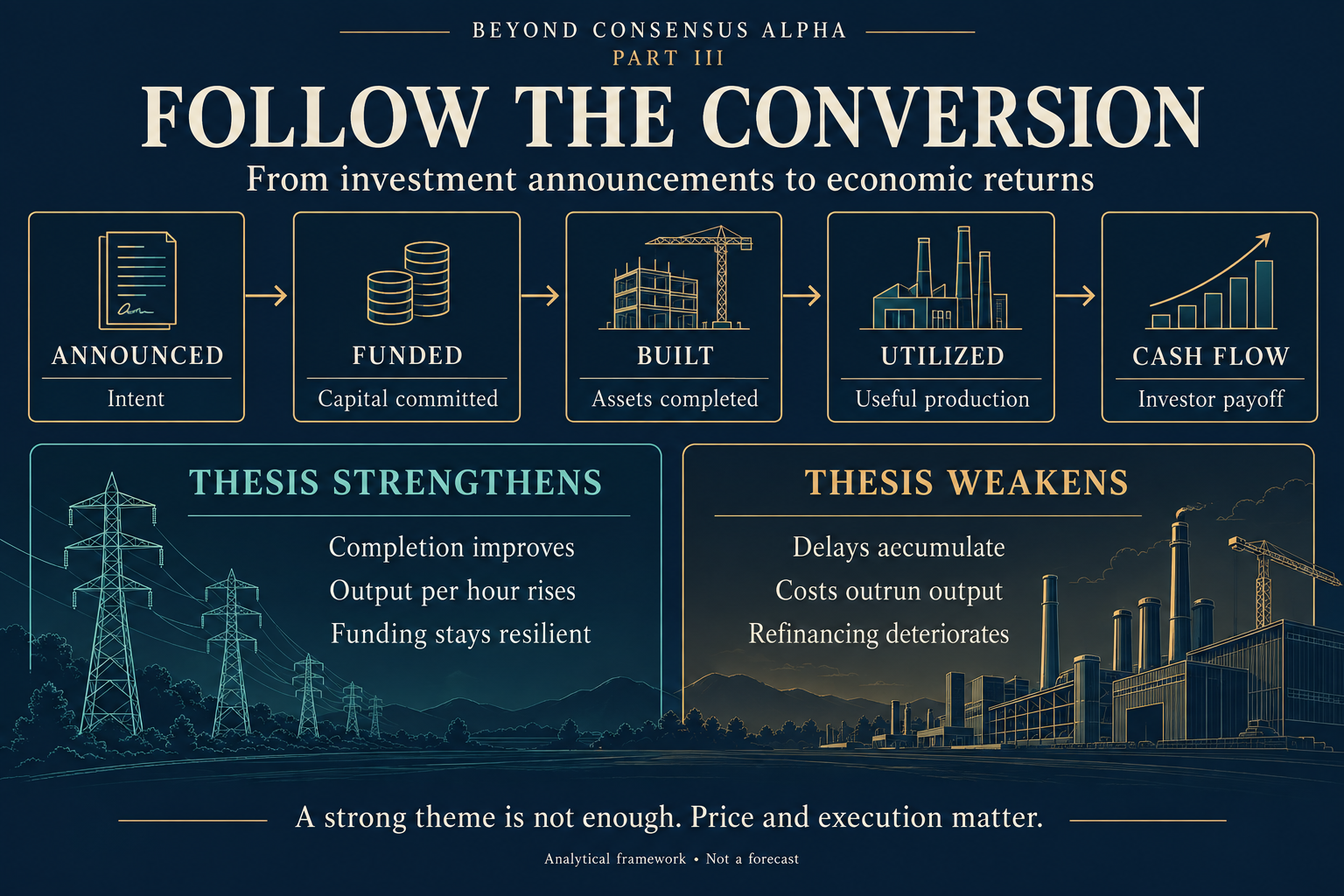
- Make the thesis falsifiable. Track completion, cash generation and funding quality, not just capex announcements.
In this article: Potential beneficiaries · Global suppliers · Bonds, gold and the dollar · Three scenarios · Monitoring dashboard · Underwriting discipline.
1. Potential winners along the conversion chain
Equipment that removes a physical constraint
Interpretation. Transformers, switchgear, transmission equipment, cooling systems, industrial water infrastructure and selected manufacturing tools can benefit when projects move from plans to orders. The attraction is their role in making other capital productive: an installed accelerator cannot compensate for an unfinished electrical connection.
The best evidence is not simply a growing backlog. Examine how much is contractually firm, when deliveries are scheduled, whether customers can cancel, and who bears material-cost escalation. A supplier may report strong orders while cash deteriorates because inventory and receivables rise faster than customer advances.
Pricing power also has a life cycle. If high margins attract new supply, a sound macro thesis can undermine its own earliest beneficiaries. Underwrite earnings at more normal lead times and margins as well as at current conditions. Expansion projects at suppliers deserve the same completion scrutiny as projects at their customers.
Generation, grids and infrastructure owners
Asset owners can capture longer-lived cash flows when the legal and commercial structure is sound. A regulated utility depends on allowed returns, rate-base treatment and the timing of cost recovery. A merchant generator depends more on power prices and contract coverage. An onsite provider adds customer concentration, fuel, maintenance and performance risks.
Battery storage requires a separate lens. It can shift electricity across time and provide services, but it is not a primary source of energy. Nameplate megawatts alone say little about duration, dispatch economics or firm availability. Compare usable service under the actual operating profile.
For AI-related developments, examine who pays for dedicated infrastructure if demand disappears. The Ratepayer Protection Pledge is a documented policy commitment; actual tariffs and contracts determine risk allocation. Do not value a broad pledge as though it were a signed take-or-pay agreement.
Semiconductors and the productivity of compute
Chips, memory, networking and advanced packaging participate in the buildout, but value can move between them as architecture changes. A business dependent on a particular configuration has a different risk profile from one serving several competing systems.
Track useful throughput, customer utilization and the total cost of delivering a workload. More hardware shipments can coexist with falling economics per unit if competition intensifies. Equally, lower compute costs can stimulate new demand. The result depends on demand responsiveness, not a universal rule that efficiency either destroys or expands the market.
Our related analysis of AI hardware, custom silicon, connectivity and power examines that moving constraint. The Y Strategy adds the financing and macro conditions under which customers can actually deploy those systems.
Banks and private credit
Financing growth can create origination fees and interest income. It can also hide deteriorating underwriting. A lender financing assets with long construction periods must assess liquidity commitments, completion protections and the borrower’s ability to refinance without optimistic growth assumptions.
Floating-rate loans can protect a lender’s contractual yield while weakening its customer’s debt-service coverage. Government-related language is not a substitute for reading the guarantee. For private credit, inspect payment-in-kind interest, covenant amendments, nonaccruals and the gap between reported income and cash collected.
Regulatory relief is not a blanket profit forecast. Funding costs, deposit competition and credit losses can offset additional balance-sheet capacity. The opportunity belongs to institutions with sound underwriting and funding, not automatically to the fastest-growing loan book.
Stablecoin and market-infrastructure businesses
Distribution, payments, custody, reserve management and settlement infrastructure may benefit from wider digital-dollar usage. But a token’s growing outstanding value is not the same as shareholder profit. Revenue sharing, compliance expenses, customer acquisition costs and competition can capture much of the gross reserve income.
Interest-rate exposure is especially important. A model dependent on earnings from short-term reserve assets may see income fall when rates decline, even if token circulation grows. Payment-fee businesses have different drivers. Map the specific business model before treating “stablecoins” as one investment category.
2. The opportunity for allied suppliers—and the localization hurdle
Interpretation. Korean memory, power-equipment, battery and engineering suppliers, Japanese industrial and electrical manufacturers, and European grid and automation businesses are natural research universes for an American capacity buildout. This is an exposure map, not a finding that every company in those groups qualifies for a particular program or will win orders.
The transmission has several gates: technical qualification, customer selection, procurement eligibility, local production requirements, factory capacity and execution. A strong order pipeline can be offset by tariffs, the cost of establishing U.S. production or unfavorable currency movements.
For global investors, distinguish the currency of revenues, production costs, debt and the investment itself. A company earning dollars but building a new American factory has different cash-flow sensitivity from an exporter whose costs remain mostly at home. A shareholder’s home-currency return adds another layer.
Local partnerships may improve access, but can also divide margins and increase capital commitments. Ask whether U.S. expansion raises sustainable return on invested capital after depreciation and working capital—not just whether it increases sales. The policy objective is domestic capacity; the shareholder objective is cash earned on the capital required to supply it.
3. A successful Y Strategy is not automatically bullish for long bonds
Long-term nominal yields reflect expected short rates and a term premium, with inflation and real-rate components embedded in those expectations. Faster productive growth may reduce inflation pressure while increasing investment demand and equilibrium real rates. Fiscal credibility can improve or deteriorate independently.
Interpretation. A long-bond rally is more persuasive when disinflation broadens, funding stress eases and net duration supply becomes easier to absorb. Stronger stablecoin demand alone is insufficient: its direct reserve demand is concentrated at the short end, and any effect on longer maturities depends on issuance choices and other investors.
A rise in real yields alongside strong project economics is different from rising inflation compensation accompanied by poor completion rates. Both can hurt long-duration asset prices, but they imply different underlying regimes. Model-based term-premium estimates can help organize this distinction; they are estimates, not directly observed truth. See the New York Fed’s ACM term-premium data.
Inflation-linked bonds also carry real-duration risk. They are not immune to mark-to-market losses when real yields rise. For investors outside the United States, currency hedging costs can materially change the relative appeal of nominal and inflation-linked debt.
Gold and the dollar are conditional exposures too
Gold may serve as an expression of concern about fiscal credibility or geopolitical uncertainty, but it does not reliably offset every equity or bond loss. Rising real yields and liquidity-driven selling can work against it. Its role should be tested against the actual portfolio risk rather than assumed from the word “hedge.”
The dollar faces competing forces. Better relative productivity and demand for dollar liabilities can support it, while fiscal concerns and changing rate differentials can work the other way. Digital-dollar adoption does not establish a one-way exchange-rate forecast. Network use and the currency’s market price answer different questions.
4. Three scenarios that can change the investment response
Speculation. The following are decision scenarios, not calibrated probabilities or dated forecasts. They replace the source report’s numerical odds, which are not supported by a reproducible estimation method.
| Scenario | Evidence to seek | Investment implication |
|---|---|---|
| Productive conversion | Completion and utilization improve; productivity broadens; funding remains durable | Favor demonstrated cash generation; reassess early scarcity premiums as supply catches up |
| Expensive transition | Orders and construction grow, but input costs and delays persist | Favor pricing protection and strong funding; stress-test leveraged developers and long-duration valuations |
| Funding outruns output | Refinancing weakens; projects are delayed or cancelled; losses migrate toward public support | Re-underwrite credit, liquidity and customer concentration; reduce reliance on a policy rescue |
The first scenario does not require every project to succeed. Some failures can demonstrate functioning capital discipline. Conversely, a temporary decline in commodity prices does not prove productive conversion; it may reflect demand destruction. Diagnose quantities, prices and credit conditions together.
An energy shock can interrupt any scenario. Monetary policy cannot immediately create replacement oil, shipping capacity or electricity. The key distinction is between an initial relative-price shock and persistent broader inflation. Fiscal and industrial measures may improve supply over time, while expectations and wage-setting determine part of the near-term propagation.
Fact. In his September 3 remarks, Governor Waller reported 12-month PCE inflation of 3.7% and core PCE of 3.3%, while describing recent disinflation and still-contained longer-term expectations. These were his assessment of then-available data, not evidence that inflation had already returned to target. See the Fed speech.
5. A monitoring dashboard that tests the thesis
This is a research workflow, not an automated live dashboard. Update it as releases arrive and preserve earlier data vintages. Revisions and reporting lags matter, particularly when comparing fast-moving financial variables with slow-moving physical completions.
| Question and frequency | Evidence and source | How to read it |
|---|---|---|
| Is credit available? Weekly and quarterly | Fed H.8, bank filings and loan surveys | C&I lending is a broad starting point; it includes uses other than new capacity |
| Is financing productive? Quarterly | Project disclosures, use-of-proceeds documents and lender reporting | Separate construction disbursements from refinancing; avoid securitization double counting |
| Are physical assets arriving? Monthly and quarterly | EIA Electric Power Monthly, utility and company milestones | Separate planned from actual additions, and nameplate capacity from reliable output |
| Is AI delivering useful output? Quarterly | Operator utilization, customer deployment and unit-economics disclosures | Energized megawatts establish access to power, not customer value or profits |
| Is productivity broadening? Quarterly | BLS productivity and costs | Look across several quarters and sectors; one release cannot identify AI’s causal contribution |
| Is Treasury risk shifting? At refundings and operations | Buyback announcements, accepted results and issuance schedules | Track duration-weighted net supply, maturity and rate-reset exposure separately |
| Is the dollar buyer base expanding? Monthly | Issuer reserve disclosures and transparent stablecoin circulation data | Estimate displacement of deposits and money funds; gross reserves are not net new demand |
| Is the inflation anchor holding? Monthly, with market monitoring | Long-horizon surveys, breakevens, real yields and term-premium estimates | Market measures include risk and liquidity premiums; corroborate across measures |
| Is funding resilient? Daily during stress | Standing repo operations, funding spreads, margin and credit conditions | Interpret facility usage with market conditions; normal usage alone is not failure |
Three composite questions organize the evidence: Is a larger share of financing reaching new productive assets? Is the same cohort of projects converting from announced to operating capacity? Is useful output expanding without destabilizing inflation and funding?
The Productive Credit Ratio proposed in the source is a useful discipline, but no official series supplies it ready-made. State the investment universe and time period, use consistent treatment of refinancing, and disclose missing data. A precise-looking ratio built from inconsistent disclosures can be less useful than a transparent qualitative assessment.
Define what would change your mind before the next headline
For a supplier, repeated shipment deferrals, rising cancellation rights or persistent cash-conversion deterioration should weaken the case even if reported backlog grows. For a project owner, slower commissioning, weak utilization or a refinancing requirement without committed funding matters more than the original announced capacity.
For the macro framework, deterioration across several dimensions is more persuasive than a single adverse release: credit grows, same-cohort completion stalls, inflation compensation rises and borrowers need repeated concessions. Conversely, stronger completions, improving output per hour and durable cash flows offer mutually reinforcing evidence.
Set thresholds appropriate to the security’s actual economics. A loan covenant or contractual commissioning deadline can be a meaningful trigger. An arbitrary universal threshold for all power, semiconductor and software projects is not.
6. Translate the theme into a security-level decision
Begin with revenues that depend on the buildout and the costs required to earn them. Then test the balance sheet and the price. An equipment company with customer advances and contractual cost pass-through differs from a developer paying floating interest on an uncompleted site, even if both appear in the same thematic basket.
A compact underwriting sequence is useful:
- Identify the paying customer. Distinguish contracted demand from a market-size projection.
- Locate the binding constraint. Determine whether the company removes it, owns it or merely depends on it.
- Stress execution and funding. Model delays, higher input costs, weaker utilization and unavailable refinancing.
- Normalize economics. Test margins after scarcity fades and maintenance or replacement spending rises.
- Check the valuation hurdle. Compare the cash-flow assumptions implied by the price with evidence, not the excitement of the theme.
For example, if a hypothetical project requires a year longer to commission, it loses a year of expected operating cash flow and incurs extra carrying costs. A guarantee covering part of lender principal may not compensate shareholders for dilution or lost returns. A correct view of the policy framework does not rescue an incorrectly priced capital structure.
Portfolio diversification also needs an economic test. Several positions labeled semiconductors, cooling, utilities and private credit may depend on the same small group of customers continuing aggressive capex. Model a common spending slowdown rather than assuming different sector labels provide independence.
Hedges should address a stated risk and include their cost. Cash reduces forced-selling exposure but sacrifices upside. Interest-rate hedges involve basis and rollover considerations. Commodity exposure can hedge some input inflation while introducing its own cyclical risk. This framework supplies questions for sizing and risk management, not a universal allocation.
What would count as winning?
The most attractive outcome is a sequence: finance reaches viable projects, projects become useful assets, useful assets raise output, and businesses convert that output into cash at returns above their cost of capital. Macro success and shareholder success overlap, but are not identical. Competition can pass productivity gains to customers while compressing supplier profits.
That is the investment discipline at the heart of America’s Y Strategy. Follow the conversion from announcement to cash flow, recognize where risk has moved, and remain willing to revise the thesis when the physical or financial evidence fails to arrive.
The full series follows one chain. Part I explains how public incentives can change private investment. Part II examines the financing architecture that carries the waiting period. This final part asks whether the resulting assets and securities justify the capital committed to them.
Evidence and methodology
This article reconstructs the source report’s asset-market implications, global supplier exposures, failure cases and dashboard, especially sections 14–24 and 37–42. Potential winners and portfolio responses are interpretations. Scenarios are uncalibrated possibilities without assigned probabilities or promised timelines. Linked official sources identify data and documented policy; no live valuation screen or company-specific earnings forecast is implied.
Disclaimer
This article is for information and education and presents thematic analysis as of September 8, 2026. It is not personalized investment advice, a model portfolio, or an offer or solicitation to buy or sell securities. Sector exposure does not establish suitability or attractive valuation. Equities, bonds, private credit, commodities and digital assets can incur substantial losses; overseas investing adds currency and jurisdictional risks. Scenarios may not occur. Readers should conduct independent research and obtain professional advice appropriate to their circumstances. Company references do not establish an author position.