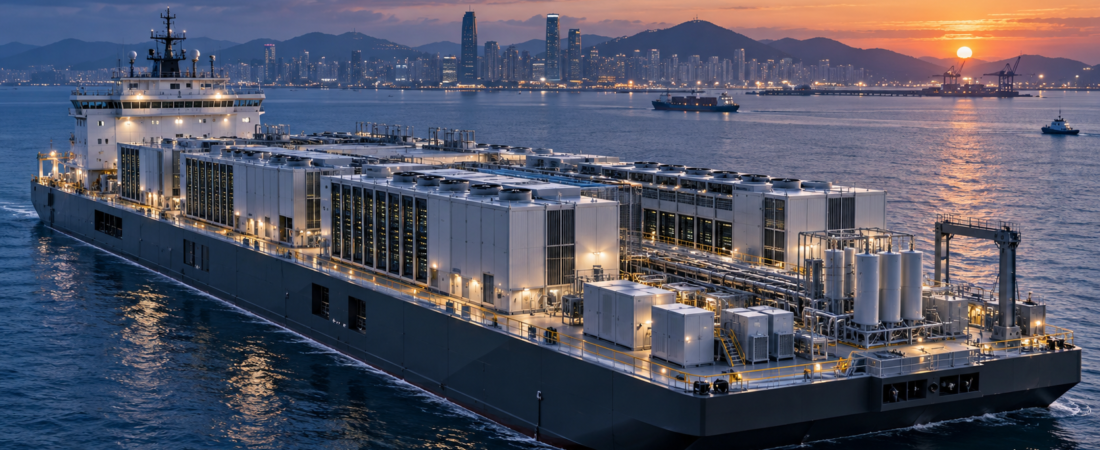
Power, water, land and politics are becoming simultaneous constraints. Floating data centers may not replace land-based campuses — but they could become an important new architecture, and Korea’s shipbuilders are moving early.
Theme View: Early-Stage, High Optionality
Data as of September 2026
For the past several years, the AI infrastructure trade has been defined by a familiar list of bottlenecks:
GPUs.
HBM.
Advanced packaging.
Networking.
Now the market is increasingly confronting another one.
Electricity.
But the story no longer stops there.
As AI data centers scale, the constraint set is broadening. Developers are running into not only power shortages, but also land scarcity, cooling complexity, water stress and rising political resistance from local communities. In other words, the next bottleneck may not be compute alone. It may be the ability to site and permit physical infrastructure fast enough to support AI demand.
That is where floating data centers, or FDCs, begin to look more interesting.
The key question is not whether data centers can float. They can.
The more important question is whether floating changes the economics of the bottlenecks that matter most in the next phase of the AI buildout: time-to-power, time-to-site, cooling efficiency and deployment speed.
If it does, then FDC may evolve from a futuristic concept into a real infrastructure category.
And if that happens, Korea’s shipbuilders may be better positioned than many investors currently assume.
The AI Buildout Is Becoming a Real-World Infrastructure Problem
Bloom Energy helped investors understand a critical shift in 2026.
When utilities cannot deliver capacity fast enough, the value of power is no longer defined only by cost per kilowatt-hour.
The megawatt that arrives first can be worth more than the cheapest megawatt.
That was the essence of the time-to-power trade.
But the same logic is now spreading beyond on-site generation. Even if developers are willing to secure private power, they still face the practical challenge of where to put the data center, how to cool it and how to get it approved.
As projects get larger, the externalities become harder to ignore:
- rising local electricity demand,
- greater pressure on water resources,
- larger land footprints,
- noise and backup generation concerns,
- transmission buildout requirements,
- and the political risk of communities asking why they should bear the cost.
This is why the data-center debate is becoming more visible in public policy and local politics. AI demand remains very real, but the social and physical friction around hyperscale development is rising with it.
That does not mean AI infrastructure stops.
It means alternative architectures become more valuable at the margin.
Why Floating Data Centers Matter More Now Than They Did a Year Ago
Floating data centers have existed as a concept for years. What has changed is the quality of the commercialization signals.
In Korea, the theme is no longer theoretical.
Samsung Heavy Industries has moved its U.S. floating data center cooperation with Mousterian into an engineering contract for 50MW-class moored units.
HD Korea Shipbuilding & Offshore Engineering has partnered with Schneider Electric to jointly develop core floating data center infrastructure covering power, cooling and control systems.
And Hanwha Ocean has now entered the field with a 60MW-class FDC model, emphasizing modularity, offshore power flexibility and seawater-based cooling.
That progression matters.
The story is no longer simply, “someone drew a rendering.”
The story is that the industry is beginning to define actual configurations, actual engineering pathways and actual commercialization questions.
The next step, of course, is still the most important one:
real customers, real contracts and repeatable orders.
Reason 1: FDC Could Help Relieve the Siting and NIMBY Problem
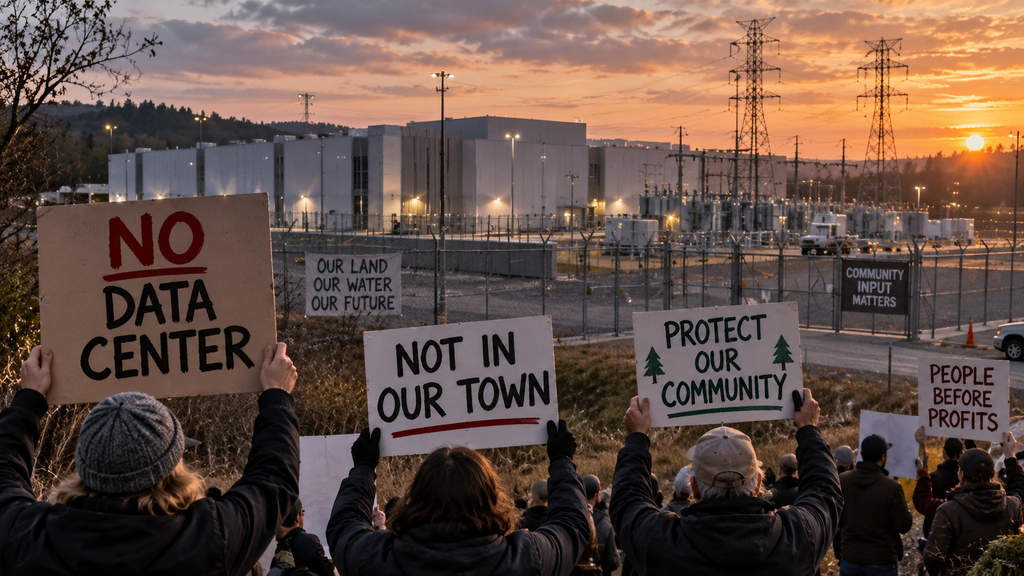
The first reason FDC deserves attention is political as much as technical.
Traditional land-based data centers are becoming harder to hide. The larger they get, the more they begin to resemble heavy infrastructure projects rather than invisible digital utilities. That raises the probability of opposition from nearby communities concerned about electricity prices, land use, water consumption and environmental impact.
In that context, FDC should not be seen as a magical way to avoid regulation. Offshore and port-adjacent projects have their own permitting burdens, marine standards and environmental constraints.
But they do offer something important:
greater siting flexibility.
A floating facility can potentially place computing capacity closer to coastal demand centers, port infrastructure, fiber routes or power access points without requiring the same land acquisition profile as a large inland campus.
That matters because the real value of FDC may not be that it replaces every land-based data center.
It may be that it provides a new siting option precisely when conventional siting is getting more difficult.
From an investor’s perspective, this is the right way to frame the theme.
Not as “the ocean replaces the land,”
but as:
“the ocean becomes one more viable infrastructure layer.”
Reason 2: Cooling and Water Could Become an Underappreciated Advantage
If power is one side of the AI infrastructure problem, heat is the other.
Higher rack densities mean more heat rejection, more cooling complexity and, in many regions, more pressure on water use. This is one reason the cooling side of the infrastructure stack has become increasingly strategic.
Here, FDC may have a genuine structural advantage.
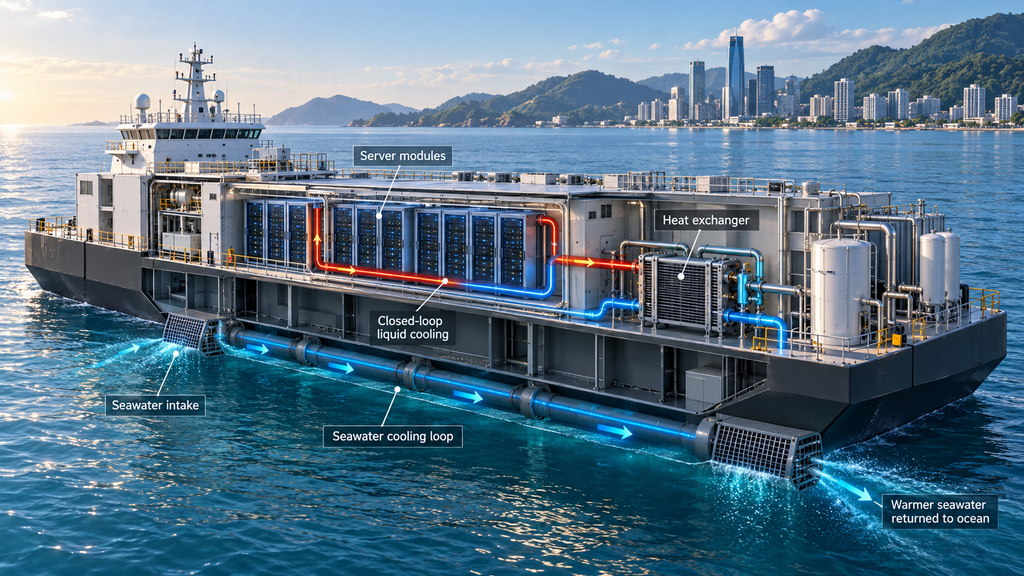
The point is not that seawater is pumped directly through sensitive computing equipment. Rather, an FDC can use a closed-loop internal cooling system connected to heat exchangers, with seawater acting as a large external heat sink.
That potentially changes the economics of cooling in three ways:
- Lower mechanical cooling burden
Access to a large external water body can reduce the need for energy-intensive cooling infrastructure. - Lower freshwater dependency
In water-stressed regions, reducing consumptive freshwater use can become a meaningful siting advantage. - Smaller thermal-management footprint
The surrounding marine environment may allow more efficient heat rejection than some land-constrained sites.
This does not mean cooling is free.
Marine biofouling, corrosion, environmental discharge standards and pumping requirements all matter. But the cooling thesis is strong enough that investors should treat it as a core part of the FDC opportunity rather than a marketing footnote.
And this is especially relevant now because the AI debate is no longer only about chips. It is increasingly about how to remove heat from those chips at scale.
Reason 3: FDC Extends the Logic of Time-to-Power
Bloom Energy showed that the market will pay for speed.
FDC may benefit from a related but slightly broader logic.
Traditional development often begins with a simple assumption: build the data center where you want it, then solve power, cooling and site preparation around it.
Floating infrastructure allows for a different question:
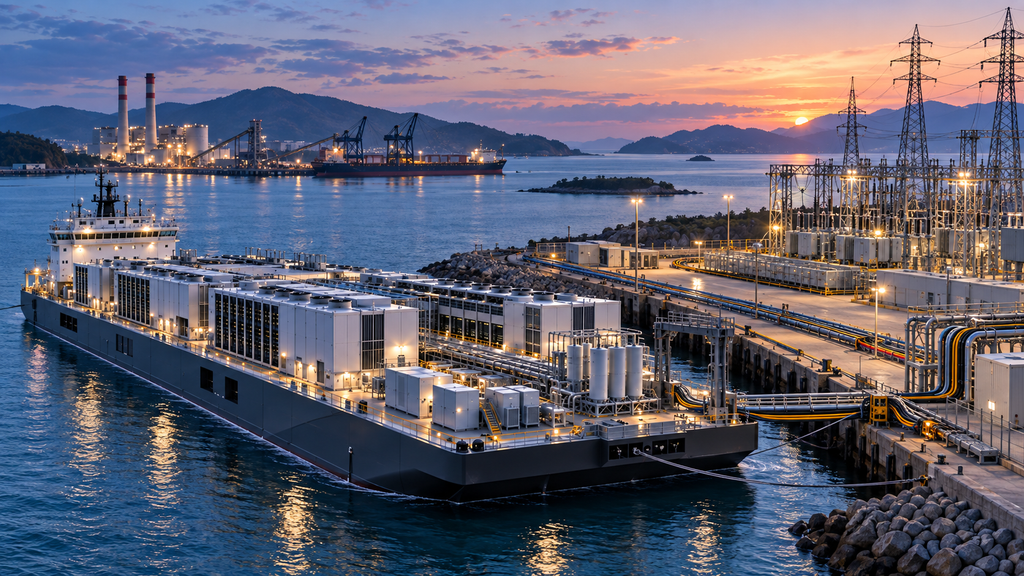
Can the data center move closer to where the infrastructure already exists?
That could mean locating near existing coastal industrial sites, power assets, water access points or port facilities. In some cases, it could also allow for hybrid architectures — connecting to nearby power sources where available, or pairing with independent offshore or barge-based generation where necessary.
This is where recent Korean developments become important.
Samsung Heavy Industries’ project-first approach appears aimed at bringing floating capacity to real deployment.
HD Hyundai’s ecosystem approach suggests the value chain could extend beyond the hull to engines, power modules, integration and ultimately after-market services.
Hanwha Ocean’s modular approach implies flexibility in matching different site and customer conditions.
All three approaches are, in different ways, addressing the same commercial question:
How do we shorten the path from AI demand to live computing capacity?
That is why FDC should be understood not simply as a marine engineering curiosity, but as part of the broader time-to-infrastructure trade.
Reason 4: The Shipyard Could Become a Data Center Factory
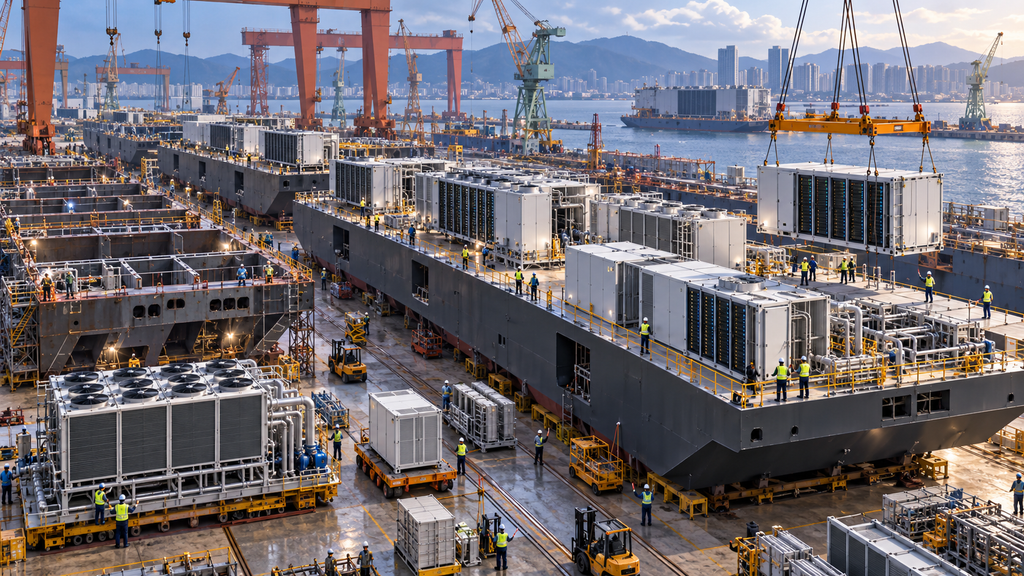
For an Asia-focused investor, this may be the most interesting part of the story.
A conventional data center is primarily a construction project.
A successful FDC platform could become something closer to a manufactured product.
That distinction matters.
If every FDC must be engineered from scratch, the business may remain niche and project-based, more similar to offshore EPC than scalable productization.
But if the industry converges toward a repeatable base design — where major platform architecture is standardized and power systems, server modules and capacity are swapped in modular form — then the economics could become much more attractive.
This is where the Korean shipbuilding industry could have a real edge.
Shipyards already understand how to do the following at industrial scale:
- fabricate large steel platforms,
- integrate complex piping and electrical systems,
- coordinate modular block assembly,
- manage delivery schedules for massive engineered products,
- and repeat high-specification builds in controlled industrial environments.
That capability set overlaps more with FDC than many investors may initially appreciate.
In other words, the FDC theme is not just a data center story.
It is also a manufacturing and industrialization story.
For Korean shipbuilders, the prize is not the first floating data center.
The prize is the second, third and tenth unit built off a repeatable platform.
That is when the business stops being conceptual and starts becoming a product line.
Land-Based Data Center vs. Floating Data Center
The FDC thesis is not that floating infrastructure wins on every metric.
Its potential advantage is that it changes the trade-off between site availability, power access, cooling, water use and construction methodology.
| Constraint | Traditional Land-Based Data Center | Potential FDC Advantage | Key Caveat |
|---|---|---|---|
| Land / Siting | Requires large contiguous sites, often near transmission and fiber infrastructure | Adds water-adjacent and offshore locations to the available site pool | Port access, marine zoning and offshore permitting remain necessary |
| Power Access | Often dependent on utility interconnection and new transmission infrastructure | Compute can potentially be moved closer to existing coastal generation or paired with dedicated power assets | FDC does not eliminate the need for generation; it changes where and how power can be accessed |
| Cooling | High-density AI workloads require increasingly complex air or liquid-cooling infrastructure | Large surrounding water bodies can serve as an external heat sink through closed-loop heat-exchange systems | Corrosion, biofouling, pumping energy and thermal-discharge regulations must be managed |
| Freshwater | Some cooling architectures can place meaningful demand on local water resources | Non-evaporative or seawater-assisted designs could materially reduce potable-water consumption | Performance depends on the cooling architecture and local environmental requirements |
| Construction | Much of the project is built and integrated at the final site | Shipyard fabrication could allow modules and infrastructure to be assembled in controlled conditions while site work proceeds in parallel | Cost benefits depend on achieving genuine standardization and repeat production |
| Community Impact | Large campuses concentrate land use, grid demand, noise and infrastructure requirements in one community | Alternative siting may reduce some local land and noise conflicts | Marine projects create a different set of environmental and stakeholder issues |
| Scalability | Expansion often requires additional land and utility capacity at the same site | Modular floating units could potentially add capacity in discrete blocks | Repeatability has not yet been commercially proven at hyperscale |
The distinction is important.
FDC does not need to beat land-based data centers everywhere.
It only needs to become economically superior in locations where one or more traditional constraints — power, land, water, cooling or permitting — become sufficiently expensive or time-consuming.
That is why we view FDC less as a replacement technology and more as an additional infrastructure architecture for an increasingly constrained AI buildout.
Three Korean Routes Into the Same Market
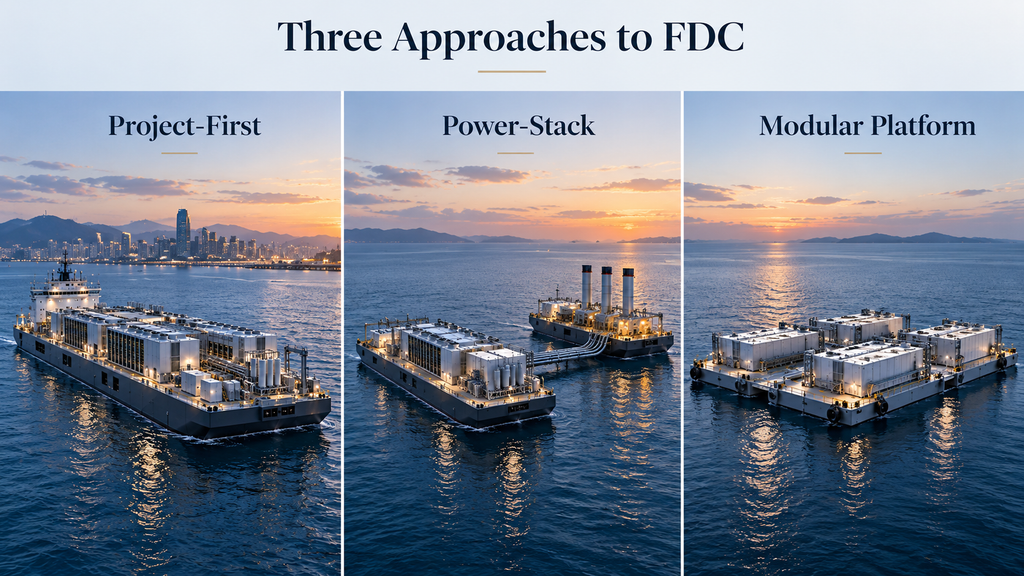
Our Framework: Three Emerging Routes to FDC Commercialization
The labels below — Project-First, Power-Stack and Modular Platform — are our analytical framework rather than terminology formally used by the companies themselves.
We use them to distinguish how Korea’s three major shipbuilding groups appear to be approaching the same emerging market from different starting points.
Samsung Heavy Industries is pushing the project itself toward execution. HD Hyundai is building around a broader power and infrastructure stack. Hanwha Ocean is emphasizing platform flexibility and modularity.
These approaches may ultimately converge as the market matures. For now, however, they provide a useful framework for identifying where each company could capture value if FDC moves from engineering concepts to repeatable commercial orders
One of the most notable developments is that Korea’s three major shipbuilding groups are not taking identical paths. That is useful, because it gives investors an early framework for how the market may evolve.
Samsung Heavy Industries: Project-First
Samsung appears furthest along the commercialization path. Its progress with Mousterian matters because it has already moved beyond concept language into engineering scope. The next milestones will be whether engineering converts into FID, EPC and ultimately construction and operation.
HD Hyundai: Power-Stack and Ecosystem
HD Hyundai may have the broadest optionality. The FDC theme can touch not only the floating platform itself, but also power integration, engines, electrical systems and potentially after-market maintenance if installed power assets remain in service for long periods.
Hanwha Ocean: Modular Platform
Hanwha Ocean’s emphasis on a 60MW-class modular platform is interesting because early markets are rarely standardized. In that environment, modularity can be a commercial advantage — provided it still allows enough commonality to support repeat production.
The key point is that these are not mutually exclusive paths.
Different customers may want different architectures depending on:
- whether grid power is accessible,
- whether self-generation is needed,
- how much cooling capacity is required,
- how close the site is to an urban load center,
- and how quickly deployment must occur.
That is why the next phase of analysis should focus less on who announced a concept and more on whose approach becomes commercially repeatable.
What Investors Should Watch Next
This theme is becoming more investable, but it is still early. The right checklist is therefore very practical.
1. Engineering to contract conversion
Engineering studies and approvals are useful, but real commercial validation starts when projects progress into binding orders.
2. The first operating references
A single live project matters because it proves more than technical feasibility. It proves customers are willing to trust the model.
3. Repeat orders using similar architecture
This is the most important signal. A repeated platform suggests the market may support standardization and industrialized production.
4. The power configuration
Will projects rely on existing nearby infrastructure, offshore self-generation or hybrid systems? This question directly affects the value pool across shipbuilders, engine suppliers and infrastructure providers.
5. Economics
Ultimately, the market will need evidence that FDC can offer either faster deployment, better cooling economics, better site flexibility or some combination strong enough to offset marine complexity.
What Could Go Wrong
This is not a no-risk theme.
Floating data centers still face meaningful uncertainties:
- marine permitting,
- mooring and storm resilience,
- corrosion and maintenance,
- network and fiber redundancy,
- insurance and financing complexity,
- environmental constraints,
- and the possibility that many AI workloads still favor giant land-based campuses.
There is also a narrative risk.
Because the theme is visually compelling, investors may be tempted to get bullish too early simply on announcements. That would be a mistake.
The real inflection point is not concept proliferation.
It is commercial repetition.
Until then, FDC remains a high-optionality theme rather than a proven volume market.
Conclusion: FDC Is Not Replacing Land — It Is Expanding the Infrastructure Map
The most useful way to think about floating data centers is not as a total substitute for land-based AI infrastructure.
It is as a new infrastructure option emerging at a time when the traditional model is under growing strain.
Power access is harder.
Cooling is more important.
Water is more sensitive.
Land is scarcer.
Permitting is slower.
Community scrutiny is rising.
Against that backdrop, FDC is becoming easier to take seriously.
The commercialization funnel is now beginning to form.
Samsung Heavy Industries is pushing into engineering.
HD Hyundai is widening the power and infrastructure stack.
Hanwha Ocean has now entered with a modular 60MW platform.
That does not guarantee a large market.
But it does mean the market is now important enough to watch with discipline.
For Asia investors — and especially for those already strong in shipbuilding — the appeal is obvious.
If floating data centers become real, this may not just be another AI story.
It may become a new Korean industrial story inside the AI buildout.
And in that scenario, the most important milestone will not be the first floating unit.
It will be the moment the market orders the second one.
Selected Sources
- Company disclosures and public materials from Samsung Heavy Industries, HD Korea Shipbuilding & Offshore Engineering, Schneider Electric and Hanwha Ocean
- Industry commentary and prior research on AI power bottlenecks, time-to-power and alternative data center architectures
- Prior framework work on Bloom Energy, distributed AI infrastructure and community resistance as a long-term constraint on data center expansion
Disclaimer
This article is provided for informational and educational purposes only and reflects the author’s personal views as of the date of publication. It does not constitute investment advice, investment research, a solicitation, or a recommendation to buy or sell any security or financial instrument.
The information contained herein has been obtained from sources believed to be reliable, including company disclosures, industry materials, prior research and publicly available information, but its accuracy or completeness is not guaranteed. Certain statements in this article — including views on future market adoption, repeat orders, cooling advantages, modular production, deployment economics and potential commercial outcomes — are estimates, interpretations or forward-looking scenarios rather than confirmed results.
Floating data centers remain an emerging area and many of the developments discussed are still at the concept, engineering, approval or early commercial stage. Actual adoption may differ materially from current expectations.
The author may hold, initiate, increase, reduce or exit positions in securities discussed in this article without notice. Readers should conduct their own research and consult an appropriately licensed financial professional before making investment decisions. Past performance is not indicative of future results.