
AI scarcity is spreading beyond GPUs and HBM. The next constraint may be hiding in the programmable chips that connect, control, and even help test the AI infrastructure boom.
For most of the AI cycle, semiconductor shortages have followed a familiar sequence.
First it was GPUs.
Then HBM.
Then advanced packaging.
Then optical networking, power equipment, transformers, and cooling.
Now another, much less visible component is beginning to tighten:
FPGAs.
Field-programmable gate arrays rarely attract the same investor attention as GPUs or memory. They are generally not the most expensive component inside an AI server, nor are they the primary engines performing AI training.
But that misses their importance.
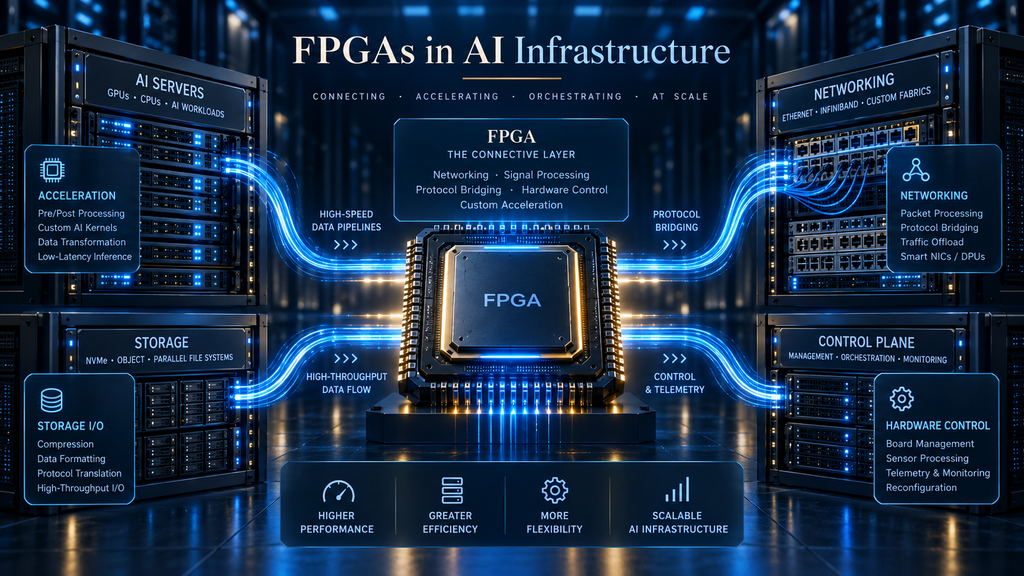
FPGAs increasingly sit in the connective tissue of modern computing systems — handling networking, protocol conversion, signal processing, hardware control, security, storage acceleration, and real-time data movement.
More importantly, they also sit inside the semiconductor test equipment required to manufacture and validate many of the chips powering the AI boom.
That makes the emerging FPGA shortage more than another semiconductor supply-chain story.
It may be another sign that the AI infrastructure buildout is entering a new phase:
The bottleneck is spreading from the chips that perform AI computation to the components required to connect, control, manufacture, and test the entire system.
AI Demand Is Moving Beyond the GPU
The scale of the AI infrastructure buildout remains extraordinary.
TrendForce estimates that the combined 2026 capital expenditure of the world’s nine largest cloud service providers — Google, Amazon, Meta, Microsoft, Oracle, ByteDance, Tencent, Alibaba, and Baidu — will exceed $886.7 billion, approximately 90% higher year over year.
The firm also recently raised its forecast for 2026 AI-server shipment growth from 28% to nearly 31%.
But an AI cluster is not simply a warehouse filled with GPUs.
Every additional accelerator requires infrastructure around it:
networking,
storage,
power management,
telemetry,
security,
signal processing,
board-level control,
and high-speed interfaces connecting increasingly heterogeneous compute architectures.
As AI clusters become larger, denser, and more complicated, the semiconductor content required around the accelerator grows as well.
That is where FPGA demand starts to become interesting.
What Does an FPGA Actually Do?
An FPGA sits somewhere between a general-purpose processor and a custom ASIC.
A CPU is extremely flexible because it can execute software across many workloads, but it operates through a predefined architecture.
An ASIC can be optimized for extraordinary performance and efficiency, but once manufactured its hardware functionality is largely fixed.
An FPGA offers something different:
hardware that can be reconfigured after manufacturing.
This allows system designers to implement specialized functions without waiting for an entirely new custom chip to be designed and taped out.
That flexibility becomes particularly valuable when hardware architectures are changing rapidly.
And few architectures are changing more rapidly today than AI infrastructure.
AMD’s Versal adaptive SoCs, for example, combine programmable logic with processors, high-speed networking interfaces, memory connectivity, DSP capabilities, and integrated network-on-chip infrastructure. AMD positions the platform across cloud, networking, storage, and heterogeneous acceleration workloads.
Lattice Semiconductor is pursuing a different layer of the system.
Its low-power FPGAs can operate as always-on control devices inside AI servers — performing tasks such as power sequencing, board-level coordination, protocol bridging, telemetry, and real-time fault response.
Microchip’s PolarFire platform targets another portion of the market, combining low-power programmable logic with real-time processing and high-speed connectivity for edge AI, industrial, communications, aerospace, and embedded workloads.
The common denominator is simple.
GPUs perform the headline computation.
FPGAs increasingly help everything around them work.
Why Is FPGA Supply Tightening?
The important distinction is that this does not appear to be a universal shortage of every FPGA.
Rather, pressure is emerging in particular product families, configurations, and manufacturing nodes.
That distinction matters.
The strongest investment thesis is not:
“Every FPGA is running out.”
It is:
AI infrastructure demand is increasing consumption of strategically important FPGA categories while the supply response is structurally slower than demand.
Several forces are converging.
1. AI Infrastructure Is Creating Incremental FPGA Demand
The first mechanism is simply volume.
More GPUs mean more servers.
More servers mean more networking.
More networking means more packet processing, protocol translation, storage interfaces, control functions, telemetry, and high-speed signal management.
At the same time, AI hardware is becoming more heterogeneous.
A modern cluster might contain GPUs, custom ASICs, CPUs, DPUs, NICs, optical components, storage accelerators, and multiple generations of hardware operating together.
Connecting those pieces creates demand for flexible hardware.
That is precisely where programmable logic becomes useful.
Altera CEO Raghib Hussain said in July that the company had returned to roughly 20% annual growth, with AI and robotics helping drive renewed demand for programmable chips used alongside GPUs for connectivity, preprocessing, and sensor-fusion workloads.
This is an important signal.
AI is no longer benefiting only the semiconductor components doing the compute.
It is starting to pull demand through the infrastructure surrounding the compute.
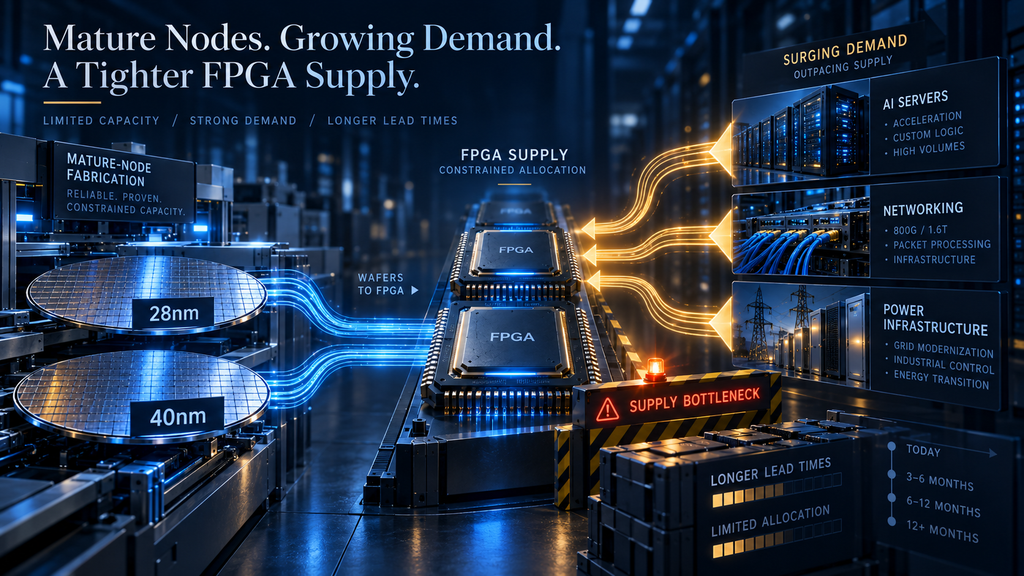
2. The Shortage Is Appearing in Mature Nodes
This is perhaps the most interesting part of the thesis.
AI investors usually associate the boom with leading-edge semiconductor manufacturing.
3nm.
2nm.
HBM.
Advanced packaging.
CoWoS.
But much of the infrastructure surrounding those leading-edge accelerators does not need to be manufactured on the latest process node.
TrendForce specifically notes that AI-driven demand is increasing wafer consumption for 40nm and 28nm FPGAs, alongside other mature-node products.
At the same time, foundries are reducing, consolidating, or reallocating portions of mature-node capacity.
TrendForce expects those dynamics to keep 12-inch mature-node utilization tight well into 2027.
This creates an important paradox:
the world’s most advanced AI systems can still be constrained by chips manufactured on technology developed many years ago.
The reason is straightforward.
A $30,000 accelerator cannot function as part of a complete system if a relatively inexpensive but indispensable controller, networking component, or interface chip is unavailable.
The dollar value of a component does not determine its importance.
Its substitutability does.
3. FPGA Has High Switching Costs
This is the second structural characteristic investors should understand.
FPGAs are not always easily replaceable.
A system may have been designed around a specific:
architecture,
package,
I/O configuration,
speed grade,
power envelope,
temperature range,
development environment,
and qualification standard.
Replacing the device can mean rewriting firmware or FPGA logic.
PCB layouts may need modification.
Timing must be validated again.
Software needs to be tested.
And industrial, medical, aerospace, automotive, and communications customers may need to repeat qualification procedures.
This makes FPGA shortages fundamentally different from shortages in highly commoditized components.
Even if another FPGA is theoretically available, switching may not be practical.
The result is low short-term elasticity of substitution.
And that is exactly the characteristic that can turn a relatively small semiconductor into a meaningful bottleneck.
The Most Important Signal: Test Equipment Is Being Hit Too
This is where the FPGA story becomes much more important than it initially appears.
DIGITIMES reported in June that semiconductor test-equipment manufacturers were facing shortages of critical components including FPGAs, CPUs, GPUs, and driver ICs, with lead times extending sharply as AI and data-center demand tightened the broader semiconductor supply chain.
Think about the implication.
FPGAs are not only being consumed by AI servers.
They are also used in the equipment required to test the chips that go inside those servers.
That creates the possibility of a second-order bottleneck.
The feedback loop looks like this:
AI demand rises
→ more GPUs, CPUs, memory, networking chips and ASICs are required
→ semiconductor manufacturers expand capacity
→ more testing capacity is needed
→ test-equipment manufacturers require more FPGAs and CPUs
→ those components themselves become constrained
→ test-equipment deliveries can slow
→ semiconductor capacity expansion becomes harder.
That is a very different problem from simply saying:
“FPGA demand is strong.”
It suggests that shortages can become recursive.
The infrastructure needed to relieve the semiconductor shortage can itself become constrained by semiconductor shortages.
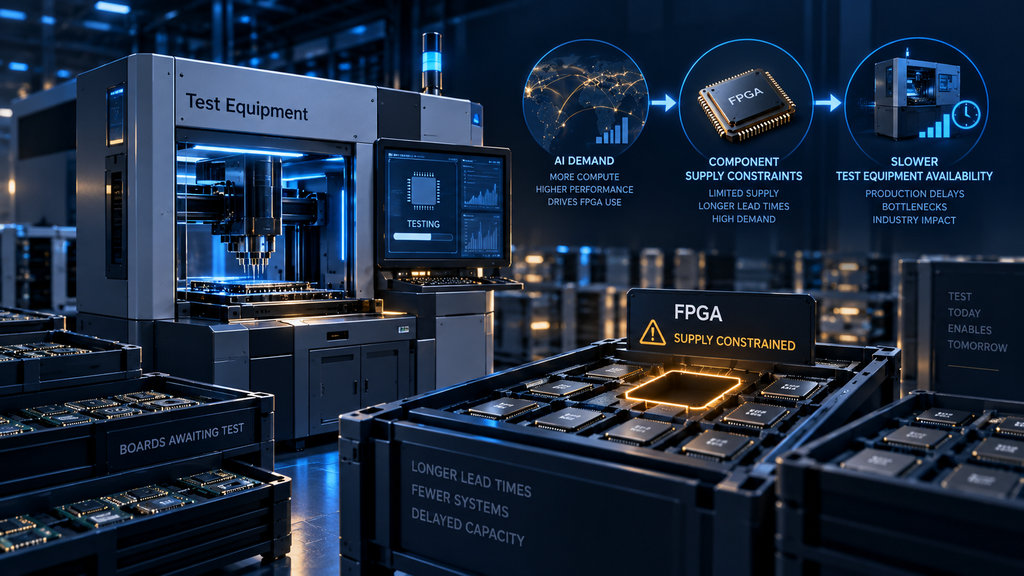
This is why the test-equipment story deserves investor attention.
An FPGA may represent only a small fraction of the value of a semiconductor testing system.
But if that FPGA is unavailable, the entire machine cannot ship.
And without the machine, additional semiconductor capacity cannot be qualified and ramped as quickly.
In infrastructure cycles, the smallest indispensable component often determines the pace of expansion.
AI Infrastructure Is Becoming an “Everything” Cycle
This FPGA shortage fits into a much broader pattern.
The first phase of the AI trade was concentrated.
Investors could largely focus on a handful of obvious bottlenecks:
GPU compute.
HBM bandwidth.
Advanced packaging.
But the physical system required to deploy AI at enormous scale is far larger.
As deployment expands, scarcity has progressively moved outward:
GPU → HBM → packaging → optical networking → power → cooling → control → test equipment.
FPGA belongs somewhere inside that expanding circle.
This does not mean FPGA will become another HBM-sized market.
That is not the thesis.
The more important conclusion is that AI infrastructure demand has become sufficiently large to influence semiconductor categories far away from the original accelerator.
That gives us another way to judge the durability of AI CAPEX.
If AI demand were narrow or temporary, shortages should remain concentrated in the most obvious high-end components.
Instead, we are increasingly seeing pressure across multiple layers of the physical infrastructure stack.
That breadth is significant.
Networking Makes FPGA More Important
Another structural trend strengthens the FPGA thesis:
the increasing importance of data movement relative to pure computation.
As AI clusters grow, moving data between processors becomes increasingly difficult.
Training requires enormous east-west traffic between accelerators.
Distributed inference requires coordination across processors.
Agentic systems can generate many simultaneous model interactions.
Custom ASICs introduce additional heterogeneous hardware into the cluster.
The result is a rapidly expanding networking problem.
AMD’s Versal platform integrates programmable networking functions and high-speed Ethernet capabilities designed for workloads requiring flexible data movement and low latency.
This creates a broader architectural shift.
The value of AI compute increasingly depends on the infrastructure connecting that compute.
The faster GPUs become, the more expensive it becomes to leave them waiting for data.
And the more heterogeneous AI hardware becomes, the more valuable flexible interfaces become.
That does not eliminate ASICs.
In fact, the opposite is likely.
As workloads stabilize, ASICs will increasingly replace programmable solutions in high-volume functions where economics justify customization.
But rapidly changing architecture creates a persistent role for FPGA:
bridging the gap between today’s hardware and tomorrow’s optimized ASIC.
That makes FPGA particularly useful during periods of rapid technological change.
Three Public Stocks Positioned to Benefit
The shortage itself should not automatically be interpreted as positive for every FPGA vendor.
If supply constraints prevent a manufacturer from shipping products, scarcity can hurt revenue rather than help it.
The real investment question is:
Which companies combine rising FPGA demand with product positioning, pricing power, new design wins, and the ability to actually deliver supply?
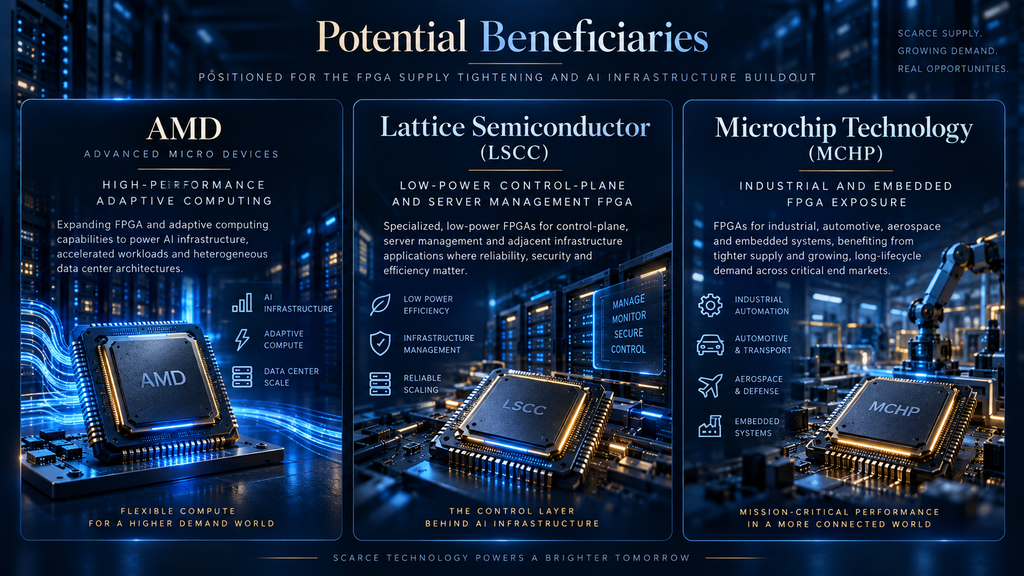
Three publicly listed names stand out.
1. Lattice Semiconductor — LSCC
The cleanest FPGA shortage / AI infrastructure exposure
Among listed companies, Lattice Semiconductor may be the most interesting pure read-through.
Lattice focuses on low-power programmable logic rather than the largest compute FPGAs.
Historically, that might have made the company look less directly exposed to the AI boom.
Today that distinction may be becoming an advantage.
AI servers require an expanding number of control functions outside the primary compute path.
These include:
power sequencing,
system telemetry,
hardware security,
fault recovery,
board coordination,
and platform management.
Lattice calls these devices companion chips.
Its FPGAs can remain operational independently of the main CPU or GPU and perform deterministic hardware-control functions throughout the server lifecycle.
And unlike a speculative future thesis, the AI contribution is already appearing in reported numbers.
Lattice reported record Q2 2026 revenue of $201.1 million, up 62% year over year.
More importantly, revenue from new products grew more than 60%, with the company explicitly saying that growth was led by AI-related server demand.
Management guided Q3 FPGA revenue to grow approximately 65% year over year and highlighted accelerating backlog and record design-win momentum across datacenter and communications customers.
The company has also acquired AMI, a major provider of BIOS, firmware, and infrastructure-management technology, creating a broader hardware-plus-management offering for AI servers and cloud infrastructure.
That makes LSCC particularly interesting.
The thesis is no longer simply:
“AI might eventually need low-power FPGA.”
It is increasingly:
AI server complexity is already translating into FPGA revenue and design wins.
What to watch
The key indicators are continued Compute & Communications growth, AI-server design wins, new-product revenue, backlog, and whether the AMI acquisition increases Lattice content per AI server.
Risk
Lattice has already begun pricing in significant AI growth expectations.
The biggest risk is therefore not necessarily demand collapse, but valuation compression if the current growth rate normalizes faster than expected.
2. AMD — AMD
The highest-quality scaled FPGA exposure
AMD acquired Xilinx in 2022, giving the company one of the world’s leading programmable-computing portfolios.
Its Versal adaptive SoCs address considerably higher-performance applications than much of Lattice’s portfolio.
The architecture combines programmable logic, CPU cores, DSP engines, high-speed transceivers, memory interfaces, and networking capabilities.
AMD positions Versal across cloud, networking, storage, AI inference, communications, and heterogeneous acceleration.
That creates an interesting strategic position.
AMD can participate in AI infrastructure from multiple directions:
GPU compute through Instinct,
server CPUs through EPYC,
and programmable infrastructure through Xilinx/Versal.
As AI systems become increasingly heterogeneous, that combination becomes more valuable.
The trade-off is that FPGA is only one portion of a much larger AMD earnings story.
Therefore:
AMD may have larger absolute FPGA exposure than smaller competitors, but FPGA shortages are less likely to materially move the entire company’s earnings on their own.
This makes AMD less of a pure shortage trade than LSCC.
But it may be the higher-quality way to express the broader thesis that AI architectures are expanding beyond GPU compute into networking and adaptive infrastructure.
What to watch
Watch Versal adoption in networking and AI infrastructure, high-speed Ethernet design wins, Embedded segment momentum, and whether AMD increasingly integrates its FPGA assets with EPYC and Instinct platforms.
Risk
The FPGA thesis is diluted by AMD’s much larger CPU and GPU businesses.
AMD should therefore be bought for the broader AI-compute platform thesis — not solely because FPGA supply is tightening.
3. Microchip Technology — MCHP
The mature-node and embedded optionality
Microchip is a less obvious AI beneficiary.
That may be exactly why it deserves attention.
Its PolarFire FPGA portfolio emphasizes low power, deterministic performance, security, and long product lifecycles.
These characteristics matter in industrial, communications, aerospace, defense, and increasingly edge-AI systems.
Microchip is already positioning PolarFire directly alongside AI platforms.
In August, the company introduced an updated PolarFire FPGA Ethernet Sensor Bridge designed for NVIDIA Holoscan edge-AI systems, providing scalable sensor connectivity while reducing power and integration complexity.
PolarFire is also notable because portions of the platform use 28nm technology — precisely one of the mature nodes where TrendForce says AI-related FPGA wafer consumption is increasing.
This does not automatically make mature-node scarcity positive for Microchip.
Supply shortages can restrict shipments.
But stronger utilization, reduced excess inventory across the broader analog/embedded semiconductor ecosystem, and rising demand for long-lifecycle programmable devices could improve the industry’s pricing environment.
Microchip therefore represents a different version of the FPGA thesis.
LSCC is primarily a data-center control-plane exposure.
AMD is primarily a high-performance adaptive-compute and networking exposure.
Microchip is more of an industrial, embedded, edge-AI, and mature-node exposure.
What to watch
PolarFire bookings, industrial inventory normalization, edge-AI design wins, factory utilization, and any commentary regarding 28nm FPGA lead times or pricing.
Risk
Microchip is diversified across MCUs, analog products, connectivity, and embedded semiconductors.
FPGA is therefore only one part of the earnings story, while mature-node shortages can become a production constraint as easily as a pricing benefit.
One More Name to Watch: Altera
There is one obvious company missing from the public-stock list.
Altera.
The former Intel FPGA business is now independently operated, with Silver Lake owning 51% and Intel retaining 49%.
CEO Raghib Hussain recently said the company had returned to approximately 20% growth as AI and robotics demand strengthened.
The company is targeting applications including connectivity, preprocessing, and sensor fusion around AI systems.
More importantly for investors, Reuters reported on September 10 that Altera is preparing for an IPO that could raise more than $2 billion, potentially as early as 2026.
If Altera becomes publicly listed, it could quickly become one of the cleanest pure-play vehicles for the programmable-computing theme.
For now, it belongs on the watchlist rather than the portfolio list.
What Would Confirm the Thesis?
For me, five developments would make the FPGA shortage substantially more investable.
1. Lead times remain elevated despite supply responses.
A few months of procurement tightness is noise.
Persistent constraints extending into 2027 would imply a genuine cycle.
2. FPGA vendors report pricing improvement.
Volume growth is good.
Volume growth plus pricing power is much better.
3. AI-server design wins continue accelerating.
Lattice’s recent numbers are particularly important here because they directly connect new-product growth with AI-related server demand.
4. Semiconductor-equipment makers repeatedly cite FPGA availability.
This would confirm that the problem is spreading beyond end equipment and into the manufacturing infrastructure itself.
5. Mature-node utilization remains tight.
If 28nm and 40nm utilization remains elevated while AI demand continues growing, the shortage thesis becomes increasingly structural.
What Would Break the Thesis?
The thesis would weaken if FPGA lead times normalize rapidly, distributor inventory rebuilds aggressively, or AI-server growth slows materially.
Another risk would be architectural substitution.
ASICs can replace FPGAs when workloads become sufficiently stable and volumes justify custom silicon.
Therefore, FPGA is not automatically the permanent winner in every AI architecture.
The more precise framework is:
FPGA benefits from complexity, architectural uncertainty, heterogeneous systems, and the need for rapid hardware adaptation.
That makes the technology particularly valuable during the current phase of AI infrastructure development.
But the investment case must eventually be validated through revenue, design wins, backlog, margins, and pricing.
Scarcity alone is not enough.
The Bigger Message
The most important takeaway from the FPGA shortage is not FPGA itself.
It is what the shortage tells us about AI demand.
The original AI investment thesis centered on a relatively narrow group of components.
Today the bottleneck map is expanding.
Compute requires memory.
Memory requires packaging.
Compute and memory require networking.
Networking requires optics.
Servers require power.
Power requires electrical infrastructure.
The system requires cooling.
The boards require controllers.
The chips require testing.
And the test equipment itself requires semiconductors.
This is what happens when a technology cycle evolves into an infrastructure cycle.
Demand begins propagating through the entire physical supply chain.
That is why FPGA deserves attention.
Not because programmable logic will replace the GPU as the center of the AI trade.
But because an FPGA shortage is another piece of evidence that AI infrastructure demand has become broad enough to create scarcity in components most investors were not even watching.
The next AI bottleneck may not be the largest or most expensive component in the rack.
It may simply be the one component the system cannot operate without.
Disclaimer
This article is for informational and educational purposes only and does not constitute investment advice, a recommendation, or an offer to buy or sell any security.
The author may hold positions in securities mentioned in this article and may change those positions without notice.
All information is based on sources believed to be reliable at the time of publication, but its accuracy or completeness is not guaranteed. Forward-looking statements, estimates, industry data, and investment views are subject to change as new information becomes available.
Investing involves risk, including the possible loss of principal. Readers should conduct their own research and make investment decisions based on their own objectives, financial circumstances, and risk tolerance.