The market is pricing the cost of Oracle’s AI buildout. The next question is whether the capacity already being built can earn an adequate return.
Company: Oracle Corporation (NYSE: ORCL)
Author’s View: BUY / High Risk
Investment Horizon: 18–30 months
BCA 12-Month Target: $260
Bull Boundary: $330
Data as of: September 12, 2026
For most of the past year, the Oracle debate has centered on one uncomfortable question:
How much capital will it take to fulfill the company’s enormous AI commitments?
That was the correct question when Oracle’s Remaining Performance Obligations were rising much faster than its live infrastructure.
It may no longer be the most important one.
Oracle’s latest quarter provided the first meaningful evidence that its AI backlog is moving from contracts on paper into operating assets producing real revenue.
OCI infrastructure revenue grew 121% year over year. Oracle delivered approximately 850MW of new capacity, shipped more than 300,000 GPUs, and reported 97.9% GPU utilization.
Meanwhile, GPUs more than four years old continued to renew at approximately 20% higher pricing.
The debate is therefore beginning to shift.
Not from risk to safety.
But from funding risk to return-on-capital verification.
That distinction is the core of my Oracle thesis.
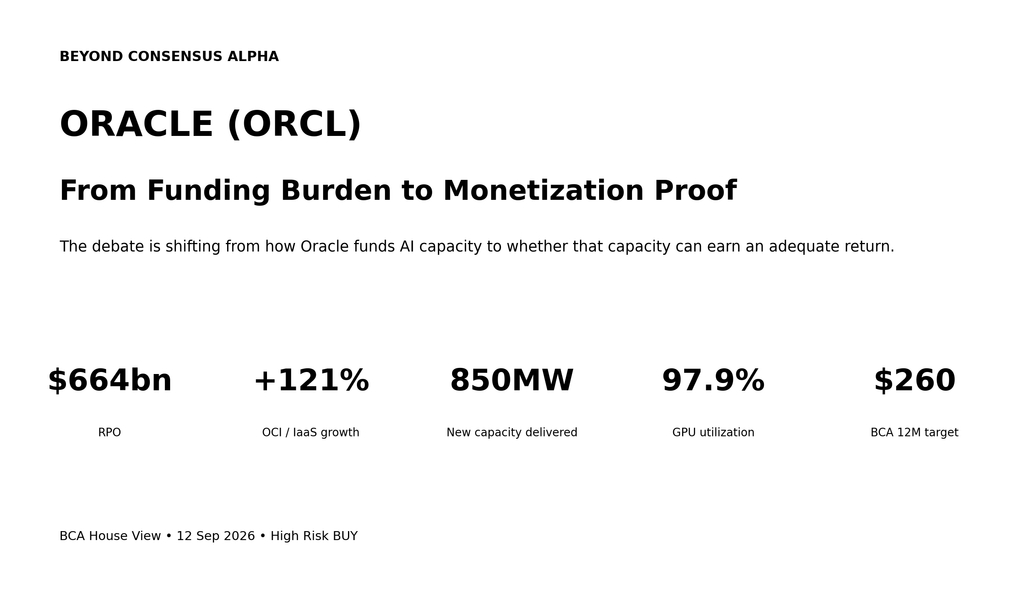
Oracle’s investment debate is shifting from how the AI buildout is financed toward whether deployed capacity can generate adequate returns.
Oracle is becoming a different company
The traditional Oracle was relatively simple to understand.
It owned one of the world’s strongest enterprise database franchises, generated recurring software support revenue and gradually migrated customers toward cloud applications.
The modern Oracle is much more complicated.
The company is now combining that high-margin software franchise with an increasingly capital-intensive AI infrastructure business.
In Q1 FY27, Oracle generated approximately $19.3 billion of revenue.
OCI/IaaS accounted for roughly $7.4 billion, or 38% of total revenue. Cloud applications contributed approximately $4.2 billion, while traditional software generated another $5.55 billion.
This matters because Oracle is not simply a GPU rental company.
Its AI infrastructure business sits on top of an installed base of databases, enterprise software, SaaS, security, storage and networking products.
That makes the economics structurally different from a pure NeoCloud.
The downside is obvious.
As lower-gross-margin AI infrastructure becomes a larger percentage of revenue, Oracle’s consolidated gross margin should fall.
But Oracle also has something most infrastructure startups do not:
a mature software cash engine capable of absorbing part of the capital burden.
The investment question is therefore not whether AI infrastructure will dilute gross margins.
It almost certainly will.
The question is whether revenue growth, utilization and operating leverage can overwhelm that dilution.
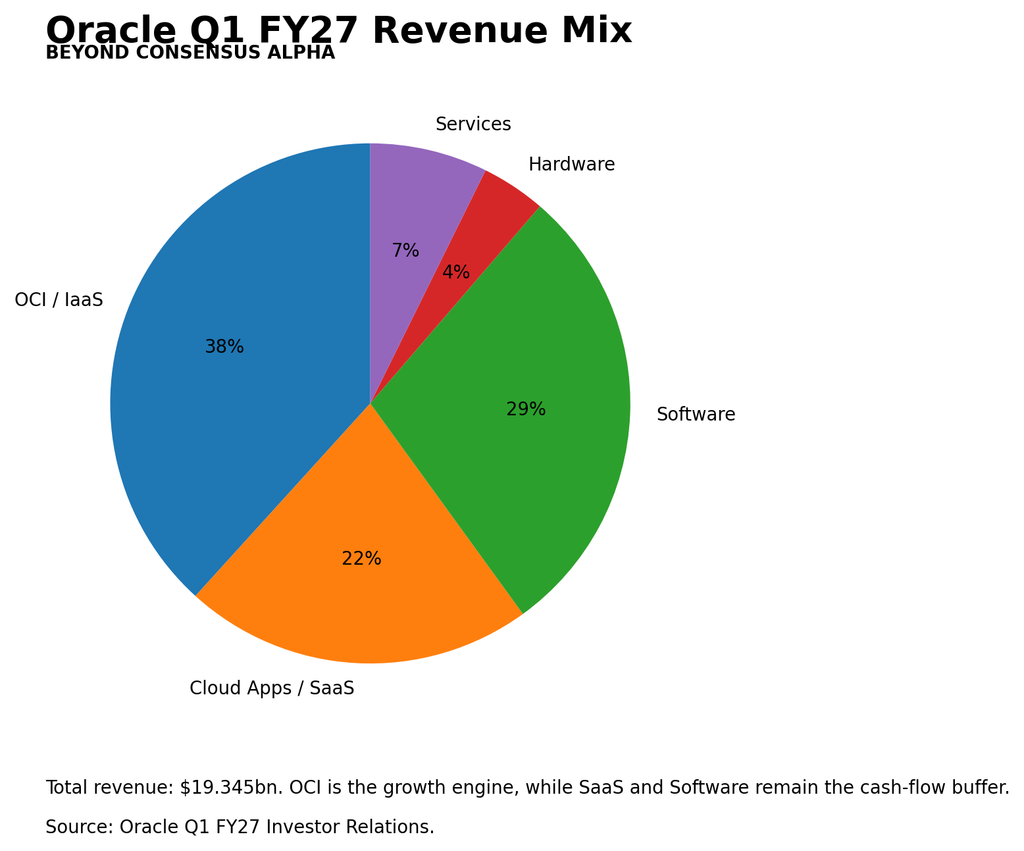
OCI has become Oracle’s largest growth engine, while software and SaaS remain an important recurring cash-flow buffer.
The backlog is no longer just getting larger
Oracle’s Remaining Performance Obligations reached approximately $664 billion in Q1 FY27, up from $638 billion the prior quarter and $553 billion two quarters earlier.
That number is extraordinary.
But the size of the backlog is no longer the most interesting part of the story.
The more important question is:
How much of it can actually become revenue?
Oracle now expects approximately half of the current RPO to convert into revenue over the next 36 months.
The latest quarter also added more than $30 billion of new AI contracts even after the company had already signed several extraordinary multi-year agreements.
That suggests booking momentum did not end with one mega-deal.
There is, however, an important concentration risk.
Oracle does not disclose customer-level RPO.
Public reporting suggests the OpenAI–Oracle arrangement may represent roughly $300 billion over five years, while J.P. Morgan has estimated that OpenAI and Stargate represented more than half of Oracle’s previous $638 billion RPO balance.
I therefore do not treat “50% of Oracle RPO is OpenAI” as a reported fact.
My working analytical range is approximately 45–55%.
That makes OpenAI both Oracle’s largest risk and potentially its largest source of upside.
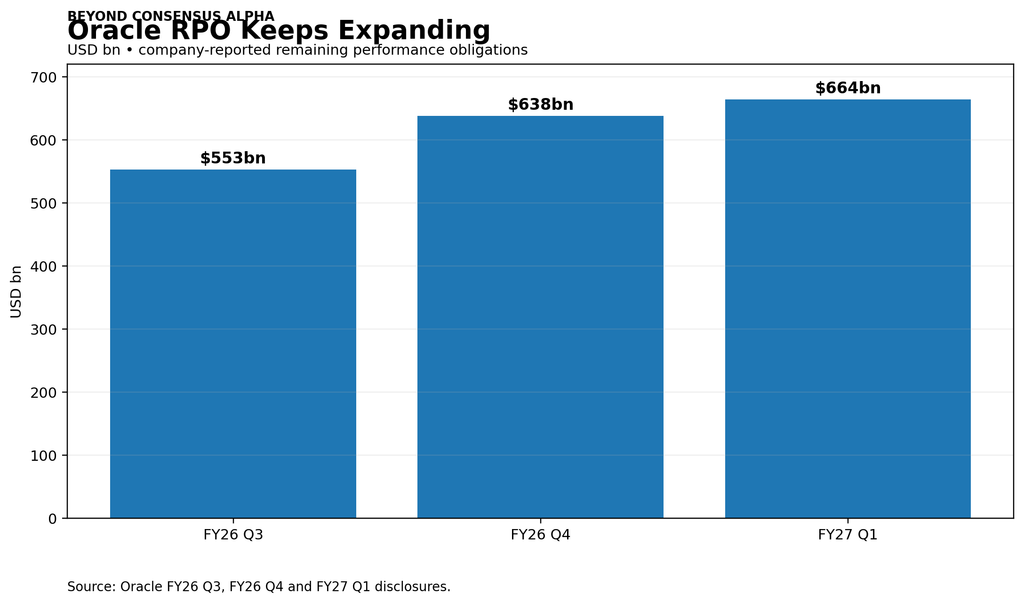
Oracle’s RPO continues to rise even after its largest AI contracts, but the quality and conversion of that backlog matter more than the headline number alone.
Astra changes the demand-side equation
Before Astra, one of the strongest arguments against Oracle was straightforward.
Perhaps OpenAI had contracted for more compute than it could economically monetize.
In that world, Oracle could build massive amounts of expensive capacity only to discover that utilization, pricing or counterparty economics were weaker than expected.
Astra makes that bear case more complicated.
The reason is not simply that the model is better.
It is that better models can expand the number of economically useful tasks AI can perform.
A simple framework is:
Total compute demand = users × sessions per user × tasks per session × compute per task
Model efficiency can reduce the final variable.
But an agentic model can increase the first three simultaneously.
If AI becomes capable of navigating software, conducting research, operating computers, creating documents, analyzing enterprise data and completing multi-step workflows, the number of tasks people are willing to delegate can expand dramatically.
And unlike a simple chatbot response, an agent can remain active for minutes or hours.
It can browse.
Call tools.
Check intermediate results.
Retry failed actions.
Process large files.
Maintain context.
And repeatedly invoke inference.
That creates a fundamentally different demand profile.
OpenAI described Astra demand as unprecedented and temporarily restricted new Pro subscriptions due to infrastructure constraints.
The company also accelerated releases across images, enterprise workflows, voice, agents, data analysis and financial services within days of the model’s launch.
I would not call this autonomous recursive self-improvement.
A more defensible description is an AI-assisted recursive product-development flywheel:
Better models improve development productivity.
Higher productivity accelerates product releases.
More products create more usage.
More usage creates more demand for compute.
And more compute supports the next generation of products and models.
This matters directly to Oracle.
Oracle disclosed that Astra was trained at the Abilene site, where approximately 131,000 GPUs and 618MW had already been delivered to the customer.
The demand story and the physical infrastructure are therefore unusually closely linked.
The most important number in the quarter may be 97.9%
RPO can be delayed.
Contracts can be renegotiated.
Forecasts can be wrong.
A powered GPU that is actually being used is much harder to dismiss.
That is why I view Oracle’s reported 97.9% GPU utilization as one of the strongest data points in the entire quarter.
It suggests that the primary problem today is not excess AI capacity.
The capacity that Oracle manages to bring online is being absorbed almost immediately.
There was a second important observation.
Oracle reported that GPUs more than four years old were still being renewed at approximately 20% higher pricing.
That matters because one of the central bear arguments against GPU infrastructure is technological obsolescence.
If every new accelerator generation immediately destroys the economics of older hardware, the useful economic life of these assets becomes much shorter than traditional depreciation schedules imply.
Oracle’s data does not eliminate that risk.
But it pushes against the idea that older GPUs automatically become stranded assets.
The current evidence instead suggests that compute scarcity and growing inference demand may allow multiple GPU generations to coexist economically.
That could materially improve lifetime returns on Oracle’s infrastructure.
Capacity execution is beginning to catch up with demand
Oracle delivered roughly 850MW of new capacity in the quarter.
That is important for another reason.
Investors had become increasingly concerned that delays at a few flagship projects could bottleneck the company’s entire AI revenue ramp.
Yet Oracle was able to deliver record capacity while some of those sites remained incomplete.
At Abilene, customer acceptance reportedly fell to around 24 hours.
That means the final step between construction, power availability, GPU installation, customer acceptance and revenue recognition is becoming faster.
This does not eliminate power or permitting constraints.
Those remain some of the biggest risks in the thesis.
But the latest quarter suggests Oracle’s capacity ramp may be more geographically distributed—and therefore less dependent on a handful of mega-sites—than investors previously feared.
The funding structure matters as much as the revenue
The most legitimate Oracle bear case remains capital intensity.
Oracle is spending at a scale that would have looked extraordinary even for a hyperscaler only a few years ago.
FY27 gross capex guidance remains approximately $90–95 billion.
Oracle has also been downgraded to BBB- by S&P.
This is not a balance sheet investors can ignore.
But the marginal funding structure appears to be improving.
A meaningful portion of recent AI contracts uses combinations of:
customer prepayments, Bring Your Own Hardware structures and supplier financing.
The distinction is important.
Prepayments should not simply be treated as free operating cash flow.
Economically, they are closer to financing.
That is why my valuation model removes customer prepayments when calculating economic FCFF.
But BYOH genuinely changes capital intensity because the customer rather than Oracle finances some of the hardware.
The significance is therefore not:
“Oracle has become self-funding.”
It has not.
The significance is:
“Every new dollar of AI contract value may no longer require an equivalent increase in Oracle-funded capital.”
That is a much more defensible—and much more important—claim.
OpenAI concentration creates both downside and upside torque
Oracle is one of the most unusual public-market expressions of the current AI financing cycle.
It is not a single point of failure for artificial intelligence.
OpenAI can access capacity from Microsoft, AWS, Google and NeoCloud providers.
But Oracle is one of the largest physical and financial nodes supporting OpenAI and Stargate’s infrastructure expansion.
That creates a highly asymmetric equity profile.
If OpenAI monetization disappoints, Oracle can be hit through several channels at once:
RPO collectability weakens.
Capacity utilization falls.
Pricing softens.
Credit spreads widen.
And high fixed costs remain.
But the mechanism also operates in reverse.
If Astra and subsequent products materially increase compute consumption, Oracle benefits from the combination of:
a large backlog,
already contracted customers,
physical capacity coming online,
high fixed-cost operating leverage,
and financial leverage.
In other words, Oracle is not the safest AI equity.
It may be one of the highest-torque large-cap proxies for AI monetization.
That is exactly why I classify it as High Risk BUY rather than a traditional quality compounder.
The cash-flow inflection matters more than near-term reported FCF
Oracle’s current free cash flow looks uncomfortable because the company is in the middle of its peak infrastructure build.
That alone does not tell us whether the investment is attractive.
The relevant question is what happens after the peak.
In my conservative economic FCFF framework, Oracle remains deeply negative through FY28, approaches breakeven in FY29 and becomes materially positive from FY30.
The House Case is more constructive.
It assumes Astra strengthens demand, live capacity converts faster, utilization remains high and BYOH reduces Oracle-funded capital intensity.
Under that path, economic FCFF improves from approximately -$51 billion in FY27 to +$13 billion in FY29, +$54 billion in FY30 and +$82 billion in FY31.
The most important difference from the conservative case is not an absurd revenue forecast.
The bigger difference is capital efficiency.
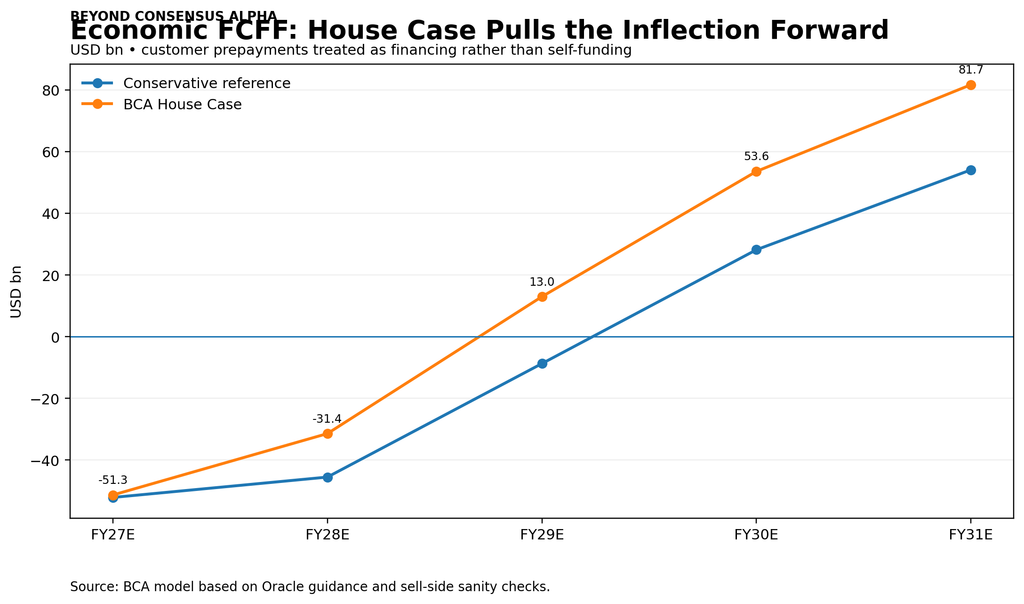
The House Case does not depend primarily on higher revenue. Faster capacity commercialization and lower Oracle-funded capital intensity pull the economic FCFF inflection forward by roughly one year.
Valuation: this is an operating re-rating call, not just a rate-cut trade
Oracle closed near $150 when this report was written.
My conservative Spot-WACC reference is approximately $142 per share.
That tells us something important.
At today’s discount rate, a conservative operating case does not produce much upside.
But applying the House Case operating assumptions while keeping the current approximately 10.9% WACC increases estimated value to around $217.
That is the key point.
The thesis does not require Treasury yields to collapse.
The valuation rises because the earnings and FCFF path changes.
If continued execution reduces Oracle’s company-specific risk premium and WACC normalizes toward approximately 10%, the same House operating path produces a DCF value near $258, which I round to a $260 12-month target.
The Bull boundary is approximately $330.
That scenario requires stronger OCI conversion, sustained margins and faster normalization of capital intensity.
It is not my base case.
But it becomes increasingly plausible if the next several quarters repeat the operational evidence we saw in Q1.
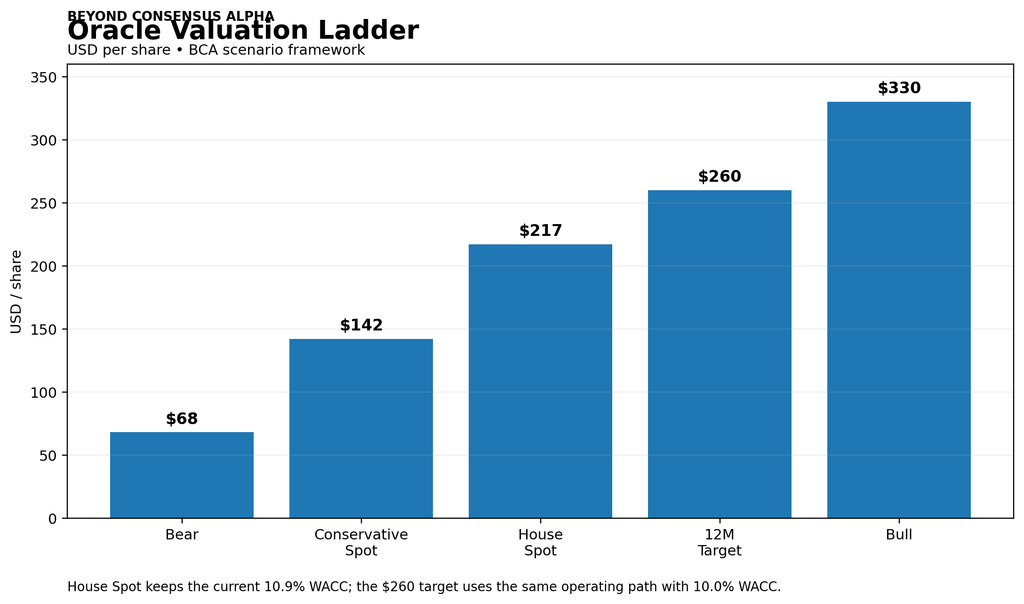
The valuation gap is driven by operating assumptions as much as discount-rate normalization. The House Case is worth roughly $217 even at the current Spot-WACC.
The Ellison overhang disappeared before it even began
There is also an important technical update that should be separated from the fundamental thesis.
Oracle said Larry Ellison has cancelled the Rule 10b5-1 trading plan he adopted on June 22, which would have allowed him to sell up to 50 million Oracle shares through October 24.
More importantly, no shares were sold under the plan, and Oracle said Ellison currently has no other plans to sell Oracle stock.
At roughly $150 per share, the cancelled plan had represented as much as $7.5 billion of potential secondary supply.
That potential overhang is now gone.
This does not change my intrinsic-value assumptions because Ellison’s planned sales were never part of Oracle’s operating economics. The sales would also have been secondary transactions rather than new equity issuance, so they would not have diluted EPS or raised cash for Oracle.
However, the cancellation improves the near-term technical setup.
The market no longer has to absorb the possibility of up to 50 million shares of founder supply just as Oracle is trying to re-rate on stronger OCI growth, faster RPO conversion and improving capital efficiency.
Oracle did not provide an official reason for the cancellation. The Financial Times separately reported, citing a person close to Ellison, that he believes Oracle shares are undervalued. I treat that as reported context rather than an official explanation from Oracle.
My interpretation is therefore simple:
The fundamental thesis is unchanged, but one meaningful technical rerating risk has been removed.
What could make this thesis wrong
There are several ways this investment can fail.
The most important is OpenAI concentration. If OpenAI cannot monetize its compute commitments—or attempts to renegotiate them—the quality of Oracle’s enormous RPO could deteriorate quickly.
Second is capital intensity. Oracle still needs extraordinary amounts of capital. If capex fails to normalize after FY28 or the company returns to aggressive equity and debt issuance, the economic FCFF thesis weakens.
Third is AI infrastructure margin. Oracle has framed normalized AI infrastructure gross margins around 30–40%. If mature capacity remains structurally below roughly 25%, the return on invested capital may not justify the balance-sheet risk.
Fourth is utilization. A sustained decline from the current 97.9% level toward the mid-80s would materially change the thesis.
Fifth is power and execution. Site delays, grid constraints, permitting problems and hardware availability can still slow the conversion of backlog into revenue.
And finally, there is the broader AI demand question.
Astra demand is currently exceptionally strong.
That does not guarantee demand remains supply-constrained forever.
The thesis requires real usage to continue growing rapidly enough to fill Oracle’s capacity.
What I am watching next
The next phase of the thesis is unusually measurable.
Oracle’s Q2 FY27 guidance implies continued strong revenue and cloud growth.
Vera Rubin system deliveries should begin providing evidence on the next hardware cycle.
Oracle AI World from October 25–28 could provide longer-term capacity, margin and RPO targets.
Beyond events, I am watching four operating variables more closely than the share price:
GPU utilization.
Renewal pricing on older GPUs.
AI infrastructure margins.
And the pace at which gross capex converts into economic FCFF.
If utilization remains above 90%, older GPU pricing stays resilient and AI infrastructure margin approaches the company’s long-term range, the return-on-capital debate will continue moving in Oracle’s favor.
If those metrics deteriorate, the high leverage that creates the upside will work just as quickly in reverse.
The investment case in one sentence
The market has already spent the past year asking whether Oracle can finance one of the largest infrastructure expansions in technology history.
The next question is different:
Can Oracle turn that infrastructure into a sufficiently profitable operating asset?
Q1 FY27 was the first quarter where the answer began to look meaningfully more positive.
RPO continued growing.
Capacity came online.
OCI accelerated to triple-digit growth.
GPU utilization reached 97.9%.
Older assets retained pricing power.
And the funding structure became less dependent on Oracle supplying every incremental dollar of hardware capital.
Astra adds another layer.
If AI capability is expanding the number and duration of economically useful workloads, Oracle’s greatest concentration risk—OpenAI—also becomes the source of its greatest operating leverage.
That is why I do not view Oracle as a conservative AI investment.
It is a leveraged monetization proxy.
And at roughly $150, I believe the market is still pricing more of the financing risk than the potential earnings torque.
BCA View: BUY / High Risk
12-Month Target: $260
Bull Boundary: $330
Selected Sources
Oracle Investor Relations — Q1 FY27 earnings release and earnings-call materials.
Oracle Investor Relations — FY26 Q3 and Q4 earnings releases and FY27 financing framework.
Oracle FY27 Q1 Form 10-Q.
Oracle Financial Analyst Meeting 2025 — OCI and AI Infrastructure economics.
OpenAI — GPT-6 Astra announcement and September 2026 product releases.
J.P. Morgan — Oracle Q1 FY27 review, September 11, 2026.
Citi Research — Oracle Q1 FY27 review, September 11, 2026.
UBS Global Research — Oracle Q1 FY27 review, September 10, 2026.
Goldman Sachs — TOO CAUTIOUS, September 10, 2026.
Mizuho Securities — Oracle Q1 FY27 review.
S&P Global Ratings — Oracle credit-rating update, July 2026.
Financial Times — Larry Ellison share-sale-plan reporting, September 12, 2026.
Disclaimer
This article is provided for informational and educational purposes only and reflects the author’s personal views as of the date of publication. It does not constitute investment advice, investment research, a solicitation, or a recommendation to buy or sell any security or financial instrument.
The information contained herein has been obtained from sources believed to be reliable, including company disclosures, corporate materials, industry research and publicly available information, but its accuracy or completeness is not guaranteed. Certain statements in this article—including estimates regarding Oracle’s future cloud revenue, RPO conversion, OpenAI-related exposure, AI infrastructure demand, GPU utilization, margins, capital expenditure, free cash flow and potential valuation outcomes—are estimates, interpretations or forward-looking scenarios rather than confirmed future results.
Investments in individual equities involve substantial risk, including the possible loss of principal. Oracle and other AI infrastructure companies may be exposed to customer concentration, technology obsolescence, capital intensity, financing risk, credit risk, power constraints, construction and execution risk, regulatory changes and significant share-price volatility.
The author may hold, initiate, increase, reduce or exit positions in securities discussed in this article without notice. Readers should conduct their own research and consult an appropriately licensed financial professional before making investment decisions. Past performance is not indicative of future results.